Bergenfield County Hospital
The Dark HalfBergenfield County Hospital is the setting of Thad Beaumont’s 1960 brain operation and the site of a mass sparrow collision whose timing binds his medical history to the birds that recur throughout his life. The hospital’s west wing, its glass facade, and the minutes surrounding Thad’s awakening turn a clinical episode into an unresolved point of contact between neurological explanation and supernatural possibility.
The hospital and Thad’s operation
In 1960, Thad began suffering increasingly severe headaches. Their onset was marked by an auditory precursor: he heard what seemed to be the distant cheeping of a thousand small birds, which he identified as sparrows. As the pain worsened, his mother took him for medical care. A seizure eventually led doctors to operate on a mass in his prefrontal lobe, initially assumed to be a tumor.
The operation disclosed an unusual condition. The mass was tissue from Thad’s twin, which had not been fully absorbed before birth and had lodged in his brain. The tissue had been inert, but something had restarted its growth; the resulting intracranial pressure accounted for the headaches and seizure. The diagnosis gave the hospital episode a concrete medical cause, while the rarity and strange location of the tissue left the case memorable to the doctors involved.
The sparrow collision
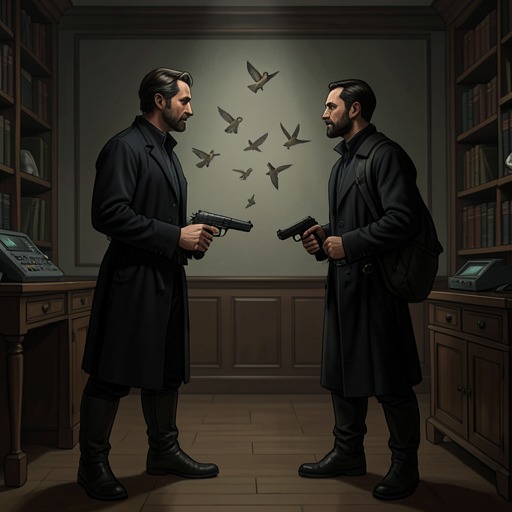
Shortly after the operation, an enormous flock of sparrows flew into the hospital’s west side. The collision occurred at just past two in the afternoon on October 28, 1960. The west side then housed the Intensive Care Unit, where Thad had been taken after surgery. Windows shattered, and maintenance workers cleared away more than three hundred dead birds.
A local ornithologist offered a physical explanation: the west side was largely glass, and reflected sunlight might have drawn the birds toward it. He also proposed that flocking birds respond collectively, so that the behavior of one could draw the rest into the same collision. The explanation made the incident intelligible as a mass-flight accident, but did not erase its uncanny proximity to Thad’s own bird-associated symptoms.
Timing, memory, and unresolved meaning
Thad woke at approximately 2:10, only minutes after the flock struck the building at about 2:05. A nurse believed the sound of breaking glass may have awakened him. When questioned the following day, Thad remembered both hearing and seeing sparrows: in his account, they were everywhere across the houses, lawns, and streets of Ridgeway, the Bergenfield neighborhood where he lived. The birds outside his postoperative vision and the flock at the hospital thus occupy the same narrow interval, though the record does not establish whether the collision caused his awakening or whether his perception extended beyond it.
Years later, Dr. Pritchard recounted the episode to Alan Pangborn. He had checked that Thad’s vital signs were stable and left to play golf before the collision, so his account depended on the hospital reports and the contemporary newspaper coverage rather than personal observation of the event. He had compared the reported collision time with Thad’s chart and remained struck by the coincidence, especially because Thad’s auditory precursor was not birds in general but specifically sparrows. Thad, when discussing his old symptoms, likewise distinguished the bird sound from other possible sensory precursors: his had been auditory, and the birds were sparrows.
Narrative significance
The hospital’s importance lies in the way it holds two explanations together without conclusively reconciling them. The operation identifies a physical source for Thad’s childhood headaches and seizure, while the sensory precursor supplies a neurological framework for the bird sounds. Yet the hospital’s real sparrow collision, timed almost exactly to his awakening and remembered bird vision, makes the clinical history feel less closed than the diagnosis suggests. Pritchard’s recollection turns the incident into evidence Alan must weigh, not proof that resolves the larger mystery.
That pattern grows beyond the hospital. In later episodes, sparrows gather in silence in overwhelming numbers, appear to select where they will go, and become agents in the final return of George Stark to the dead. At Gold’s Junkyard and Auto Supply, a carpet of birds appears without Thad hearing them arrive; on the road, a sparrow peers into his car as he realizes that reaching the house will mean driving over the flock. At the end, the birds come to escort Stark back to the land of the dead. Against those later scenes, the hospital incident reads as an early, ambiguous recurrence: a documented flock behaving in a way that admits ordinary explanation, yet appearing at the exact threshold between Thad’s operation and awakening.