Berol Black Beauty pencil
The Dark HalfThe Berol Black Beauty pencil is more than a writing tool in Thaddeus “Thad” Beaumont’s story: it is the most tangible link between the novelist and George Stark, the supposedly fictional alter ego who acquires a separate, dangerous existence. Stark’s preferred instrument, it appears in Thad’s unexplained writing, helps Stark reach toward him, and is finally chosen by Thad as part of a plan to face him. Its ordinary material form gives the conflict over authorship and control a recurring object to hold onto—and a means through which the boundary between the two men grows difficult to maintain.
Stark’s instrument and Thad’s evidence
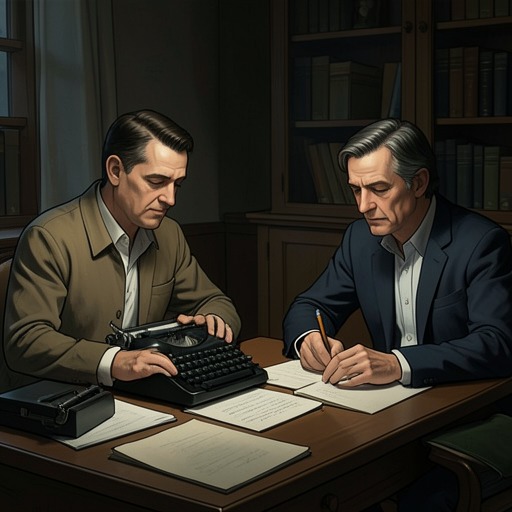
A wide-mouthed mason jar beside Thad’s old Remington 32 typewriter holds a dozen or so Berol Black Beauty pencils. Thad takes one out and gnaws it lightly, a habitual gesture suggested by the other pencils’ chewed ends. Asked whether he murdered Stark, he denies it and says Stark died of natural causes; the pencil remains in his hand and then returns to the jar. The scene ties an ordinary habit to a question that is anything but ordinary: what it means for a writer to be responsible for a character who has crossed into life.
The pencil’s association with Stark reaches back to 1975, when Thad first began writing under the name George Stark. Thad says he rolled paper into his typewriter, then rolled it back out: although he typed his books, Stark apparently would not use a typewriter. Instead, Thad found an old notebook in a desk drawer and began writing in it with the pencils from the jar. He recalls starting and then discovering that it was midnight and Liz was asking whether he was coming to bed. The change of instrument marks a change in the writing itself: the work associated with Stark begins by departing from Thad’s usual practice.
The night’s output makes that departure concrete. Thad says he had written sixteen pages without a single scratch-out and had sharpened three-quarters of a new pencil into shavings. He does not normally write with pencils; his hand tires, and he needs a typewriter. Stark’s hand, by contrast, does not tire in the same way. The physical contrast between the two methods gives the pencils a double significance: they are a practical means of writing, but also a sign that the work has taken on a momentum and bodily rhythm unlike Thad’s own.
Automatic writing and the return of the pencil
Years later, in 1988, Thad finds large capital letters slashed across a neatly typed manuscript: “THE SPARROWS ARE FLYING AGAIN.” He has no memory of switching from his Scripto pen to a Berol Black Beauty. He has stopped using the pencils, considers them relics of a dark age, and puts the one he used back in the jar before stowing the jar in a drawer. His hand is unsteady. The pencil’s reappearance is therefore not a deliberate return to Stark’s method; it is evidence that the old connection has surfaced without Thad’s conscious choice.
When Thad sees the writing, he fears that the brain tumor he had as a child may have returned. He does not tell Liz what has happened. Then the doorbell rings, and Liz calls out that he is back. For an instant Thad believes she means Stark: the phrase, the unexplained pencil writing, and the warning about the sparrows converge into the certainty that Stark has returned despite having been publicly buried and, in Thad’s view, never having existed as a real person in the first place. The Berol pencil thus stands at a threshold between a medical fear and a supernatural one, carrying the trace of an act Thad cannot remember performing.
A token of contact and a threat
The pencil is useful to Stark as well as to Thad. When Stark finds it difficult to reach Thad through their mental connection, he handles a Berol Black Beauty he bought in Houston Street stationer’s; doing so helps him make contact. The object’s force is not confined to the words it can write. Its feel and presence act as a material prompt for the connection between the two men, turning a familiar writing implement into a kind of tactile link.
During Stark’s attack on the Beaumont home, Liz sees him holding a pencil and gently tapping its eraser against the telephone table. She recognizes it as a Berol Black Beauty and initially thinks it may be one of Thad’s. She corrects herself: Thad sometimes bought them, but they had never truly belonged to him; they belonged to Stark. Stark has used the pencil to write two messages on the back of a faculty directory, including “GUESS WHERE I CALLED FROM, THAD?” and “TELL ANYBODY AND THEY DIE.” The pencil is now part of an explicit threat, connecting Stark’s established writing instrument to the danger facing Liz and the twins.
That moment sharpens the pencil’s ambiguity. Thad’s possessions and habits appear to offer a route back to Stark, but Liz’s recognition distinguishes ownership from mere purchase: the pencils are Stark’s in a deeper, more unsettling sense. What had seemed like a tool Thad could store away has become an object Stark can handle, write with, and use to control the scene. Its recurrence makes the author’s attempt to put his alter ego aside look less like a clean separation than a contested claim over shared materials and methods.
Thad’s countermeasure and the final escort
As Thad prepares to go to Castle Rock, he decides he needs pencils Stark has never touched, whether Stark existed as part of Thad or as a separate being. At a stationer’s on Court Street, he buys a box of Berol Black Beauties and sharpens six of them. He arranges them in his breast pocket, their points protruding in a row like small missiles. Unlike the pencils in the jar, these are selected precisely because Stark has not handled them. Thad treats their untouched condition as a possible advantage in a confrontation whose rules remain uncertain.
Thad knows the plan could put Liz and the children in danger. He also recognizes that Stark may notice the pencils, and that his broader intentions must remain hidden. The new pencils are not simply a return to Stark’s writing practice: Thad is trying to distinguish his own materials from Stark’s and turn that difference to his advantage. The strategy exposes how little the object’s meaning can be fixed. The pencil that once marked Stark’s control of the writing becomes, in Thad’s hands, a prepared instrument for resisting him.
At the confrontation’s culmination, Thad is writing when he understands that the psychopomps have come to escort Stark back to the land of the dead. He drops the pencil and retreats toward his children as the sparrows gather on Stark and strike at him. The object is not itself the force that carries Stark away, but its fall marks the end of Thad’s immediate participation in the writing and his movement back toward his family. Across the novel, the Berol Black Beauty passes from the first emergence of Stark’s writing, through involuntary messages and threats, to Thad’s attempted countermeasure; at the end, the pencil is released while the sparrows complete the separation that the writing alone could not secure.