Bird-call whistle
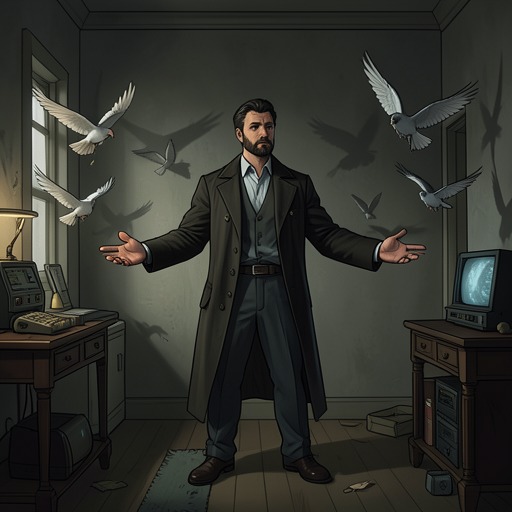
The Dark HalfThe Bird-call whistle is a short, hollow piece of peeled wood with a notch cut into one end. Rawlie DeLesseps gives it to Thad Beaumont after discussing the folklore of sparrows as guides for souls, at the very moment Thad is trying to understand the birds’ presence and what it portends. Thad recognizes what the object is before Rawlie names it, takes it with an unsteady hand, and says it might come in handy. Yet the later encounter with the flock turns on Thad’s voice, not on any demonstrated use of the whistle: it serves as a physical token of a possible way to summon the birds, while the story leaves the actual source and limits of his influence unsettlingly beyond the object.
Form and Gift
Rawlie finds the whistle while searching through the pockets of the old checked sport coat he wears in winter and summer. The object is modest and handmade in appearance: tubular, hollow, roughly as long as Thad’s forefinger, and cut with a notch at one end. Its age is visible, but the text does not identify who made it or describe any prior use. Rawlie offers it conditionally, telling Thad to take it if he thinks it can be useful.
Thad’s response gives the exchange a significance beyond an ordinary gift. He already knows what Rawlie is holding before asking, and feels another piece of an “unthinkable thing” he is building slide into place. He thanks Rawlie and puts the whistle in his breast pocket, his hand not quite steady. The gesture makes the object part of his preparations, but not a confirmed instrument of control: neither man demonstrates how it sounds, and the later scenes do not show Thad blowing it.
Folklore and the Sparrows
The gift follows a conversation in Rawlie’s office about sparrows and other birds as psychopomps—conductors between the land of the living and the land of the dead. Rawlie’s account distinguishes them from loons and whippoorwills, which folklore associates with approaching death and the guidance of newly dead souls. According to the source he consults, gatherings of sparrows are more ominous: they are said to be outriders of the deceased, guiding lost souls back into the living world. Rawlie calls them harbingers of the living dead.
Thad has already asked whether Rawlie still teaches his Folk Myth seminar and described a story idea that remains in the exploratory stage. Later, Rawlie says he had detained Thad because he may have found what Thad was looking for about the sparrows. He retrieves Barringer’s Folklore of America and presents the psychopomp explanation. The whistle arrives within this chain of inquiry: it is a concrete object passed from the folklore expert to the writer just as cultural explanation begins to meet events that are no longer merely material for a story.
A Call Without the Whistle
At Gold’s Junkyard and Auto Supply, Thad and Rawlie discover that sparrows have silently carpeted the wrecked vehicles stacked across the back acreage. The flock is immense, yet it has made no sound as it arrived. Rawlie claps his hands, but the birds do not move; they appear to have no interest in him and to be looking only at Thad. Thad then tells them to find George Stark and fly. The birds rise in a dark mass and head west.
This sequence gives the whistle its central dramatic tension. Rawlie has offered a bird-call as something Thad might use, and Thad carries it in his pocket, but the flock answers a spoken direction without any stated sound from the instrument. The contrast does not prove that the whistle is useless; the narrative simply does not show it being used. Instead, Thad’s direct address establishes that the birds’ response cannot be reduced to the ordinary operation of a tool. The whistle stands beside a new, difficult question: whether Thad can call or direct the sparrows, and what that power means.
Object and Limit of Control
The sparrows’ later appearances reinforce the gap between a small human object and the scale of the force surrounding it. At the Williamses’ driveway, one bird lands on Alan Pangborn’s shoulder, hops onto his hand when he brushes at it, and then returns to the driveway. The flock remains watchful rather than behaving like birds summoned for a simple, predictable task. Thad, driving toward the house, finds the road itself covered by sparrows and understands that reaching his destination will require driving over them. A bird peers at him from the hood of his VW with what he senses as dispassionate curiosity.
At the climax, the birds’ role becomes explicit: the psychopomps have come to escort George Stark back to the land of the dead. They gather on Stark and strike at him in increasing numbers as he struggles against them. The ending makes the whistle’s limits legible without resolving its mechanics. It is a possible aid Thad accepts, but it neither accounts for the flock’s overwhelming presence nor contains the birds’ agency. Their appearance, movement, and final action belong to a force that no small instrument can adequately explain or command.