Castle County
The Dark HalfCastle County is the Maine jurisdiction at the center of the investigation into Homer Gamache’s murder. It is both a working police district, with local officers and a medical examiner, and a place whose ordinary routines are repeatedly unsettled by violent and increasingly inexplicable events. Under Sheriff Alan Pangborn, the county becomes the ground on which physical evidence, competing explanations, and supernatural possibility collide.
Jurisdiction and Setting
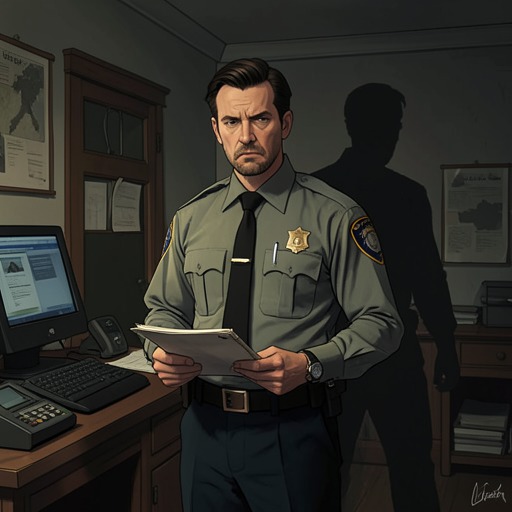
Alan Pangborn had been sheriff for nearly eight years by the time Homer Gamache’s body was found. He nevertheless thought of himself as the county’s “new Sheriff,” a self-description he expected to keep using so long as he remained in office. Before coming to Castle Rock, he had overseen highway enforcement in a small-to-medium-sized city in upstate New York, not far from Syracuse. The change of jurisdiction places an experienced lawman in a town whose history he did not witness firsthand and whose latest crisis makes him wish, briefly, that he were back in his former post.
Castle County’s law-enforcement structure appears through the practical details of the case. Officer Norris Ridgewick returns from his cruiser while police-band radios carry calls through the late-spring air; Pangborn asks whether Ray Van Allen, the county medical examiner and coroner, is coming. The investigation therefore begins as coordinated local police work, involving patrol officers, forensic examination, and communication with agencies beyond the county. When Pangborn later identifies himself by telephone, he gives both his office and jurisdiction: sheriff of Castle County, Maine.
A Place with a Recent History of Violence
The county’s present danger is set against Castle Rock’s record of bad luck. In the preceding eight or ten years, the town had experienced several events severe enough to make national news. George Bannerman, affectionately known as Big George, was sheriff during those earlier crises. He survived a series of rapestrangulations committed by one of his own officers, but two years later a rabid dog killed him on Town Road #3. Pangborn did not have to handle Gamache’s case with Bannerman: Bannerman was dead, and his successor inherited a town where extraordinary violence had already become part of the local past.
Gamache’s murder makes that history feel less like a completed sequence than a pattern that may recur. Pangborn sees Gamache’s battered body in a ditch beside Route 35 and thinks that the town’s bad luck may not have died with Bannerman. The thought is immediately challenged by his own inward correction: Castle Rock has been a good place for his wife, Annie, and their sons, and a good place for him. The contrast keeps the setting from becoming simply cursed. It is a home and community worth protecting, even as its history gives the new crime an ominous context.
The Murder Investigation and Its Evidence
The county case against Thaddeus “Thad” Beaumont initially appears to have a direct forensic basis. Pangborn tells the Beaumonts that Gamache was probably killed between one and three in the morning on June 1, after an eyewitness account was considered alongside the medical examiner’s post-mortem. Gamache had been killed with his own prosthetic arm. His truck was later found in a Connecticut rest-stop parking lot near the New York border, broadening the investigation beyond Castle County.
The truck carried a confusing abundance of fingerprints. Most belonged to Gamache, but several belonged to the perpetrator; some were exceptionally clear. One had been preserved in gum that the suspect had removed from his mouth and pressed onto the dashboard, while the clearest was on the rearview mirror, rolled in blood rather than ink. When the prints were entered into a graphics computer by the relevant records and identification personnel, Thad Beaumont’s service record returned. That match gives the local investigation a powerful reason to scrutinize Thad, but it does not by itself settle how his prints came to be on the truck.
Thad challenges the inference by pointing out that he was at a party and by describing the elaborate twin-based scenario he imagines the police might have constructed to place him in Castle Rock and elsewhere. His account is deliberately absurd, and the response from Liz Beaumont is startled laughter; Pangborn, however, is struck by Thad’s apparent sincerity. The exchange separates the question of whether Thad is lying from the harder question of what the physical evidence means.
Thad then presses the technical weakness in treating the prints as self-explanatory. He asks whether a certain number of comparison points must be present before a fingerprint can be admitted as evidence. Pangborn answers that in Maine six perfect comparisons are required. Thad notes that prints are often incomplete or smudged, a distinction that matters because the prints on Gamache’s truck are unusually good. The inquiry thus turns on both the apparent strength of the match and the suspiciously exceptional quality of the evidence.
County Duties and the Wider Case
Pangborn’s attention to the Beaumonts competes with the routine obligations of his office. He tells Thad that he will return to Castle Rock and remain there unless an unforeseen development changes the case. The people of Castle County pay his salary, he explains, and the county has other matters requiring his attention. Yet he promises that a State Police cruiser will remain outside the Beaumont home around the clock and that other officers will protect the family while the investigation continues. Local jurisdiction does not mean local isolation: the county sheriff coordinates with state and city police while trying to preserve direct protection for the people at risk.
The everyday work of the office makes that responsibility concrete. During one June week, Pangborn deals with a fatal crash on Route 117, a domestic assault followed by the assailant’s suicide and his wife’s near-fatal attempt to take her own life, lost children found after eight hours in the woods near Castle Lake, fights, shoplifting, and a small drug bust. A deputy is laid up with poison ivy contracted during the search for the children. Pangborn can barely find time to drink a cup of coffee uninterrupted, but his thoughts keep returning to Thad and Liz, the man haunting them, and Gamache’s murder. The supernatural case does not replace ordinary county policing; it presses into its crowded midst.
The Case Exceeds Ordinary Explanation
The investigation gradually accumulates details that Pangborn cannot comfortably explain away. Neurological tests on Thad are reported as negative, and Pangborn seeks information from Dr. Hugh Pritchard, who operated on Thad as a child. He also learns that the voice-print results are far more remarkable than he expected. Those developments broaden the inquiry beyond the initial fingerprint match, while leaving Pangborn to distinguish what has been established from what remains conjecture.
A separate report from Fuzzy Martin sharpens that uncertainty. Martin says that words had appeared in blood, including the message “HIGH-TONED SON OF A BITCH.” Pangborn initially tells himself that the report proves nothing supernatural. But the explanation is difficult to maintain alongside the voice-print and fingerprint evidence and the earlier event in which hundreds of sparrows crashed into the windows of Bergenfield County Hospital. His reaction is physical: he is overcome by a fit of shivering. Castle County’s importance lies in this accumulation. Its sheriff does not simply accept a supernatural account; the case makes conventional explanations less secure as separate forms of evidence converge.
The county therefore functions as more than a map reference for the murder. Its sheriff’s office supplies the institutions through which clues are tested, its everyday demands establish the ordinary world under pressure, and Castle Rock’s history makes another extraordinary crisis feel both unprecedented and recurrent. Pangborn’s task is to keep the jurisdiction’s people safe while pursuing evidence that increasingly challenges the limits of routine police reasoning.