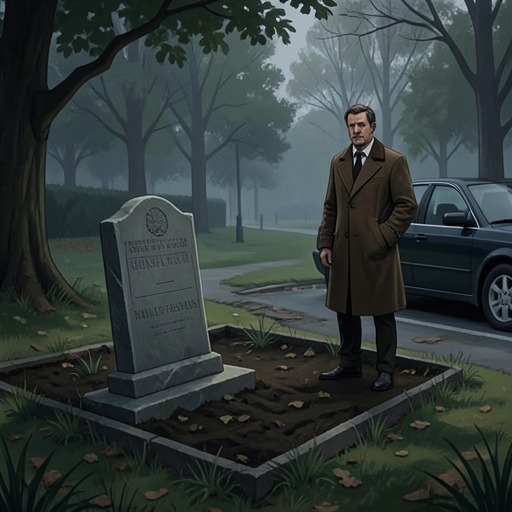
Discovery of the grave hole at Homeland Cemetery
The Dark HalfThe discovery of the grave hole at Homeland Cemetery is the first concrete sign that someone has emerged from the earth and left the cemetery. Groundskeeper Digger Holt initially treats the damage as a familiar nuisance, but the hole’s shape, the marks in the wet soil, and the purposeful trail away from it lead him to a far less ordinary explanation. The scene also returns to the plot where a false grave marker had been staged for a story about Thad Beaumont, joining a recent publicity stunt to the unexplained event now unfolding there.
Setting and discovery
Homeland is the largest and prettiest of the town’s cemeteries. Its central lane is broad enough to resemble a road, crossed by four narrower lanes with grass growing between the wheel tracks. Digger drives up the central avenue, passes two intersections, and brakes at the third when he spots a ragged opening in the grass. Dirt lies scattered around it. He recognizes the general kind of mess: teenagers or late-night visitors sometimes dig shallow holes for a prank, but this excavation does not fit that pattern.
The opening has no squared edges or rectangular outline. It tapers unevenly into a cone and is deeper than the holes Digger expects from casual grave-digging. What makes it especially unsettling is the impression it gives of a person buried alive, coming to, and clawing a way out with bare hands. Digger tries to dismiss that interpretation as a prank, but the absence of a coffin or disturbed headstone does not resolve the problem: this particular plot was not occupied by a buried customer.
The plot and its earlier use
The six-plot section belongs to the town’s First Selectman, Danforth “Buster” Keeton. Only two plots in it contain bodies, those of Buster’s father and uncle, and their headstones remain undisturbed. Digger knows the section for another reason: it is where a New York photography crew had placed a false gravestone while preparing a story about Thad Beaumont.
That earlier setup had been arranged in the spring. Thad, who had a summer home on Castle Lake, asked Digger in an embarrassed manner whether a photographer could use the cemetery for a staged image. Digger agreed after hearing that the work was for People magazine. The fake marker had since been removed, but the photographer’s high-heeled shoes had left fading round marks in the sod. Those old marks establish the site’s recent history; when Digger notices fresher impressions among them, the cemetery’s staged image and the new disturbance occupy the same patch of ground.
Reading the tracks
The damp grass preserves evidence that would otherwise have dried and crumbled away. In the loose dirt near the hole, Digger sees a footprint beside a nearly dish-sized circular depression. Farther back are short grooves made by fingers that first slipped and then caught in the soil. Beyond the first impression, he finds more footprints, including one partial print where dirt fell from a shoe onto the grass.
Digger has spent his life tracking and hunting. Though he tries to talk himself out of what the marks imply, he can read their arrangement: a person in the hole has braced both hands against the dirt and pushed upward, the fingers slipping as the loose earth gave way. The circular depression suggests a knee taking the person’s weight after the climb. A foot then came down beside it, and the person stood and left. The prints appear to belong to a large adult; Digger estimates that the feet would need to be at least size twelve if they belonged to a child.
The departure and its implications
The tracks continue across the cemetery, widely spaced but not suggesting a run. Their maker appears to have moved quickly and with purpose. About forty yards farther on, Digger finds a large flower basket kicked aside, directly along the apparent route. The person could have gone around it but did not, a small detail that makes the departure seem forceful and unhesitating rather than confused.
The path angles toward the low wall between the cemetery and the main road. Digger briefly imagines a large, confident figure striding through the cemetery and moving the basket without breaking pace. That image is his reconstruction from the tracks, not a direct sighting: he sees no person emerge. Still, the combination of the ragged hole, the hand marks, the knee-like depression, and the trail outward leaves him with a sequence that ordinary vandalism cannot comfortably explain. The event turns Homeland from a place where a false grave had recently been arranged into the apparent starting point of a living person’s escape from the ground.