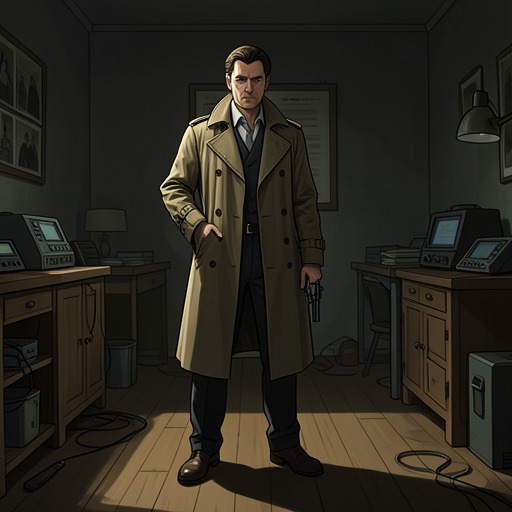
Federal Bureau of Investigation
The Dark HalfThe Federal Bureau of Investigation enters the case as a federal investigative presence alongside local and state authorities, questioning Thad and Liz Beaumont and helping pursue George Stark. Its arrival brings formal procedure and technical surveillance, but the agents’ confidence in those methods is tested when Stark calls almost immediately after the telephone equipment is installed—and the agents fail to recognize the danger in time.
Entry into the Investigation
After the murders had drawn law-enforcement attention to Thad, the Federal Bureau of Investigation questioned him and Liz at their Ludlow home. Thad angrily rejected the suspicion directed at him, insisting that he had done nothing and objecting to being treated as though he were guilty. His outburst unfolded in front of state troopers and Sheriff Alan Pangborn, while one of the twins began to cry in the adjoining room. The encounter shows the investigation extending beyond local jurisdiction while leaving Thad, its central suspect, convinced that the authorities have misunderstood the case.
The federal agents’ inquiry followed concrete evidence connecting Thad to the crimes. Homer Gamache had been killed with his own prosthetic arm, and his pickup truck was found at a Connecticut rest stop near the New York border. Investigators recovered several fingerprints attributed to the perpetrator, including a strong impression on the rearview mirror made in blood. When the prints were entered into a graphics computer through the military records and identification service, Thad’s service record—and, more precisely, his fingerprints—came back. This match supplied a powerful investigative lead, even as the circumstances made the apparent answer difficult to reconcile with Thad’s presence elsewhere.
Evidence, Suspicion, and Competing Explanations
Thad challenges the interpretation of the fingerprint evidence by questioning whether its quality itself should provoke suspicion. Drawing on research he had done for the George Stark novels, he points out that Maine requires six perfect points of comparison before a fingerprint can be admitted as evidence, while many real-world prints are incomplete or smudged. The exchange shifts attention from the simple fact of a match to the conditions under which prints were obtained and evaluated. In a case where the evidence seems to implicate Thad, the question becomes not only whose prints were found, but how an apparently complete impression could have been left at the scene.
Thad also articulates the investigators’ possible theory of an identical twin: one brother could have attended the party and maintained Thad’s ordinary relationships, while the other committed the murders and traveled between Castle Rock, Connecticut, New York, Washington, and Ludlow. He presents this as an absurdly elaborate explanation, and Liz responds with surprised, rueful laughter. Pangborn says that Thad appears to be telling the truth and acknowledges that he already knows what checking the birth records would show. The exchange makes the case’s central contradiction explicit: the prints point to Thad, but the proposed ordinary explanations do not convincingly account for the rest of the evidence.
Surveillance and Stark’s Call
The Federal Bureau of Investigation’s telephone surveillance is installed by state police technicians, who discover that the Beaumonts’ modern-looking Merlin phones depend on Ludlow’s outdated rotary-dial system. The contrast between the apparatus and the town’s old telephone infrastructure becomes immediately consequential: the technicians have only just pronounced themselves satisfied with the tap-and-trace equipment when George Stark calls, less than five minutes after installation.
At that moment, the agents are finishing their interview. Malone closes his leather-bound notebook, and Prebble closes his own; both say they have what they need for now and thank the Beaumonts for cooperating. Liz has been rubbing her temple, then stops and looks toward Thad with alarm as the phone rings. The agents seem not to notice the call. When Liz tells Prebble that it is Stark, he and Malone exchange an uncertain glance rather than acting decisively. Thad experiences the call as a direct confrontation with Stark, while the investigators remain outside that connection; the surveillance system has captured the timing of the threat without making its significance legible to those assigned to detect it.
Limits of Procedure and the Case’s Development
The agents’ presence does not resolve the conflict between material evidence and the increasingly difficult explanations surrounding it. Later, the voice-print results arrive shortly after eight o’clock and astonish Thad, though the available passage does not specify their detailed findings. The results add another forensic strand to a case already shaped by fingerprints and the telephone call, without ending the uncertainty described in the investigation.
The limits of ordinary proof are also visible in Pangborn’s response to a report from Fuzzy Martin. Fuzzy has seen the words “HIGH-TONED SON OF A BITCH,” and Pangborn initially tells himself that this proves nothing supernatural. Yet the thought of the voice-prints, the fingerprints, and the sparrows that crashed into the windows of Bergenfield County Hospital leaves him shivering. That reaction does not establish what the Federal Bureau of Investigation concludes, but it captures the larger investigative pressure: physical traces and testimony keep accumulating, while the events they must explain strain the boundaries of conventional police reasoning.