George Stark
The Dark HalfGeorge Stark begins as the name behind Thaddeus “Thad” Beaumont’s crime novels and becomes a living antagonist who refuses to be treated as disposable fiction. His emergence turns the act of naming into a revelation, the act of writing into a means of coercion, and the author’s claim over his creation into a conflict neither man can settle by assertion alone.
Identity and Literary Origin
Stark is Thad’s other writing name, a fact made explicit when an investigator identifies the name Thad had written under. Thad confirms it as George Stark, and the simple declaration brings relief: the concealed identity can now be spoken aloud. But disclosure does not end the danger. By the time Thad names him, Stark is not merely a byline that can be explained away; the story has made him an active presence beyond the books.
The division between Thad’s literary identities is also a division of styles. Thad describes Donald E. Westlake’s work as having a comic social mode under the author’s own name and a separate crime-writing mode under another. In the crime novels, the robber who has been robbed recurs, and Parker moves through his adversaries with the single-mindedness of a programmed machine, insisting on getting his money. Thad uses that model to invite recognition of Stark: the character’s hard, narrowly focused purpose belongs to a recognizable crime-fiction tradition, but it has escaped the limits that normally contain it on the page.
Stark’s fiction has its own internal continuity. Thad explains that Machine appears as a character in two of Stark’s novels, the first and the last. The detail places Stark inside a chain of crime-fiction conventions and gives his imagined career a shape, while also underscoring the distinction between Stark as a writer of books and the separate characters within them. The danger is not simply that fictional violence appears in his work; it is that the writer himself has crossed into the world where that violence can be enacted.
Exposure and the Crime-Writer’s World
When Thad imagines the case against him, he describes an elaborate twin scenario: one brother could have remained in Castle Rock, murdered Homer Gamache, and left fingerprints on Gamache’s truck, while the other traveled through Connecticut and New York to Washington, D.C., killed Frederick Clawson, and returned to Ludlow. The imagined arrangement depends on a twin who could attend Thad’s party, sleep with his wife, and keep his appointments while Thad was elsewhere. It is a piece of defensive reasoning shaped by the facts investigators must explain, but it also approaches a deeper truth: the apparent double is not an ordinary accomplice who can be located and questioned.
The crimes and their interpretation draw on the conventions of hard-boiled crime fiction. Dodie Eberhart’s reading tastes run toward novels of bank robbery, shootings, and violent relationships, a preference that helps establish how thoroughly the crime genre belongs to her understanding of Stark’s world. The books’ established codes give characters and readers a vocabulary for interpreting violence, yet Stark’s existence makes that vocabulary unstable: conduct that might be convention within a crime novel becomes a real threat when its author is physically present.
The investigation’s decisive turn comes when Thad tells the authorities Stark’s name. Saying it plainly releases some of the pressure of concealment, but Thad understands that evidence and technology cannot by themselves stop the man he has named. He guides his wife away after considering that no collection of recorders or high-tech equipment would be enough; Stark may be resting or already coming toward them. The contrast is central to Stark’s role: he is legible as a name and a criminal-fiction identity, but not thereby manageable as an ordinary suspect.
Survival, Control, and the Ultimatum
Stark’s demands are bound to his own conviction that he has a right to survive. The narrative enters his reasoning as he questions why Thad should be entitled to refuse him merely because Thad existed first. Stark does not regard priority as a moral argument that obliges him to disappear. He sees survival as his responsibility to himself, a position that turns the conflict from a simple creator-versus-creation dispute into a contest between two beings who each claim a stake in continued life.
That self-assertion takes the form of a writing ultimatum. Stark tells Thad it is time to begin a new book, another Stark novel, and gives him a week to produce at least thirty pages of manuscript. If Thad fails, Stark threatens to come for him, beginning with his children and then his wife before turning to Thad himself. The demand makes the relationship between writer and character brutally practical: Stark needs Thad’s writing, but he seeks it not through collaboration freely chosen by the author but through threats against the people Thad is trying to protect.
Stark’s hold over Thad is not entirely one-way. After an episode in which Thad has managed to capture and bend Stark to his will, Stark wakes uncertain whether he revealed anything while under Thad’s control. He suspects that he may have said things but believes Thad would not know how to distinguish important disclosures from meaningless ones. The reversal complicates the image of Stark as an autonomous pursuer: the connection between the two men permits Thad, however briefly, to affect Stark as well.
The Family Threat and the Final Confrontation
The threat moves into Thad’s home when Stark calls from there. A message challenges Thad to guess where the call originated; Thad immediately understands the implication: Stark has reached the house and has Liz and the twins. The domestic space that Thad had hoped to protect becomes the setting of Stark’s leverage. The kidnapping gives the writing ultimatum its full stakes, joining Stark’s demand for a new book to the safety of Thad’s family.
At the confrontation, Stark tells Liz that she and the police officer should leave because the conflict is now between the two men. He calls it a matter of the boys, stripping the immediate scene down to the author and the identity that has become his rival. Yet the family cannot be separated from the contest: Stark’s earlier threats and seizure of the household have already made them its intended cost, while Thad’s efforts to confront Stark arise from the need to protect them.
Stark’s relation to authorship briefly changes in the final writing scene. He lights a Pall Mall, takes one of his Berol pencils, opens his own notebook, and pauses to look at Thad with unguarded honesty. The pause marks a moment in which the two writers meet over the work rather than only through threat and resistance. Their proximity does not erase their conflict, but it allows the act of writing to become a shared, consequential encounter before Stark’s end.
Death and Narrative Significance
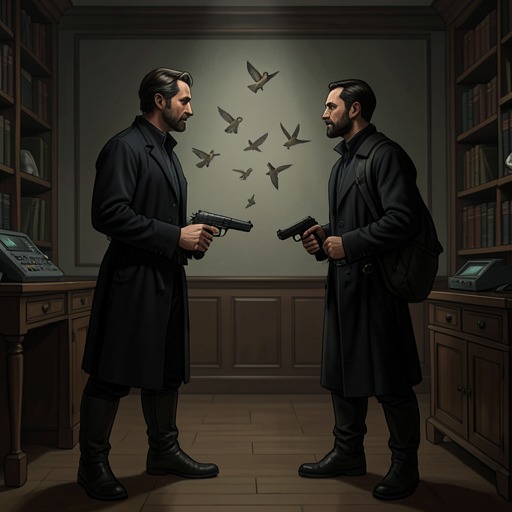
As the sparrows arrive, Stark’s expression shifts to horror and understanding. They have come to serve as his escort back to the land of the dead. The ending gives the birds a role that is not merely atmospheric: they carry Stark away, bringing the embodied character’s passage from fiction into reality to a close. Afterward, Thad stands with Alan Pangborn at the hole in the study wall and says that Stark is gone. The brief confirmation contrasts with the long struggle required to make that departure possible.
Stark’s arc binds crime-fiction form to the novel’s supernatural conflict. His machine-like persistence recalls the single purpose Thad associates with Parker, while his insistence that he has a claim to survival resists reducing him to a programmed instrument. He is at once Thad’s pseudonym, a writer of crime novels, a threat to the Beaumont family, and an adversary who contests the author’s right to erase him. The sparrows’ final escort resolves that contest without making the boundary between author and creation seem secure: Stark’s brief existence has made the written identity consequential in the world beyond the books.