George Stark emerges from the grave
The Dark HalfGeorge Stark emerges from the grave in the story first as an inference drawn from a hole, a set of tracks, and a groundskeeper’s reluctant expertise. At Homeland Cemetery, Digger Holt reads the disturbed ground as evidence that someone had climbed out of a grave by hand; the scene turns the earlier fake gravestone associated with Thad Beaumont into a disturbing sign of a boundary crossed between fiction and reality.
Discovery at Homeland Cemetery
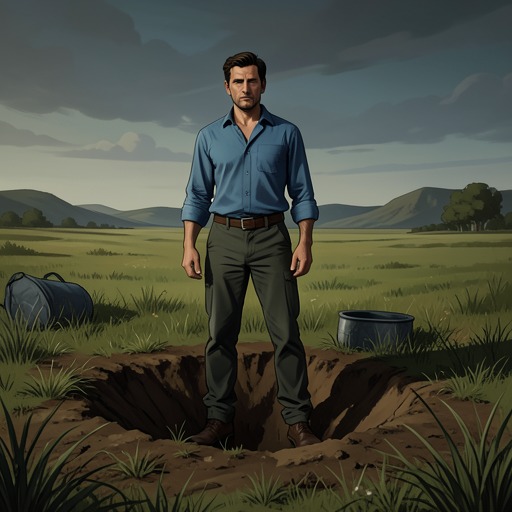
Homeland is the town’s largest and prettiest cemetery, its broad central lane intersected by four narrower grass tracks. Digger drives along the central avenue and brakes near the third intersection when he sees a ragged hole roughly fifty feet down and to the right. Dirt lies scattered around it. The shape immediately distinguishes it from the shallow holes he has encountered after drunken or adolescent grave-digging pranks.
The hole is irregular, deeper than the usual pranksters’ efforts, and tapered into a cone rather than squared into the familiar shape of a grave. Its form suggests to Digger that the person inside had been buried alive, regained consciousness, and dug upward with bare hands. He initially tries to dismiss that interpretation as a prank, but the physical evidence resists the explanation.
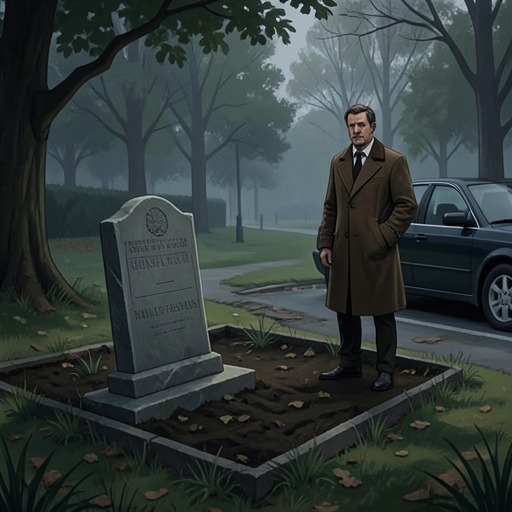
The plot belongs to Castle Rock’s First Selectman, Danforth “Buster” Keeton. Its only occupied graves are those of Keeton’s father and uncle, whose headstones remain undisturbed. Digger therefore knows the hole is not simply an ordinary, recently disturbed grave. The empty plot’s history supplies another unsettling association: Thad Beaumont had previously asked permission to place a fake gravestone there for a photographic trick shot connected with a story about himself.
Reading the escape
Digger does not rely on the hole alone. In the dirt nearest it, he finds a deep shoe impression. Further examination reveals grooves made by fingers, a round depression just beyond them, and a footprint beside the depression. Together, the marks give him a sequence: someone stood in the hole, pressed both hands into the loose earth, pushed himself upward, and shifted his weight onto a knee and then a foot before walking away.
The roots appear twisted and torn, as though the sod had been pulled apart by hand rather than cut neatly with a spade. Digger also judges that the hole is too deep for a person simply to jump out of. The mechanics he reconstructs are ordinary in themselves—hands braced in dirt, fingers slipping, a knee taking the weight—but their implication is extraordinary: the person escaped from below ground without assistance. The tracks seem too large to belong to a child, reinforcing his sense that this was no routine cemetery prank.
A sparrow’s ordinary call briefly helps Digger resist the conclusion he has reached. He tells himself to stop thinking about it and turns back to the clearest marks. But the bird does not erase what the ground records. Beyond the first footprint, other prints cross the grass at wide intervals. They do not suggest a run, yet their spacing indicates that the person was moving with purpose and wasting little time.
Forty yards farther on, a large flower basket has been kicked over, apparently in the route marked by the footprints. The person could have gone around it but did not. Following the direction of the tracks, Digger understands that the walker crossed diagonally toward the low wall between the cemetery and the main road, as if headed somewhere specific. The evidence transforms the hole from an isolated disturbance into the beginning of an escape route.
From discovery to murder investigation
Digger fills in the hole, intending to leave the matter alone. Later that afternoon, Deke Bradford brings him news that Homer Gamache has been found dead less than a mile away, up Route 35 from Homeland. The town is already full of rumor and speculation. The proximity of the murder changes the significance of Digger’s discovery: the tracks may belong to someone connected with a killing, rather than to a prankster who simply vanished into the night.
Digger does not claim to know what the hole and the tracks mean, or that they are definitively linked to Gamache’s death. He goes to Sheriff Alan Pangborn because he believes the investigators should have what he found and decide its importance. His report carries the force of practical observation: the impression of a shoe, finger grooves, a knee mark, the route across the cemetery, and the overturned basket. The account is less a supernatural explanation than a careful handover of evidence that Digger would rather not have interpreted.
The false grave and the real trail
The fake gravestone makes the discovery resonate beyond its physical clues. Digger remembers that people from New York had set up the marker in the same plot while preparing a story about Thad Beaumont. Beaumont had asked permission for the staged photograph, and Digger had agreed. In the later scene, the empty plot no longer serves only as a location for an image: the hole makes the idea of a grave opened from within frighteningly concrete.
The episode also establishes how the novel lets crime-fiction expectations enter the investigation. Beaumont later describes the model for George Stark’s fictional persona through crime writer Donald E. Westlake’s Richard Stark books: their criminal protagonist Parker is driven toward robbery with the single-mindedness of a programmed machine. Beaumont connects that model to Alexis Machine, the central figure in the first and last George Stark novels. Digger’s evidence, by contrast, gives the supposed fictional identity a physical route through the world: an escape from a grave, purposeful tracks, and a path leading out of the cemetery.
That connection becomes part of the investigation’s widening suspicion. When Beaumont later lays out a hypothetical twin’s role in the crimes for Pangborn, he describes a figure who could remain in Castle Rock while another person killed Gamache, used the victim’s truck, and then moved between places before the two resumed their lives. The speech is a proposed scenario, not a confirmation of the hole’s meaning, but it shows how the possibility of a double becomes a framework for imagining the murders. Stark’s emergence from the grave thus works as both a physical mystery and an early material sign that the story’s distinction between invented criminal and actual killer has become unstable.