George Stark's false gravestone
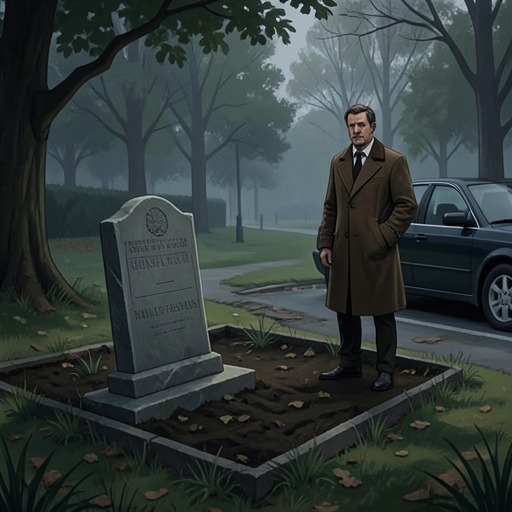
The Dark HalfGeorge Stark's false gravestone is the staged marker of the fictional writer's burial, but it does not remain a merely symbolic prop: Thad Beaumont learns that Stark was buried at the cemetery where the stone was set up, and the detail helps connect the public story of Stark to the murders and the threat confronting Thad. The grave's precise location is withheld, turning the marker into both evidence and a protected secret.
A Burial Made for a Fictional Identity
The gravestone belongs to a fabricated public ritual: Thad has arranged for George Stark, the name under which he wrote crime novels, to be treated as dead. The distinction between a pen name and a person has already become unstable in Thad's experience. After dreaming of a flock blotting out the daylight and hearing Stark speak, he tries to dismiss the idea that a pen name could come to life and kill. Yet he keeps returning to the dream, which he calls his William Wilson complex. Against that doubt, the gravestone gives Stark's supposed death a material, public form.
The choice of a false burial also echoes the origin of Stark's literary identity. Thad had sought a name separate from his own to break his writer's block; he took inspiration from Richard Stark, Donald E. Westlake's pen name for a harder-edged series about Parker, a professional thief. Thad recalls Westlake's distinction between writing under his own name on sunny days and letting Stark take over on rainy ones. The gravestone marks the apparent end of that split, but the story makes the supposed ending unstable.
Location and Secrecy
The cemetery is later identified in conversation as the place where George Stark was buried. However, the accompanying magazine coverage does not name it as Homeland Cemetery, either in the photograph's caption or in the article's text. Alan Pangborn reasons that the omission was deliberate: Dan Keeton, the First Selectman, would have required the cemetery's identity to remain private to reduce the risk of vandalism by people searching for the gravestone.
That concealment gives the object two different public faces. The article makes the staged burial visible enough to be discussed, while withholding the information that would let readers locate the stone. The gravestone therefore functions not only as a declaration that Stark is dead but also as the center of a managed boundary between public knowledge and physical access.
The Grave as a Clue
The article's report prompts Thad to tell another person that the woman involved had arranged the fake tombstone and that this was where George Stark was buried. The reaction on the other end of the call is immediate alarm. The gravestone's significance lies in the connection it establishes: a seemingly staged detail in a magazine story points back to the cemetery associated with Stark's burial and helps Thad and Alan make sense of what was otherwise concealed.
Its meaning is sharpened by the novel's contrast between the figure Thad invented and the violence being investigated. Thad describes to Alan a hypothetical identical twin who could account for his apparent presence in Castle Rock during one crime and elsewhere during another. That explanation is a speculative account of how the evidence might be reconciled, not proof that a twin committed the crimes. The false gravestone belongs to the same effort to understand how an identity Thad created can acquire consequences beyond the page.
Material Evidence and Literary Irony
As an object, the gravestone gives an abstract literary identity a physical address and a public death. Its force depends on the contradiction between its appearance as an ordinary marker and the truth it conceals: the burial is part of a deliberate fiction, while the cemetery's identity is withheld to protect the site. Rather than resolving whether Stark is only a name, the stone makes that uncertainty harder to ignore.
The grave also reflects the crime-fiction tradition from which Thad developed George Stark. Stark's novels center on Alexis Machine, a character Thad describes as resembling a programmed figure with a single goal. Dodie Eberhart, Stark's landlord and a devoted reader of hard-boiled crime, admires the books in which men rob banks, shoot one another, and express attachment through violence. The false gravestone carries that invented criminal world into a real cemetery: it is a prop in Thad's attempt to bury a name, and a clue that the boundary between the name and the world around it has failed.