Gold's Junkyard and Auto Supply
The Dark HalfGold’s Junkyard and Auto Supply is a roadside auto-parts business surrounded by a vast field of wrecked vehicles, but in the novel it becomes much more than a place to conceal a car. Its decaying rows give Thad Beaumont temporary cover as he evades pursuit, while the sparrows gathering among the wreckage transform the yard into a silent assembly ground. There, Thad recognizes that the birds are attending to him—and sends them west to find George Stark.
Setting and Physical Character
The junkyard lies off Route 2, near Gold’s retail parts building, a long tubular structure assembled from prefabricated aluminum sections and painted an aggressively bright shade of aqua. The surrounding yard covers roughly a dozen acres and holds nearly twenty thousand cars, arranged in dozens of zigzagging rows. Their windshields glitter in the hazy sunlight, a startling brightness set against so much decay.
The yard’s interior is a landscape of wreckage and stubborn growth. Cars are stacked two and sometimes three deep; those underneath have lost their recognizable forms and seem to be melting into the ground. Oil darkens the earth, yet weeds and large sunflowers grow in coarse clusters. One sunflower rises through the shattered windshield of an overturned bakery truck, its stem curled around a wheel stump while another growth clings to the hood ornament of a Cadillac lying above it. The scene makes the junkyard seem at once industrial and strangely alive: discarded machinery becomes the substrate for unruly vegetation.
The scale and disorder of the place give it the feel of a maze. Narrow aisles pass between heaps of metal, the air carries the smells of oil and sour transmission fluid, and the only ordinary sound Thad can hear is traffic far away on Route 2. A dried splash of blood on the dashboard of a Datsun adds a more intimate trace of violence to the larger field of abandoned things. For Thad, the yard is a silent Detroit necropolis, an image that prepares the setting to hold both the dead machinery and the living birds.
Thad’s Flight and Temporary Refuge
On a Saturday afternoon, Thad approaches the junkyard in a boxy gray Suburban with brilliant red sides. The vehicle is too large and conspicuous to remain on the road unnoticed, so the yard offers a possible hiding place among its thousands of derelict cars. He hopes that the Saturday lunch hour has left the yard unattended, though the retail building may still have a clerk or two selling parts to weekend mechanics.
After doubling back to Route 2, Thad turns into Gold’s through an open gate in the chain-link fence. A faded sign warns that the area beyond the point is for employees only; on a weekday, he expects he would have been spotted and turned around. The timing allows him to pass into the yard and move down its aisles. He eventually backs the Suburban into an open space before a late-model Cutlass Supreme whose entire front end has been removed. The refuge is practical but uneasy: the narrow aisle makes him feel trapped in a maze, and the silent, oil-soaked surroundings offer concealment rather than safety.
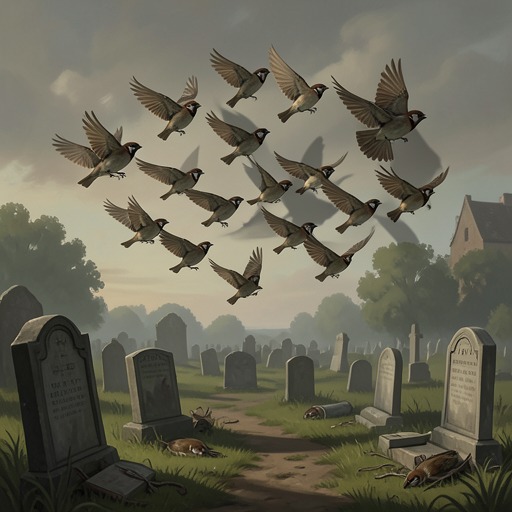
The sparrows are already present among the wrecks. Thad sees them on roofs, trunks, and greasy engines, and watches three bathe in water collected in a hubcap. They do not flee when he approaches. Others hold their places along a windshield, fluttering nervously but remaining close as he passes. Thad thinks of them as heralds of the living dead and rubs the small white scar on his forehead. His response connects the birds to the supernatural episodes that have marked him, while their behavior makes clear that they are not merely incidental wildlife: they watch him and select him as the focus of their attention.
The Flock and Thad’s Command
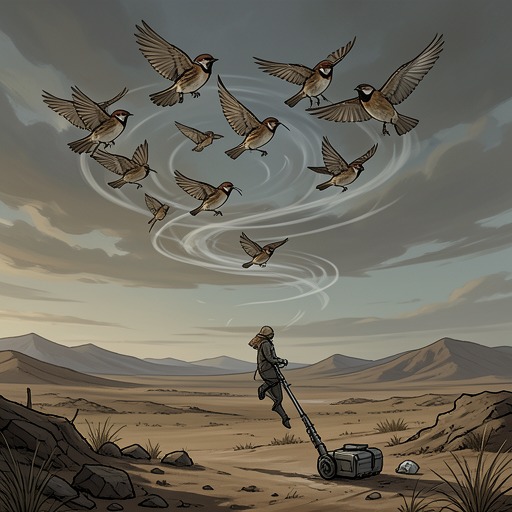
As Thad reaches the end of an aisle, the sparrows take flight together—hundreds, perhaps a thousand—then bank west in the direction of Castle Rock. The sudden movement is accompanied by a crawling sensation inside Thad’s skin. Later, after he has contacted Rawlie DeLesseps, the birds are no longer confined to scattered perches. The dead cars and trucks across the back ten acres of Gold’s are carpeted with them. Thad and Rawlie see a silent mass that may number twenty or forty thousand, covering hoods, windows, roofs, exhaust pipes, grilles, engine blocks, joints, and frames.
Rawlie calls the birds psychopomps and asks what their presence means. Thad’s answer is that he is only beginning to understand. When Rawlie claps his hands, the flock does not stir; it is not responding to him. Thad then quietly tells the birds to find George Stark and fly. The flock rises in a black cloud, its wings making a sound like thunder rendered delicate, and turns west. Men inside the parts shop run outside to look. The scale of the event makes the yard’s ordinary commercial life briefly visible beside the supernatural spectacle: the bird-filled wreckage draws witnesses out of the building, but the command has been directed to Thad alone.
Narrative Significance
Gold’s binds concealment to revelation. Thad enters looking for somewhere to hide an oversized vehicle and finds a place whose wreckage echoes the dead and whose birds reveal an agency he can call upon. The progression from a few sparrows bathing in a hubcap to a flock carpeting ten acres gives the setting a changing scale: what first appears as scattered, watchful animals becomes a coordinated presence, and the junkyard’s rows turn into a staging ground for pursuit.
The birds’ relationship to the place is not simply symbolic. They occupy its machinery, gather in extraordinary numbers, ignore Rawlie’s attempt to startle them, and answer Thad’s instruction to search for Stark. Their selective response unsettles any assumption that humans control the scene. Later, at the Beaumonts’ lake house, sparrows land on Alan Pangborn’s shoulder and hand without behaving as ordinary startled birds would; the narrative likewise shows them covering trees and staging near the house. In a further journey toward the house, Thad encounters a sharply bounded flock that has filled the road, making passage seem possible only by driving over the birds. The movement from Gold’s gathering ground to that later barrier develops the flock from an uncanny presence into an obstacle and active force in the human conflict.
At the novel’s climax, the psychopomps serve as Stark’s escort back to the land of the dead. That destination gives the earlier junkyard scenes a grim retrospective force: the birds first assembled among wrecked vehicles, then followed Thad’s command west, and ultimately gathered around Stark. Gold’s is therefore a threshold location where Thad’s uneasy recognition of the flock becomes action, and where the birds’ own scale, silence, and selective responsiveness begin to alter the course of the pursuit.