Hugh Pritchard
The Dark HalfHugh Pritchard is the surgeon whose unusual 1960 operation on Thad Beaumont becomes a crucial link between Thad’s childhood medical history and the recurring sparrows. Years later, when Alan Pangborn investigates Thad’s past, Pritchard’s recollection supplies both a diagnosis and a startling coincidence: the mass removed from Thad’s brain was tissue from his unabsorbed twin, and shortly afterward a large flock of sparrows struck the hospital where he was recovering.
Identity and Medical Background
In 1960, Pritchard operated on eleven-year-old Thad after severe headaches and a seizure led doctors to find a mass in his prefrontal lobe. The surgeons had assumed it was a tumor; according to Pritchard, the tissue proved to be part of Thad’s twin. He later explained that fetal twins are often absorbed in utero, but in this rare case the absorption had been incomplete and the remaining tissue had grown inside Thad’s brain. Its location was unusual, as was its growth after a period when it should have remained inert.
Pritchard’s account places Thad’s symptoms within a medical framework. He associated the growth-spurt of the tissue with the early onset of puberty and explained that the pressure inside the skull was sufficient to produce the headaches and seizure. The explanation accounts for the immediate medical crisis, while leaving the accompanying bird sounds—and their later significance—open to another interpretation.
Pangborn’s Search for the Surgeon
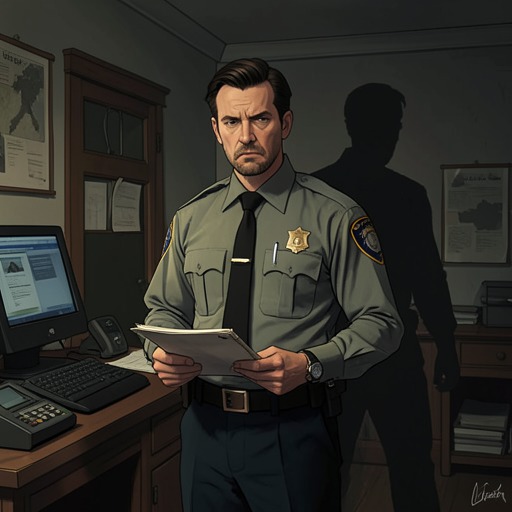
Pritchard re-enters the story when Pangborn seeks a reliable account of Thad’s childhood operation. In a cramped office at the rear of the State Police barracks, Pangborn writes down two leads: Pritchard’s name and Bergenfield County Hospital, where the operation had taken place. The hospital reports that Pritchard retired in 1978 and provides an address and telephone number in Fort Laramie, Wyoming. Pangborn reaches an answering machine and leaves a message identifying himself as a Maine law-enforcement officer and asking Pritchard to call about Thad, whom he says Pritchard operated on in 1960.
The first attempt yields no medical explanation. When Pangborn later tells Thad and Liz that he has identified the surgeon, Thad only tentatively recognizes the name; Pangborn says he has reached Pritchard’s answering machine and left a message. A separate check through dispatch establishes that Pritchard and his wife are on a camping trip in Yellowstone National Park until the end of the month. The delay matters: Pangborn is trying to test a connection while a murder investigation is under way, but the doctor who can clarify Thad’s history is temporarily difficult to reach.
Pritchard’s Account of the Operation
When Pritchard eventually speaks with Pangborn, the sheriff explains that he is investigating the murder of Homer Gamache and that Thad may be a witness. He is concerned that Thad’s past brain condition could complicate how his testimony is understood. Pritchard immediately recognizes the patient as Thaddeus Beaumont and doubts that the symptoms under discussion represent a recurrence of the old tumor. His quick identification turns the call from a general medical inquiry into a conversation about a specific and memorable case.
Pritchard asks to give the history in his own order. He recalls that Thad’s condition culminated in a seizure, after which surgeons found the mass in the prefrontal lobe. They operated on the assumption that it was a tumor, then discovered that it was tissue from Thad’s twin. Pritchard stresses the rarity of the incomplete absorption and the unusual location, adding that such tissue ordinarily remains inert. His explanation revisits the diagnosis given at the time while clarifying why the case stayed in his memory.
The Sparrows and the Case’s Unresolved Meaning
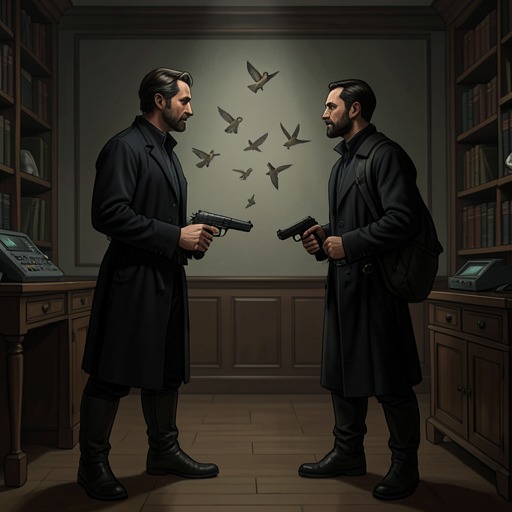
The most consequential part of Pritchard’s testimony concerns the birds. Thad had heard birds before his childhood headaches; Pritchard identifies this as a sensory precursor associated with brain tumors or epilepsy. Thad’s auditory precursor was sparrows. Pritchard also recalls that, shortly after the operation, sparrows attacked Bergenfield County Hospital, an event he describes as unusually well documented. On October 28, 1960, just after two in the afternoon, a large flock flew into the hospital’s west side, where the Intensive Care Unit was located and where Thad was recovering.
Pritchard had questioned Thad about his symptoms a day after the operation. The boy remembered not only hearing the birds but seeing them across the houses, lawns, and streets of Ridgeway, the Bergenfield neighborhood where he lived. Pritchard compared Thad’s chart with reports of the hospital incident: the birds struck at about 2:05, and Thad woke at 2:10, perhaps a little earlier. An intensive-care nurse believed the sound of breaking glass had awakened him. The close timing makes the episode more than a private memory in Pritchard’s account: it is aligned with hospital records and contemporary reports, yet the evidence does not establish what connected the flock to Thad.
Pritchard’s role is therefore both explanatory and limited. His medical history establishes that Thad’s childhood headaches had a physical cause and that the birds had once accompanied a recognized neurological symptom. His recollection also supplies an external record of a sparrow event coinciding with Thad’s recovery. Later, sparrows gather in unnaturally large numbers and appear to act as psychopomps, accompanying George Stark back toward the land of the dead. Pritchard does not witness that later action, and his account does not explain it; instead, it makes the final supernatural recurrence echo an anomaly already attached to Thad’s earliest crisis.