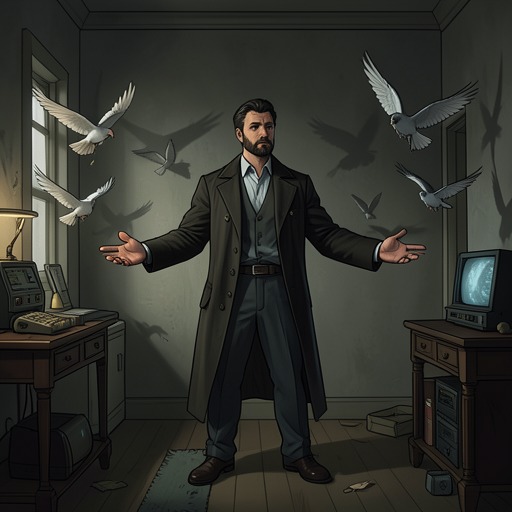
I Am the Knower; I Am the Owner; I Am the Bringer
The Dark HalfThe expression “I am the knower. I am the owner. I am the bringer” is a three-part formula through which Thad Beaumont tries to grasp his connection to the sparrows. Each title seems to promise mastery: knowledge of what the birds are, ownership of their power, and the ability to summon or direct them. Yet the phrase’s recurrence does not establish that Thad commands the flock. Instead, it marks the distance between naming a force and controlling it, as the birds gather in immense numbers and finally serve as George Stark’s escort back to the dead.
The Formula and Its First Meaning
The words surface as Thad works through a series of questions about the sparrows and George Stark. Asked who wrote about the birds, the answer comes as an assertion of knowing and owning; when the question turns to who brought Stark back to life, the answer again identifies the owner and the knower. The repetition makes the expression less like an ordinary description than a set of clues. Thad recognizes that the answers are approaching something terrible, and his response is a groan. The formula is bound to the revelation that his relation to Stark is not merely professional or imagined: some part of Thad has helped make the danger possible.
That recognition is morally complicated by Thad’s own doubts about his motives. He protests that he did not mean to bring Stark back, but immediately questions whether that is true. He acknowledges that part of him has admired Stark’s simple, violent nature: a figure who never appears weak or silly, has no family obligations, and does not falter before the difficulties that burden Thad’s ordinary life. The phrase’s claim to ownership therefore carries an unwelcome implication. If Thad is the owner, he may be implicated in what has come into being, even if he did not consciously intend its return.
Recurrence on the Road
Later, as Thad drives away from Orono toward Bangor and Ludlow, the formula returns in a moment of uncertainty. He is trying to evade the police and has made Rawlie DeLesseps part of a plan whose success depends on finding him still at his office. The words do not resolve those immediate risks. Rather, their recurrence keeps the problem of the sparrows present while Thad is still unsure what he can do with them—and still wary that a part of himself may not want Stark to die.
The expression becomes more directly confrontational when Thad finds sparrows gathered on the front seat of his Datsun. He asks what they want, and seems to hear their answer in his mind: the question is returned to him, along with the assertion that he is the owner, the bringer, and the knower. Thad answers that he knows nothing. The exchange overturns the apparent confidence of the formula. The birds do not merely wait as instruments for him to use; they present him with a question about his own purpose, and his uncertainty is the scene’s decisive response.
A Claim Tested by the Flock
At Gold’s Junkyard and Auto Supply, the scale of the birds’ gathering makes the formula’s limits visible. Rawlie looks behind them and sees that the wrecked vehicles across the back ten acres are carpeted with sparrows. They occupy hoods, windows, roofs, exhaust pipes, grilles, engine blocks, joints, and frames. The flock has arrived so silently that Thad has not heard it come. Its immense, coordinated presence is not explained by the simple act of naming oneself its owner or bringer.
Thad later takes the repeated words as a clue to a possible means of action. While checking for police at an Auburn traffic light, he thinks that magic requires a wand and decides to seek pencils at a stationer’s store on Court Street. He wants pencils that Stark has never touched, distinct from the Berol Black Beauty pencils at the house in Castle Rock or Stark’s own supply. This practical turn gives the expression a new force: Thad tries to translate its claim of power into an act of writing, using a fresh object rather than one shared with his adversary. The formula itself does not guarantee the success of that plan, but it shapes how he understands the tools and choices available to him.
The birds’ conduct around Alan Pangborn further complicates any idea of ownership as command. One lands on Alan’s shoulder, hops to his hand, and pauses before pecking; after he lowers his hand, it leaves him and returns to the driveway. Sparrows fill the visible trees near Castle Lake, and a branch cracks under their accumulated weight. Alan retreats from the slope toward Lake Lane, observing that the flock appears to be holding back, as if the area were a staging ground. The birds’ selective proximity and collective stillness suggest agency beyond Thad’s private claim over them.
From Ownership to Escort
On the road toward the house, Thad finds a sharp boundary where the flock begins, less than twelve feet from his stopped Volkswagen. A sparrow settles on the hood and peers in at him. He senses a dispassionate curiosity in its dark eyes and understands that the road ahead has become a barrier made of birds: if he means to reach the house, he will have to drive over them. Here the old formula offers no easy mastery. The birds’ presence determines the route and forces Thad to confront what reaching his family may cost.
At the climax, the meaning of the phrase resolves not as command but as recognition. Thad understands that the psychopomps—the birds acting as guides for the dead—have come to escort George Stark back to the land of the dead. Thad drops his pencil and retreats toward his children as the door opens and the sparrows fill the air. They settle on Stark’s shoulders and arms, then strike his chest in growing numbers, while he twists and struggles against them. The flock carries out the decisive action; Thad’s formula has named his connection to the birds, not given him lasting sovereignty over them.
Knowledge, Responsibility, and Limits
The expression moves through several related meanings: an answer to questions about authorship and Stark’s return, a repeated assertion during Thad’s journey, an apparent reply from the birds themselves, and a clue that directs him toward writing with untouched pencils. In each context, knowing and owning remain unsettled. Thad can sense that the birds are connected to him and can identify their role in Stark’s fate, but his own admission of ignorance and the flock’s independent actions prevent the phrase from serving as a straightforward declaration of control.
Its final irony is that Thad’s titles are most persuasive at the moment they fail as guarantees. He is a knower because he recognizes the birds’ purpose; a bringer because the supernatural relation has made their arrival intelligible in connection with him; and an owner only in a precarious, morally charged sense that never makes the flock obedient. The words therefore bind agency to responsibility without collapsing the sparrows into tools. They name Thad’s involvement, while the silent, multitudinous birds retain the power to choose how the story ends for Stark.