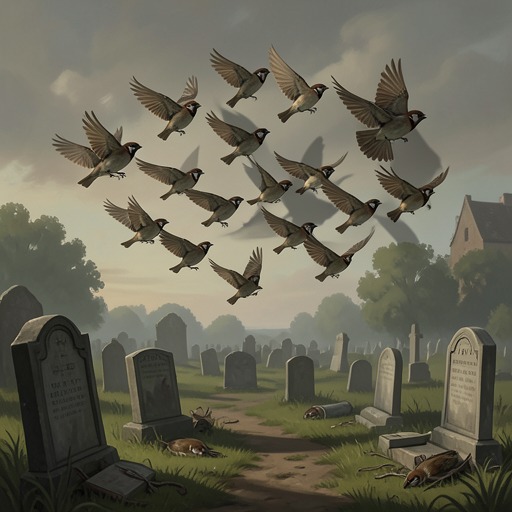
No man controls the agents of the afterlife. Not for long—and there is always a price.
The Dark HalfThe warning that no one controls the agents of the afterlife for long—and that there is always a price—is the governing rule of the sparrows’ intervention in Thad’s struggle with George Stark. The birds may clear a way, gather around a chosen target, and carry Stark back toward death, but their aid does not make them servants; its final cost remains uncertain even to the man they help.
The Warning and Its Context
Rawlie DeLesseps’s warning reaches Thad as he approaches the Williamses’ A-frame. At Gold’s Junkyard and Auto Supply, the sparrows had appeared in overwhelming numbers, carpeting the stacked wrecks without making a sound. Now, as Thad drives toward the house, they occupy the road itself. A bird peers through the windshield, and he understands that reaching the house means driving over the flock.
He remembers Rawlie’s words while weighing whether to turn back toward Route 5. The birds have opened a way in front of him, but he doubts they would open one behind him; changing course seems to carry consequences he cannot face. As he creeps downhill, the sparrows part before the Volkswagen. He remembers little of the drive afterward, as if his mind draws a curtain over it. The episode makes the warning practical: passage is granted, but not on terms Thad can confidently control.
The Sparrows Act on Their Own Terms
The flock’s behavior resists ordinary explanation and human command. At the Williamses’ driveway, a sparrow lands on Alan Pangborn’s shoulder, hops onto his hand, and pauses with its beak above his palm before flying back to the ground. Alan brushes at it, then lowers his hand; the bird neither attacks nor submits. Around him, the trees appear full of sparrows, their weight cracking a branch, while the birds remain silent and watchful.
Alan retreats up the driveway, sweating, and finds the birds gathered over his car as well. From Lake Lane, he sees them concentrated on the slope by the A-frame, apparently holding their distance. The scene suggests a staging area without explaining what the flock intends. Its selective proximity makes the birds’ agency more unsettling than a simple swarm: they can approach, pause, and withdraw, while human beings can only guess at their purpose.
Stark’s Escort and the Cost of Aid
At the house, the psychopomps gather around Stark as the door opens and Thad retreats toward his children. Sparrows settle on Stark’s shoulders, arms, and head, then strike his chest in growing numbers. He twists amid feathers and cutting beaks, trying to return the violence being done to him. The flock’s role is not merely to frighten or obstruct: it has come to serve as Stark’s escort back to the land of the dead.
Afterward, a sparrow’s action prompts Liz to ask why it did what it did. Thad does not answer aloud, but thinks the moment may have been a forceful reminder rather than a fairy-tale reward. He recalls the warning that no one can control the agents of the afterlife for long and that there is always a price. The rescue therefore ends without a simple assurance of safety: Thad wonders when the bill will come due, then considers that perhaps it has already been paid.
Meaning and Limits
The saying links the flock’s supernatural power to a boundary on human mastery. Thad is called the knower, the bringer, and the owner, yet the episode does not establish that those names give him lasting command over the birds. Their path-making helps him reach the house, and their attack carries Stark away, but neither act turns them into predictable instruments.
That tension gives the warning its force at the novel’s close. The sparrows can be allies in a desperate struggle and still remain agents of an afterlife beyond human authority. Thad’s uncertainty about the debt preserves the cost as an open question: he can imagine that he is finally even, but cannot know with certainty what the flock’s intervention has required of him.