Rawlie DeLesseps
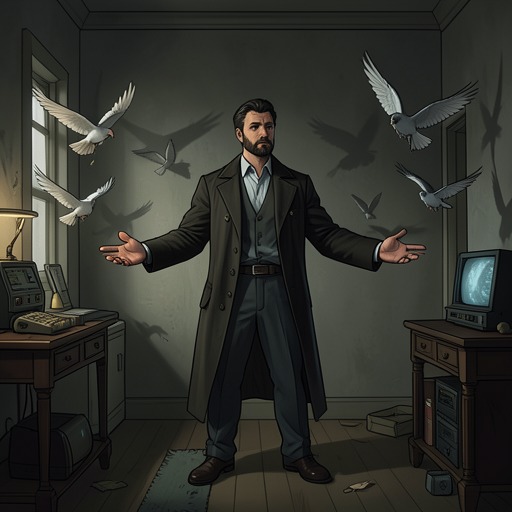
The Dark HalfRawlie DeLesseps is an English Department professor whose apparently absent-minded manner conceals sharp perception and a deep familiarity with folklore. When Thad Beaumont asks about the significance of sparrows, Rawlie’s research identifies them as psychopomps—guides between the living and the dead—and turns Thad’s recurring bird encounters into a usable clue. He later loans Thad his car and supplies a disguise, helping him pursue George Stark, while his account of the sparrows’ power also warns that no human can command them for long without consequence.
Identity and Background
Rawlie teaches a Folk Myth seminar, offered every fall, whose catalogue description ranges from dowsing and witches to holistic remedies and Hex Signs of the Rich and Famous. He is a familiar presence in the Department, where he drifts along the hall in mild loops, peering at notices on locked office doors. His movements and manner can make him seem so distracted that even acquaintances might not know where he is headed.
His most conspicuous accessory is an enormous yellow pipe held between his dentures. The pipe has been unlit since 1985, when his doctor forbade him to smoke after a mild heart attack. Rawlie explains that he never much liked smoking, but without the pipe in his teeth he would not know where to go or what to do if he happened to arrive there. The joke folds his habitual vagueness into a carefully maintained persona: some people never discover that the professorial fool is not foolish at all.
Reading Thad’s Evasion
Rawlie encounters Thad in the Department corridor on a hot weekend afternoon, while Thad is accompanied by two police officers in plain clothes. He notices the officers, dismisses them with a glance, and addresses Thad as Thaddeus. When Thad says he is not teaching summer courses, Rawlie asks what has brought him to the building on the first real dog day of summer.
Thad disguises his interest as research for a story and asks whether sparrows have a place in American superstition or folk myth. Rawlie does not accept the pretext uncritically. He wonders aloud whether the professed story idea is really the reason for the question; Thad admits that his interest is not something he can explain quickly and that he is pressed for time. Rawlie neither forces a confession nor treats the inquiry as idle. Instead, he offers to consult Barringer’s Folklore of America and call Thad with anything he finds.
When a call for Thad comes in on Rawlie’s telephone, Rawlie reports it as a likely wrong number. Thad’s heart begins beating slowly and hard, but Rawlie’s appraising look makes clear that he is attentive to the unease beneath the exchange. He asks if everything is all right. Thad insists that it is, although his private thoughts reveal the truth: he fears a killer partly bound to him, and the possibility that the killer can take control of his body. Rawlie does not know the details, but his questions show that he sees more than Thad is willing to say.
The Folkloric Clue
Rawlie later asks to speak with Thad privately and explains that he has found what Thad was looking for. Consulting Barringer, he reports that sparrows, loons, and especially whippoorwills are psychopomps, a word derived from Greek for those who conduct. In the folklore he summarizes, loons and whippoorwills gather near places where death is about to occur and guide the newly dead to their proper place in the afterlife. They are not simply birds of ill omen.
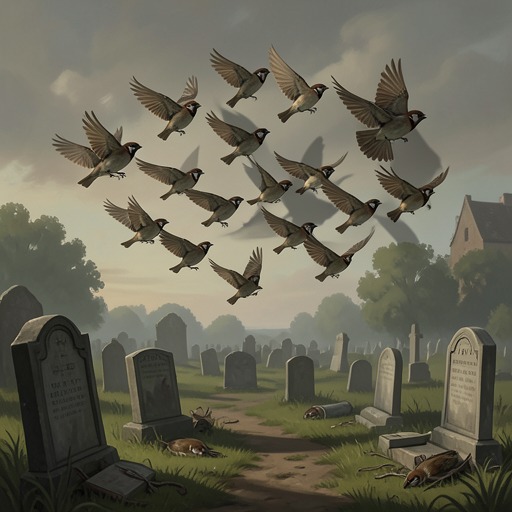
Sparrows carry a more unsettling association. According to Rawlie’s source, gatherings of sparrows are outriders of the deceased: their task is to guide lost souls back into the land of the living. Rawlie gives this role a concise, ominous formulation, calling the sparrows harbingers of the living dead. His scholarship supplies Thad not just with an evocative label but with a way to interpret the birds’ recurrence in relation to George Stark and the boundary between life and death.
The distinction between the birds’ folkloric roles matters to the plot. Thad is not asking about an abstract symbol; he needs to understand a phenomenon that has become entangled with real danger. Rawlie’s answer provides a framework, but it does not make the sparrows ordinary or controllable. The lore points toward what they do while preserving their frightening independence.
Practical Help and the Sparrows
When Thad eventually needs to leave, Rawlie agrees to lend him his car. Thad’s relief is physical: he closes his eyes, stiffens his knees to keep them from buckling, and wipes sweat from his neck. Rawlie jokes that if Thad is a fugitive from justice, his insurance company may not cover damage to the car. He declines Thad’s offer of money, claiming that a summertime English teacher like himself must have more than forty dollars, and promises instead to present a cab receipt later.
Rawlie has also stopped at the five-and-ten to buy Thad sunglasses and a Boston Red Sox cap that will cover his hair. He hands them over in a paper bag. Thad is absurdly touched by this modest, practical kindness. Rawlie says that the emergency has finally given him an excuse to use his old car after ten months of waiting for something sufficiently apocalyptic; his humor does not diminish the fact that he has recognized Thad’s need and prepared to help.
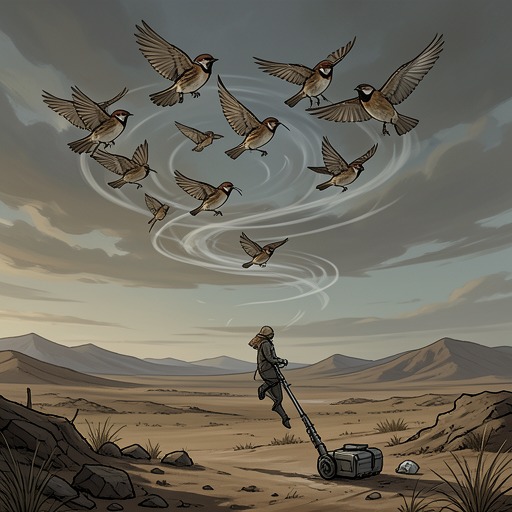
At Gold’s Junkyard and Auto Supply, Thad tells Rawlie to find George Stark. The cars and trucks across the back ten acres are carpeted with silent sparrows, which Thad says are looking only at him. At his command, the birds rise as a single dark cloud and fly west. Rawlie has seen the flock, but the birds respond to Thad, not to him. The moment gives concrete force to the folklore Rawlie has uncovered: the birds are not merely subjects of academic description, and their presence has become an active part of Thad’s pursuit.
Knowledge, Limits, and Narrative Role
Rawlie’s contribution spans several kinds of assistance. He takes Thad’s question seriously, searches a reference book, offers to call with his findings, lends him transportation, and supplies a cap and sunglasses. He is not a police investigator or a participant in Thad’s confrontation with Stark; his importance lies in recognizing that the apparently eccentric inquiry has weight and in offering help without demanding that Thad first explain everything.
His folkloric account also anticipates the final cost of Thad’s reliance on the birds. At the climax, the sparrows arrive to escort Stark back to the land of the dead, as the psychopomp tradition predicts. Afterward, when a sparrow’s action prompts Liz to ask why it behaved that way, Thad thinks Rawlie would have understood the warning: no one controls the agents of the afterlife for long, and there is always a price. Rawlie is not present to deliver that caution in the final scene, but the rule belongs to the knowledge he helped bring into focus.
The contrast between Rawlie’s comic pipe-and-professor exterior and his discernment gives his role its particular shape. He can seem directionless, yet he reads Thad’s evasions; he treats folklore as a field of study, yet the lore becomes consequential beyond the classroom. His learning helps Thad act, while its central lesson denies the fantasy of mastery. The sparrows may answer Thad’s call, but they remain agents in their own right, and the help they give cannot be separated from the danger of summoning them.