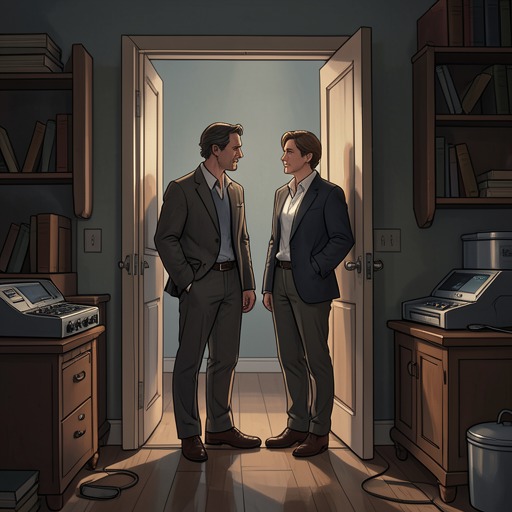
Rick Cowley and Miriam Cowley
The Dark HalfRick Cowley and Miriam Cowley are divorced spouses whose connection survives in a close working partnership and the prospect of getting back together. Miriam’s murder by George Stark turns that unfinished possibility into permanent loss: Rick identifies her body, receives a call from the killer, and must face a future in which his grief is only beginning.
A Marriage That Continued as a Partnership
After their divorce, Miriam remained Rick’s business partner at Cowley Associates. The arrangement was described as unusual, but the two got along very well. Their professional collaboration therefore preserved an active bond after the marriage had ended; they were not simply former spouses who had gone their separate ways.
The possibility of reconciliation remained between them. Alan Pangborn reported that Rick and Miriam had spoken of it from time to time, and with considerable longing. Their relationship held two truths at once: the marriage was over, but neither the working partnership nor the hope of renewed intimacy had erased their attachment.
That distinction matters when the threat reaches the agency. Frederick Clawson asked Miriam whether George Stark was really Thad Beaumont. She answered with a deliberately absurd joke about having divorced James Madison, Thad divorcing Liz, and herself and Thad marrying in spring, then hung up. She went to Rick’s office to tell him that someone in Washington, D.C., was probing Thad’s concealed identity. When Clawson continued calling, the agency gave him only quick hang-ups. The response shows Miriam acting independently to protect the secret while also bringing the danger to Rick’s attention; their business partnership puts them in the same chain of events that will destroy their private future.
Murder and the News of the Loss
Miriam was killed in her apartment by Stark, who had come to her door while posing as part of the effort to locate Thad. Rick was elsewhere and did not witness the attack. He learned the outcome from Pangborn, who told Thad that Rick was safe in his apartment and under police protection, and that he would soon travel to identify Miriam at the Borough of Manhattan Morgue on First Avenue. The same call made clear that the reconciliation they had both longed for would never happen.
Pangborn also said that the police had withheld Rick’s connection to Miriam’s murder from him pending developments. That decision meant Rick was initially protected from some investigative information, even as he faced the immediate fact of her death. When Thad asked how she had been killed, Pangborn answered that her throat had been cut. The account gives the relationship’s ending a blunt finality: the possibility of reunion is not resolved by a choice between them but taken away by violence.
Rick’s Grief and Stark’s Call
Less than three hours after identifying Miriam’s body, Rick sat in his apartment, exhausted, red-eyed, and half-drunk. He struggled to believe that the events were real: the morgue visit, the death, and the police posted outside his door because the killer might come after him as well. When the telephone rang, he answered in the hope that it might offer a reprieve from the nightmare. Instead, Stark identified himself as the man who had killed Rick’s woman and told him to ask Thad who he was. The call connected Miriam’s death directly to the larger danger surrounding Thad while making Rick, too, a target of the killer’s intimidation.
After the call ended, Rick lowered the telephone into his lap and burst into tears. At nine that morning he called the agency and told Frieda that she and John should go home; no one would work that day or for the rest of the week. Asked why, he said that Miriam had been killed in her apartment the previous night. He was close to tears again as he told Frieda that it was true.
Rick’s grief is not presented as a simple declaration of idealized love. He remembers Miriam as difficult and sweet in her own way, and says inwardly that he had loved her. The coexistence of those qualities gives weight to the relationship’s earlier possibility of reconciliation: their bond was not made uncomplicated by the prospect of returning to one another, but it remained meaningful despite its imperfections.
Consequences and Narrative Significance
The call from Stark changes Rick’s position from bereaved survivor to a person directly threatened by the murderer. Rick tells the police what happened; they take the call seriously, inform headquarters, and arrange to fit his telephone with recording and traceback equipment in case Stark calls again. Rick has intended to contact Thad, but first tells the police, caught in a state of shock that has altered the scale of what he can understand.
Miriam and Rick’s story ends without the reconciliation they had discussed. Her death leaves Rick with the immediate work of identifying her, informing colleagues, and cooperating with police, while the killer’s voice prevents grief from remaining private. Their relationship thus marks a cost of Stark’s campaign beyond its threat to Thad: an unfinished marriage and a shared professional life are abruptly converted into bereavement, fear, and a future Rick knows will contain many more tears.