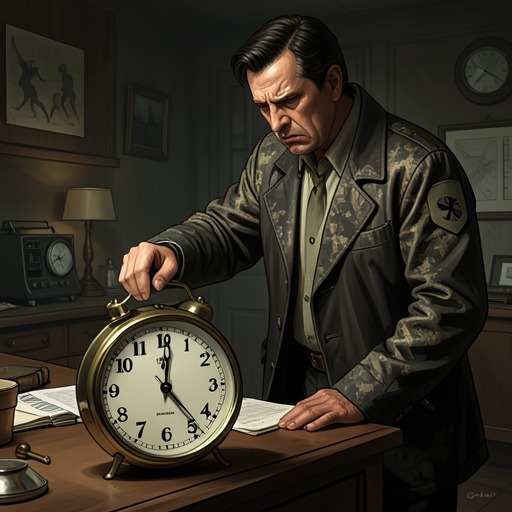
Stark’s one-week grace period
The Dark HalfStark’s one-week grace period is a temporary reprieve that functions as a threat’s timetable: George Stark gives Thad Beaumont seven days to begin a novel about an armored-car heist, then treats the week’s expiration as grounds to attack Thad’s family. The interval does not soften the ultimatum. It makes the danger measurable, and forces Thad to decide whether to write, resist, or seek some clue to Stark’s vulnerability before the clock runs out.
The Offer and Its Conditions
On the evening of June 10, Stark tells Thad he will give him a week to get started. He insists that Thad already has an idea for a story involving a wedding and an armored-car score, an idea that predates the blackmail that helped bring their conflict into the open. Thad answers that the notes Stark threw away were his, but that notes are unnecessary and the book could still be good. The supposed latitude is therefore narrow: Stark is not asking Thad to invent a project from nothing, but to put an existing premise into motion.
The week comes with a precise minimum and a brutal enforcement mechanism. If Thad has not produced at least thirty pages of manuscript by the deadline, Stark says, he will come for him—but not first. He threatens to kill Thad’s children slowly, then his wife, and finally Thad himself, promising an agony beyond anything any man has suffered. The order makes the ultimatum more than a demand for work: it turns Thad’s own delay into a danger he imagines his family will pay for before he does.
Thad tells Stark that George Stark is dead, rejecting the premise that the threat can compel him. Stark counters that Thad is the one who does not understand. Their exchange leaves the interval suspended between two incompatible claims: Thad names Stark as dead, while Stark speaks as an active power capable of reaching the Beaumont family. The week is the measure Stark imposes on that contradiction.
The Deadline Expires
As the days pass, Thad does not start the novel. He can see more clearly how the armored-car story might develop and has even dreamed about it, but recognizing a possible book is not the same as giving Stark the required pages. By the morning after the week has run its course, Thad’s first thought is that he is over the deadline. The reprieve has ended without producing the manuscript Stark demanded.
The missed deadline immediately changes the purpose of Thad’s next move. He decides that he has to speak to Stark again, despite not wanting another of their nightmarishly intimate conversations. Thad hopes that an angry, uncontrolled Stark might let something slip if Thad can goad him far enough. He believes Stark may already have revealed something when Thad’s hand intruded into his journal and wrote “Losing cohesion,” but Thad cannot be sure what those words mean. A mistake in interpreting them, he recognizes, could cost more than his own life.
Thad’s Countermove
Thad drives to the University of Maine and heads for his office in the English-Math Building. Collecting Honors files is part of the trip, but not its real purpose: the office has a telephone Thad believes is not tapped, and he needs a way to contact Stark. The expired week therefore sends him toward a deliberate confrontation rather than the manuscript Stark demanded.
Thad has already learned that a telephone is not the only channel between them. He once tried to contact Stark through his own body, plunging a sharpened pencil into the back of his hand as his uncontrolled body hurt itself under Stark’s command. The physical pain was not the full cost. Thad considers the arrival of the sparrows the deeper price: their presence has made him fear that the forces at work exceed even Stark. He increasingly associates the birds with death but does not know whose death they signify. The deadline and the mystery of the sparrows thus converge: both press Thad toward action, while neither tells him what the consequences will be.
The Call After the Week
Once Thad reaches the telephone, Stark confirms that the week is over and complains that Thad has done nothing. Stark’s voice has grown hoarse and rough, a change that makes Thad wonder whether it would still match the voiceprints exactly. His response is a refusal, not a belated attempt to bargain: whether Stark gives him a week, a month, or ten years, Thad says, he will not write the novel, and insists that Stark is dead and should remain so.
Stark answers that Thad is wrong, keeping the confrontation open rather than resolving it. The call supplies no evidence that the promised violence has already occurred; instead, it marks the point at which the grace period has expired and the threat is renewed. The week has served Stark as coercion, but its expiration also lets Thad turn the demand into a test of Stark’s composure and a chance to pursue whatever “Losing cohesion” might mean.
Narrative Function
The interval links a concrete writing demand to an escalating supernatural contest. Stark’s minimum of thirty pages makes the coercion specific, while the threatened sequence of deaths reveals what he means to do with the time he has allotted. Thad’s failure to begin the manuscript does not make the week uneventful: he watches the possible story take shape, dreams about it, and considers what his earlier contact with Stark has cost him.
The deadline also structures a reversal in agency. Stark sets the week to force Thad toward the typewriter, but after it expires, Thad uses the missed demand as a reason to seek Stark out and provoke him. His refusal does not make his family safe, and his theory about the words in his journal remains uncertain. The grace period ends, then, not in a clean release from the ultimatum but in a telephone confrontation shadowed by the birds, the threatened manuscript, and the still-unanswered question of what Stark has begun to lose.