Steel Machine manuscript
The Dark HalfThe Steel Machine manuscript is the physical and imaginative ground of Thad Beaumont and George Stark’s last confrontation: a story they write together, though not for the same purpose. Thad opens a notebook to a blank page and begins with a scene from the novel; Stark takes up the writing in turn, entering the fictional world as Alexis Machine. As the pages fill, the manuscript becomes both a collaboration and a means for Thad to steer Stark toward the sparrows. Its final appearance is not as a finished book but as handwritten sheets lifted from the burning house and charred in the night.
The Notebook and the Opening Scene
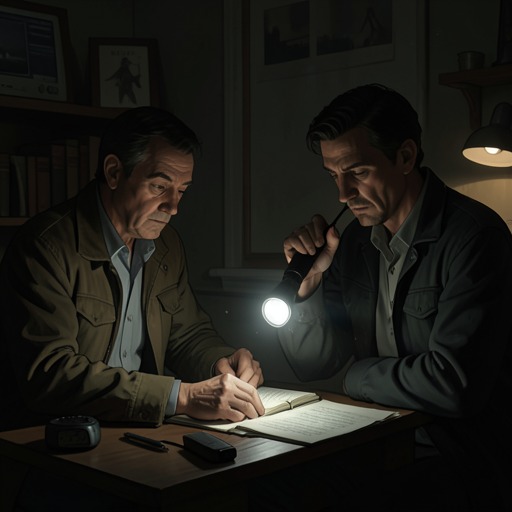
After Liz closes the door and leaves the two men alone, Thad looks at a blank notebook page, picks up a sharpened Berol pencil, and tells Stark he will begin with the cake. Stark agrees with visible eagerness. The opening installment identifies the manuscript as Steel Machine by George Stark and begins with Chapter 1, “The Wedding.” Its central figure, Alexis Machine, finds himself inside a moving wedding cake, holding a Heckler & Koch .223 semiautomatic weapon. The cramped, precarious setting establishes the kind of action story that Stark wants to inhabit: Machine cannot breathe deeply without risking the cake’s structure and the bride and groom standing above him.
The manuscript is not being composed under ordinary circumstances. Thad’s part of him that wants to write Steel Machine protests, even as he bends over the page and fills it. Later, he admits that he wants a drink, and Stark recalls that Thad had quit. Thad acknowledges that he was wrong, takes a drag, and turns the notebook toward Stark with an invitation to continue. Their exchange makes the writing’s divided ownership plain: Thad supplies the opening and gives up the pencil, while Stark receives the story as something he can resume from within.
Alternating Authors, Shared Story
Stark reads Thad’s last paragraph, though there is little need to read further because both men already know how the story proceeds. The scene has Machine waiting to get out of the cake, with armed allies inside the house preparing to cover his retreat. The manuscript thus offers Stark an established fictional route and a temporary focus beyond the real room where he and Thad sit.
Thad feels sympathy for Stark despite everything he knows about him. He recognizes that the difficulty of beginning does not disappear with experience: the page’s words do not grow darker, but its blank space seems to grow whiter. He tells Stark that the only way to do it is to do it. Stark checks Thad’s last paragraph twice, then begins writing. The words form slowly in Thad’s mind as Stark puts them down; after nearly half an hour, Stark sets down the pencil, satisfied with what he has made.
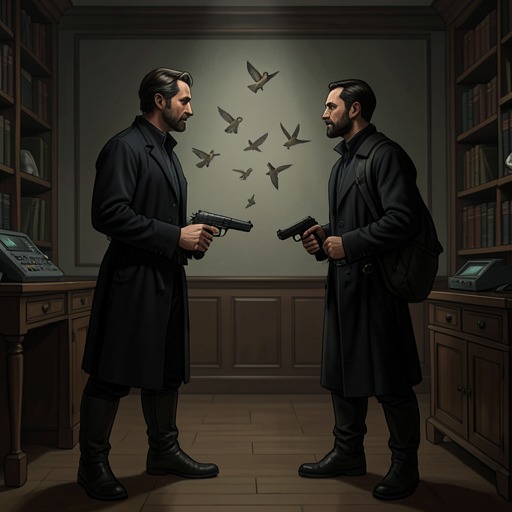
Thad does not stop at Stark’s own assessment. He picks up the notebook and reads all nine pages, looking for a particular development. On the third page, he finds the guests at the wedding pushing their folding sparrows along the tables and applauding the sparrow cake. The manuscript has brought the sparrows into Stark’s story, but Stark has not understood what that repetition means. Thad recognizes that the word is appearing again and again without Stark grasping its significance. The fictional scene is therefore doing double work: it continues the action Stark wants to write while carrying a signal that Thad can read more clearly than its author.
The Manuscript and Their Changing Bodies
Writing in the fictional world of Alexis Machine coincides with a change in Stark’s physical condition. While Stark is absorbed in the story’s violent world, his sores begin to disappear; damaged skin grows pink and starts to knit together, his eyebrows return, and the discharge on his shirt dries. Thad notices that Stark looks better, then touches a sore beginning on his own temple. When he checks again, his forehead is smooth and the small scar from the operation performed in the year his real life began has vanished.
The manuscript’s effect is not presented as a simple exchange of pages for health. Instead, the scene links Stark’s recovery to the time he spends writing and shows a corresponding change in Thad’s body. That linkage intensifies the struggle over who controls the work: Stark’s renewed strength accompanies his absorption in Machine’s world, while Thad’s own body bears a sign of the connection. The notebook is at once a creative instrument and the setting for a contest whose consequences reach beyond the written narrative.
Thad’s Counterwriting
As the moment to act approaches, Thad finds that his desire to finish the book is weaker than it was when Liz and Alan left the study. He understands this as a separation: Steel Machine is no longer simply his book, and Alexis Machine belongs with the person who has possessed him from the beginning. Still holding the bird-call in his left hand, Thad bends over his notebook and writes, “I am the bringer.” The birds overhead stop shifting.
Thad then keeps Stark inside the world the latter is making. He grips the bird-call in his lips and avoids letting Stark look out from that world into reality. On a blank sheet, Thad writes the capitalized word “PSYCHOPOMPS,” circles it, draws an arrow beneath it, and adds “THE SPARROWS ARE FLYING.” As he writes, the sparrows fill his perception; the narrative locates the vision in Bergenfield, New Jersey, before correcting the apparent setting. The manuscript’s blankness has become an active space in which Thad places the words that direct the story toward the birds. His writing is no longer merely a contribution to Stark’s novel but a deliberate intervention in the boundary between fiction and reality.
Destruction and Material Afterlife
After the confrontation, the Toronado becomes a fireball and the flames catch the house. Thad and Alan watch the fire enter the study, where sheets of paper are pulled out of the opening by the draft. Alan can see longhand writing on them as they crinkle, catch fire, char, and rise above the flames. He thinks that ordinary breezes may carry them away, perhaps even to the ends of the earth. Thad raises his hands over his face.
The manuscript’s ending is thus a physical destruction witnessed by the characters, not a report of a completed novel’s publication. Its pages become visible as handwritten objects only at the moment they are lost, rising from the burning study like dark birds. The image answers the story’s recurring presence of sparrows without equating the pages with the birds: the manuscript is consumed, while its words disperse beyond the house. As a material object, it has served first as the surface of collaboration, then as the means by which Thad redirects Stark, and finally as one of the things the fire carries out of their shared space.