Thad Beaumont—Liz Beaumont marriage
The Dark HalfThad Beaumont—Liz Beaumont marriage is defined by a division of creative labor that neither spouse allows to be simplified: Liz suggests the pseudonym that releases George Stark, but Thad insists that the public story belongs to both of them. Their marriage is also the place where the consequences of that invention are felt most plainly—in Thad’s difficult work, Liz’s watchful care, their shared relief at Stark’s death, and the ordinary routines of raising their twins.
Partnership and the Making of George Stark
The marriage enters the public record through a People magazine profile that revisits the creation of George Stark. Asked whether he regrets what happened, Thad first corrects the premise: he says he did not do it alone, but that he and Liz did it together. The correction is more than a courteous acknowledgment. It rejects the idea that the pseudonym was simply a private act of male authorship, even though Thad was the writer who brought Stark into being.
Liz’s account supplies the specific beginning. When Thad was suffering from serious writer’s block, she suggested that he try writing a novel under another name and see what happened to it. Yet she does not claim sole credit for the result. She describes Stark as already present in Thad’s unfinished work, waiting to emerge. In their different accounts, the pseudonym is both a deliberate shared experiment and something that seemed to precede its formal invention.
The profile’s photograph makes their collaboration visible while withholding the work itself. It shows Liz offering Thad a pan of brownies as he sits at his typewriter, but the page in the machine cannot be read. The image stages companionship beside solitary labor; in practice, Thad says, writing is hard work, and he cannot do it with an audience, especially a photographer from People watching. The domestic gesture is therefore not proof that Liz participates in every writing session. She knows when to keep her distance, and Thad distinguishes that care from the more public image of a wife bringing treats to her author husband.
Work, Publicity, and Domestic Life
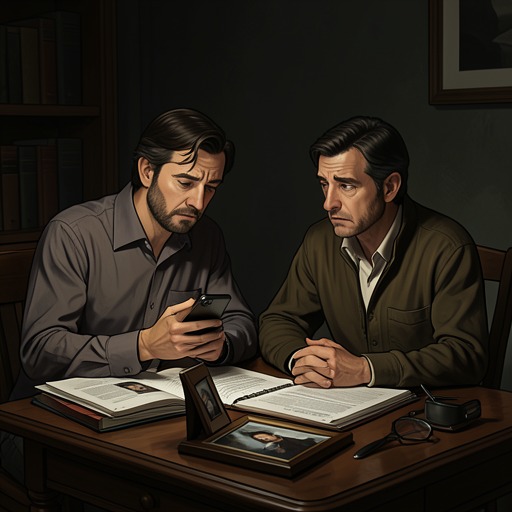
The spouses’ conversation about the profile moves between unease and playfulness. Liz asks whether Thad is sorry about what happened, while keeping an ear out for the twins, who are sleeping. Thad handles the question by insisting on their shared part in the story. When the exchange turns light, he gently holds her hand and asks whether she minds the publicity. Liz says she does not, and jokes that it may help The Golden Dog when he finally gets serious about finishing it. Her support is affectionate but not presented as a solution to his writing difficulty: the unfinished novel remains unfinished.
Their intimacy appears through small, specific gestures rather than grand declarations. Thad tells Liz he loves her; she answers in kind, then goes to get the twins while he returns to the profile. In another moment, they take the babies to their bedroom and change their wet diapers side by side, with Liz moving a little faster. Such household work places the public story of Thad’s authorship alongside the shared, unglamorous work of caring for William and Wendy.
That ordinary rhythm is not free of strain. Liz’s smile after saying that the People appearance is over does not quite convince Thad, though he chooses not to press her. He recognizes that he can pick at her when he feels uncertain, and that his persistence sometimes brings tiredness into her eyes. Their marriage is thus not rendered as effortless agreement: Liz can have reservations she leaves unspoken, and Thad knows that his own habits may burden her. Still, the scene turns back toward tenderness and cooperation rather than confrontation.
Stark’s Death and the Marriage’s Boundary
The couple’s clearest agreement concerns the distinction between Thad and the persona he created. Liz says it is good that George Stark is dead and admits that she did not like him much. Thad understands without requiring her to specify whom she means, and agrees. The exchange draws a firm boundary between her husband and the threatening figure associated with his writing: her dislike of Stark is not a rejection of Thad.
That distinction also sharpens the meaning of their shared responsibility. Liz helped set the pseudonym in motion, but the book does not make her responsible for Stark’s methods or collapse her judgment into Thad’s. She can acknowledge that the experiment was theirs while feeling relief that Stark is gone. The marriage holds both facts at once: creative partnership made the double possible, and intimacy depends on recognizing that the double was not simply another name for the man she married.
The Public Story and Private Knowledge
The People profile frames the couple for an audience, but its claims do not exhaust what their private exchanges show. It reports that writers were concerned about Thad’s sanity during the years after his first book and that one believed he might have attempted suicide after The Sudden Dancers received more critical acclaim than financial reward. Thad rejects that account in the interview, calling suicide a foolish idea and identifying writer’s block as the real problem. The contrast places the marriage within the pressures of Thad’s public career without establishing that Liz confirms the profile’s speculation.
Instead, the private scenes show Liz responding to the person she knows: she proposes a way to restart his writing, gives him room to work, joins him in the publicity surrounding the profile, and shares the practical care of their children. Thad, for his part, names their creative history as joint and returns to her with affection. Their marriage is neither a simple cure for his block nor merely a backdrop to the creation of George Stark. It is the relationship that makes the authorship shared, keeps the public narrative answerable to two perspectives, and preserves a personal distinction between Thad and the dangerous identity his work released.