Thad Beaumont’s childhood brain surgery
The Dark HalfThad Beaumont’s childhood brain surgery is the medical and bodily origin of the novel’s central mystery: an operation for what doctors first assume is a brain tumor reveals that part of Thad’s twin survived in his brain. The surgery explains his childhood headaches and convulsion, while the later return of the sparrow sounds that preceded them makes the removed tissue’s history part of a larger, unresolved pattern.
Symptoms and Emergency
The crisis began in 1960, when Thad was eleven. In August he developed headaches that worsened from mild pain into prolonged, devastating attacks; by October, the agony was so severe that he feared he might not survive it. The headaches were usually preceded by a sound only he could hear, like the distant cheeping of many small birds. His mother took him to a doctor, but the symptoms continued.
Four days before Halloween, Thad convulsed in the driveway while waiting for the school bus. His mother ran out but was afraid to touch him. The bus driver, who had served as a medic in Korea, opened Thad’s airway before he choked on his tongue. An ambulance took him to Bergenfield County Hospital, where neurologist Hugh Pritchard happened to be working in the emergency room. After examining X-rays, Pritchard told the family that the sudden headaches and absence of earlier seizures suggested a probably small, hopefully benign brain tumor.
The Operation and Its Discovery
During surgery, Pritchard and his colleagues found an extraordinary structure rather than an ordinary tumor. Thad’s brain was gray with a faint rose tint, and a malformed, blind human eye protruded from the dura, pulsing with the brain and seeming to wink. The team also found part of a nostril, three fingernails, and two teeth, one with a small cavity. Pritchard removed the foreign tissue with a needle-scalpel; the probing and excision took twenty-seven minutes, and five pieces of flesh fell into a stainless-steel pan beside Thad’s shaven head.
Pritchard explained that the mass was not cancer. In some pregnancies, a child begins as one of twins and absorbs the other fetus; in Thad’s case, part of the twin had remained unabsorbed and lodged in the prefrontal lobe. Such tissue usually stays inert. Pritchard believed that a growth process that should have stopped before Thad’s birth had somehow started again, increasing pressure inside the skull and causing the headaches and convulsion. He could not explain why the tissue had resumed growing. He considered the excision of the rare, apparently benign mass successful, while choosing not to explain the twin discovery to Thad’s father.
Later Recurrence and Retrospective Meaning
The operation did not settle the significance of the birds. Years later, Thad recognized that their sound had been a sensory precursor to the headaches: while discussing the old illness, he clarified that the auditory sensation was specifically sparrows. The distinction tied the bird calls to a physical crisis that had preceded the surgery, rather than to a vague memory or ordinary background noise.
In 1988, after the sounds recurred twice without a return of the headaches, Thad consulted Dr. Hume. He reported the bird sounds and the history of the 1960 tumor removal, but withheld his trance state, what he had written during it, and the writing found on a murder victim’s apartment wall in Washington, D.C. He tried to dismiss those events as remote and dreamlike; Dr. Hume took the recurrence seriously and ordered cranial X-rays and a CAT scan. The contrast left Thad’s medical history relevant but incomplete: the familiar warning had returned, while the symptoms and explanation no longer aligned neatly.
Pritchard later gave Alan Pangborn the fuller account of the childhood operation: the presumed tumor had been Thad’s twin, whose incomplete absorption and unusual growth spurt had produced the crisis. That disclosure made the surgery more than an episode of successful treatment. It supplied a bodily history for the split at the center of Thad’s later conflict, without explaining why the tissue had resumed growing or why the birds returned.
The Operation’s Lasting Mystery
The surgery removed the growing tissue, but it did not make the sparrows an incidental detail of Thad’s childhood illness. When he later explained the episode, he identified the sound before his headaches as an auditory sensory precursor and specified that it was sparrows. In 1988, after hearing the sounds recur twice without the headaches returning, he told Dr. Hume about the episodes and the tumor removed in 1960. He did not disclose his trance, what he had written in it, or the writing found on a murder victim’s apartment wall in Washington, D.C. Although Thad tried to treat those events as distant and dreamlike, Dr. Hume took the bird sounds seriously and ordered further brain imaging. The old medical warning had returned, but without the symptoms that had once given it a clear explanation.
Recurrence and the Birds’ Agency
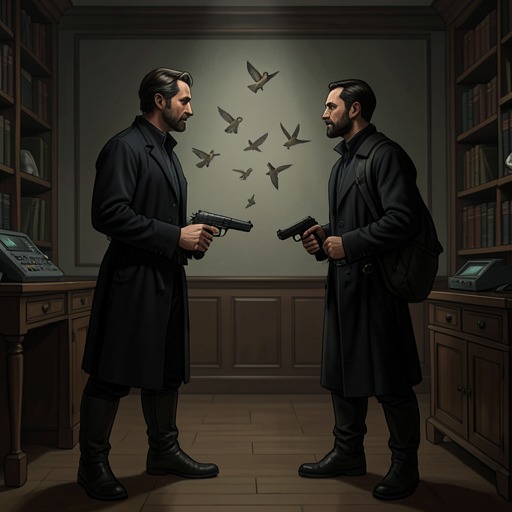
The later flock scenes enlarge the meaning of the childhood auditory precursor without supplying a medical explanation for it. At Gold’s Junkyard and Auto Supply, Thad and Rawlie DeLesseps find the vehicles across the back ten acres carpeted with silent sparrows—so many that they have gathered without Thad hearing them arrive. Rawlie recognizes them as psychopomps, beings associated with the passage to death. The episode turns the birds from a private symptom into a visible, collective presence, while their silence preserves the unsettling difference between what Thad once heard and what others can now see.
The flock’s presence is selective and watchful rather than merely atmospheric. When Alan Pangborn encounters the birds at the Williamses’ driveway, one lands on his shoulder, hops onto his hand, and stops before pecking his palm; he lets it go, and it rejoins the others. They stare back with bright, senseless eyes, while nearby trees appear full beneath their weight. Alan retreats toward Lake Lane and concludes that the birds do not want to come closer yet, as though the slope were a staging area. Their restrained approach gives the gathering the quality of an organized presence, but the scene does not establish that Thad commands it.
On the road to the house, Thad encounters a clean boundary where the flock begins, less than twelve feet ahead of his stopped Volkswagen. A sparrow settles on the hood and peers inside; Thad senses its dispassionate curiosity and understands that reaching the house means driving over birds that have become the road itself. The scene brings the earlier bodily history into direct contact with the present crisis: the sparrows that once announced pain now obstruct movement and force a choice, without making their purpose fully legible.
At the end, their role becomes explicit. As the door opens and the flock grows from a river into a flood, Thad understands that the psychopomps have come to escort George Stark back to the land of the dead. Sparrows settle on Stark’s shoulders, arms, and head, then strike his chest in increasing numbers as he twists against them. The childhood operation had removed the twin tissue but left the bird sound’s significance unexplained; the final escort gives the flock a concrete function in the novel’s supernatural action, while preserving the distinction between that later function and any proven medical cause for Thad’s original symptoms.