Thad and Stark’s voiceprint comparison
The Dark HalfThe voiceprint comparison between Thad Beaumont and George Stark is an attempted forensic test of whether the two men can be distinguished by sound. Its result is strikingly inconclusive in the technical sense but powerful in its implications: two sheets of recorded voice patterns appear nearly identical, and their only visible differences occur at moments when Thad is emotionally strained. The comparison makes the uncertainty surrounding Stark harder to contain within ordinary investigative explanations.
Background and stakes
Earlier evidence had already linked Thad to crimes attributed to Stark. Investigators found numerous fingerprints on Homer Gamache’s truck, including unusually clear impressions attributed to the perpetrator; one had been made in blood on the rearview mirror. When the prints were processed, Thad’s service record and fingerprints came back. Thad challenged the inference, asking whether the quality of the prints itself might be suspect and reminding Alan Pangborn that Maine required six perfect points of comparison for a fingerprint to be admitted as evidence. The fingerprint evidence thus raised an unresolved question: was someone imitating Thad, or did the apparent match point to a more unsettling connection?
The voice comparison extends that inquiry from physical impressions to speech. By this stage, Thad has described Stark as a figure with a short fuse and a dangerous temperament, while also supplying specific identifying details: Stark is tall, broadly built, blue-eyed, and blond, and was born in New Hampshire before moving with his mother to Oxford, Mississippi. Thad’s description gives the investigators a concrete profile, but the voice test bears on a more fundamental issue than appearance: whether Stark’s voice can be separated from Thad’s.
The comparison and its result
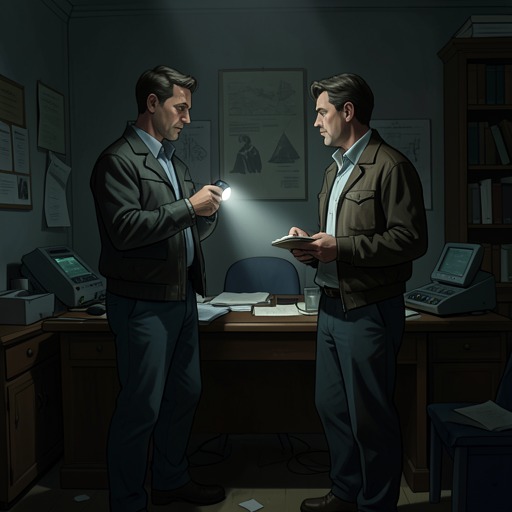
The voice-print results arrived shortly after eight in the evening. Rather than the complicated graphs Thad expected, Pangborn showed him and Liz Beaumont two sheets of plain white paper, each marked by a single line. The patterns were mostly irregular sine-waves, with occasional groups of spikes. Viewed side by side, they seemed identical or very close to it.
Pangborn placed one sheet over the other and held the pair to the light. The overlay made the resemblance immediately legible: the lines matched so closely that Liz remarked on their sameness. Pangborn then pointed out three small differences where the lower sheet showed through. All three occurred at spikes rather than along the otherwise closely matching wave pattern.
Those deviations corresponded to moments when Thad’s speech was stressed: his angry challenges and objections during the conversation under examination. Stark’s portions, by contrast, contained no comparable stress-points. Pangborn explained that officials were concentrating on the minute differences because they wanted to retain the assumption that two different people had spoken. Yet the pattern itself offered little support for a clean separation between the voices. Thad observed that Stark had sounded calm throughout, a contrast that helped account for why the few discrepancies appeared on Thad’s side of the comparison.
The search for an alternative explanation
The authorities did not stop at visual comparison. After the expert in Augusta examined the prints, the recording was sent to Washington for further analysis. A copy of the tape was transported from Bangor on a commuter flight and examined with an audio enhancer, a device used to determine whether a person had spoken the words in question or whether the voice being heard came from a tape recording.
Pangborn acknowledged that officials at State Police Headquarters did not really believe the two prints represented different voices, despite the small variations. The technical follow-up gave them a possible alternative to confront: perhaps Stark’s side of the exchange had been recorded in Thad’s voice and played back. Thad understood that logic and suggested the enhancer had been used in the hope that Stark’s contribution would turn out to be a recording made by him. The test therefore did not simply compare two speakers; it also tested whether an apparent second voice could be explained as a technological reproduction.
Consequences and significance
The comparison left investigators caught between what they could see and what they wished to conclude. The small deviations offered a limited technical foothold, but their concentration at Thad’s stress-points made them less persuasive as evidence of two separate speakers. The near-identity of the voice patterns, together with the search for a recording-based explanation, kept open the possibility that Stark’s speech was somehow Thad’s own voice rather than an independently produced one.
The result also gives the novel’s broader identity conflict a measurable form. Stark’s voice carries a trace of a Southern accent, and when he later speaks to Thad by telephone, the accent remains while the performed country-bumpkin quality has disappeared. The voice can be modified in its social presentation, but the comparison suggests that beneath those changes the vocal pattern remains extraordinarily close to Thad’s. In a plot already testing the boundary between the author and the figure created under his pen name, the sheets of matching lines turn that boundary into a problem of evidence: the more closely investigators examine the voices, the less securely they can treat them as separate identities.