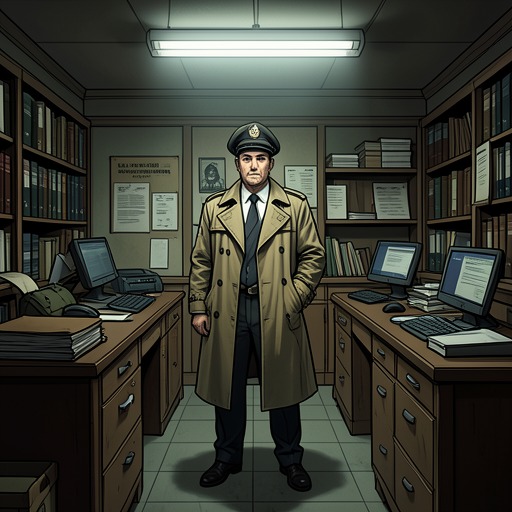
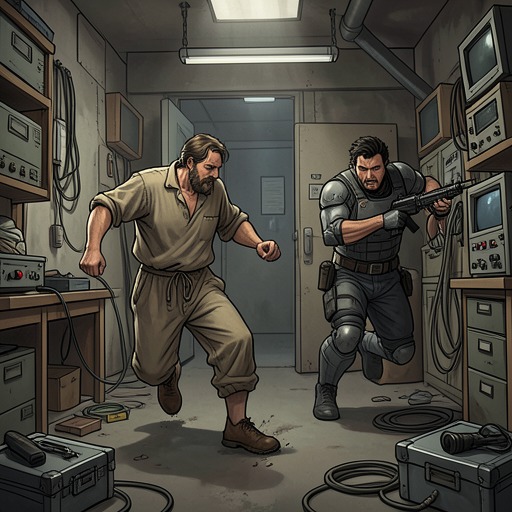
Thad evades his police escort
The Dark HalfThad Beaumont’s escape from his police escort turns the act of imagining a story into a practical means of survival. With Harrison and Manchester following him and George Stark threatening his family, Thad breaks from the route he is expected to take, hides the conspicuous Suburban in Gold’s junkyard, and disguises it as wreckage. The maneuver buys him a chance to act, but its urgency comes from the lives at stake: Liz and the twins may be killed if he fails.
The plan takes shape
As Thad turns left onto College Avenue and leaves the campus behind, he tells himself to pretend that what is happening is a book he is writing—and that he is a character in it. The thought interrupts the panic that had been churning through his mind. Instead of being trapped inside an immediate crisis, he can picture people and events as things he might arrange, much as he arranges characters on paper in his study. The fragments of a possible plan settle into a form he believes might work.
The imaginative shift does not make the danger less real. Thad understands that failure could put him in protective custody while leaving Liz and the children exposed to Stark. As he approaches the school zone, his fear returns physically, like a hot wire in his gut. He checks the rearview mirror: the brown Plymouth carrying Harrison and Manchester is still two cars behind. For a moment, he considers stopping and telling Harrison plainly that Stark has his family and that the sparrows are still flying. Instead, he proceeds with the escape.
Breaking the escort
At a busy four-way stop, Thad joins the line of southbound traffic and keeps checking the Plymouth’s position. The intersection’s ordinary, awkward turn-taking supplies an opening: a Grant’s Dairy tanker is about to cross east-west just as Thad can move north-south. He waits until the tanker rolls across and blocks the Plymouth from his mirror, then floors the Suburban’s accelerator.
Thad takes a right onto a short street, drives quickly through it, and makes successive turns to return to Route 2 roughly a quarter of a mile north of the intersection. He has deliberately doubled back. If the tanker concealed his turn, Harrison and Manchester may still be heading south, unaware that he has left their route. Thad does not assume the deception will last: he doubts Manchester might catch on, but recognizes Harrison as less likely to be fooled.
He cuts across a narrow gap in traffic, forcing a southbound Ford to brake, and heads back toward Gold’s. The risk of attracting a passing police officer matters less than getting the vehicle off the road. He watches the rearview mirror through the half-mile drive to the junkyard entrance; the Plymouth remains out of sight when he turns in.
Disappearing into Gold’s
Gold’s is a sprawling automobile junkyard, its rows holding nearly twenty thousand cars in various stages of decay. Thad’s gray Suburban with brilliant red sides is conspicuous enough to stand out on the road, but inside the yard he hopes its size will be less of a liability. It is Saturday, near the lunch hour, and he enters through an open gate marked for employees, conditions that make it less likely he will be noticed immediately.
He drives between wrecked cars stacked two and sometimes three deep. The setting offers concealment, but the Suburban’s appearance remains a problem: it is too large and too bright to pass as part of the wreckage. Thad decides that hiding it is not enough; he has to make it look damaged.
Making the Suburban a wreck
Thad finds a rusty motor-mount on the oily ground and uses it to batter the vehicle. Singing snatches of “John Wesley Harding” under his breath, he thinks of the extra time even a little camouflage might give him—and of that time as potentially decisive for Liz and the twins. He throws the heavy metal part into the driver’s side, denting it deeply, then strikes the grille hard enough to break its plastic. He raises the hood slightly, giving the Suburban another mark of damage.
He throws the motor-mount once more, sending it through the windshield. The impact pains him despite the necessity of the act. His wounded hand has begun bleeding through its bandage, but he cannot stop to deal with it. When he judges that the Suburban now looks sufficiently like the other wrecks, the escape has changed from a fast drive to a calculated act of concealment: Thad has sacrificed the vehicle’s intact condition to make it disappear in plain sight.
After the break
Thad walks back along the row toward the gate and the retail parts shop, where he remembers seeing a pay telephone. Halfway there, he stops singing and listens—not for an approaching car, but to his own body. The crawling, itching sensation that had been troubling him has disappeared. The immediate evidence of pursuit is also absent: the brown Plymouth was nowhere to be seen on his return to Gold’s. But his escape remains a precarious interval, not a resolution. He has evaded Harrison and Manchester for the moment and hidden the Suburban; the larger danger to Liz and the twins, held by George Stark, is still what drives him onward.