Thad’s drive through the sparrow swarm
The Dark HalfThad’s drive through the sparrow swarm is a harrowing passage to his family’s besieged summer house and the point at which folklore becomes an immediate physical ordeal: silent birds open a road beneath his wheels, then seal the world behind him. Their selective, unsettling response makes the journey less a triumph over nature than a test of whether he can proceed without believing himself its master.
Folklore Becomes a Physical Threat
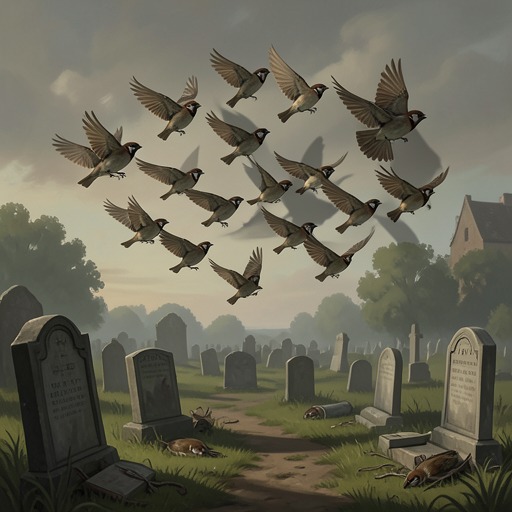
Before the drive, Thad had asked Rawlie whether he still taught his Folk Myth seminar, presenting a story idea as his reason for asking. Later, Rawlie drew him back into the office to explain what he had found about the sparrows. In Barringer’s folklore, Rawlie said, gatherings of sparrows were the outriders of the deceased: psychopomps whose task was to guide lost souls back into the land of the living. The explanation gave a name and a terrible direction to the birds that had already intruded on Thad’s life.
The swarm’s scale makes that account difficult to keep at the level of metaphor. At Gold’s Junkyard and Auto Supply, sparrows carpeted the stacked dead cars and trucks, but Thad and Rawlie had heard none of them arrive. Later, one bird landed on Alan Pangborn’s shoulder; when Alan brushed at it, it hopped onto his hand and paused with its beak lowered toward his palm. The other birds remained close, while the trees beyond Lake Lane bent under their weight. Alan guessed that they were holding back, as if the slope were a staging area. The birds behave not as a panicked flock but as a presence that can gather, wait, and approach.
The Road Is Replaced
Thad encounters that presence on Lake Lane, a mile-long approach from Route 5 to the Beaumont summer house. He stops less than a tenth of a mile along it. Trees, rocks, and open ground are covered; the road has disappeared beneath a silent, jostling surface of sparrows. A sharp line marks where the mass begins, and a bird descends onto the hood of Rawlie’s Volkswagen, seeming to regard Thad with dispassionate curiosity.
The obstacle is also a warning about what may lie ahead. Thad wonders whether the birds reach the house and whether George Stark has seen them. The car cannot take another route: the flock occupies the road itself. To reach the house, Thad understands, he will have to drive over the birds. His imagination supplies the crushing bodies, blood, and feathers that the wheels might leave behind. He knows what the choice costs even before he makes it.
A Passage Opened by the Flock
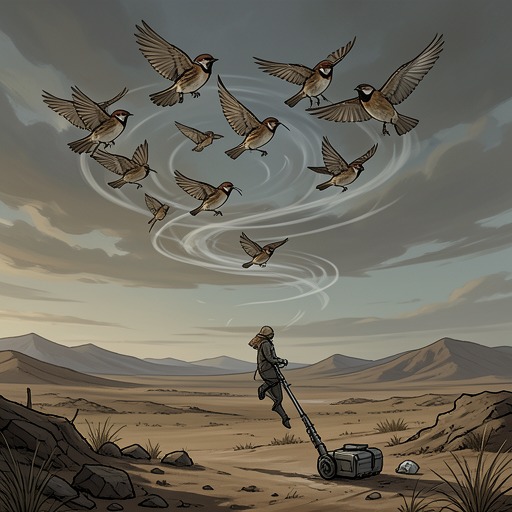
Thad mutters that he is going because he has to, shifts the balky Volkswagen into first, and begins to hum “John Wesley Harding.” In that moment, his grimly focused expression recalls George Stark, the dangerous double whose presence has made the journey necessary. The car chugs forward with three backfires. Thad expects the sparrows to rise in a vast dark cloud, as they do in his trance-visions, but they do not take flight. Instead, birds withdraw from the road’s surface, leaving two bare strips aligned precisely with the Volkswagen’s wheels.
Thad creeps down the hill, and the birds continue opening a path before him. The passage seems to divide one world from another: he thinks of the sparrows as sentinels guarding the border between the living and the dead. He cannot precisely remember the rest of the drive; afterward, his mind draws a curtain over it. Repeating to himself that they are only sparrows does not lessen the strain of seeing them everywhere, packed onto branches and fallen logs. The flock’s sheer number overwhelms ordinary perception, making the route feel less like a road through a landscape than a crossing into an alien one.
The scale stays impossible to measure. Thad wonders whether there are millions or billions. Passing the Williamses’ house, he sees only a feathery mound where the A-frame stands and does not know that Alan Pangborn’s cruiser is in the driveway. He passes the Saddlers’ and the Massenburgs’ homes, then reaches a second straight-edged boundary: four hundred yards from his own house, the birds stop. Six inches beyond their mass, the road is bare. Once again, they move aside to reveal the tracks of the wheels, and once again their arrangement looks deliberate rather than accidental.
The Cost and Purpose of Continuing
Once clear of the flock, Thad stops, gets out, and vomits. He is sick with sweat and sees behind him a black, silent world waiting along the road. The physical reaction is part of the passage’s cost: the birds have let the car through, but the crossing has left him shaken and unable to treat the experience as a manageable spectacle. The path’s opening offers access, not safety or mastery.
Thad decides the birds will wait, and that he will wait too, until he knows the right time to act. If he cannot do it for himself, he will do it for Liz and the twins. He tries to make the coming danger bearable by pretending it is a story he is writing, one with no birds in it. Then he starts driving again and resumes singing “John Wesley Harding” under his breath. The song and the imagined story are small acts of self-command, not explanations for the flock’s behavior; his purpose is simply to reach his family and endure what comes next.
The journey’s central reversal is that the beings Thad must pass through also make his passage possible. He fears crushing them, yet they clear a way beneath the wheels; they halt the swarm short of his house, yet their presence remains tied to what awaits him there. Their actions resist any easy distinction between obstruction and aid. Most decisively, when George Stark’s end comes, the psychopomps appear not merely as Thad’s obstacle or escort along the road, but as Stark’s escort back to the land of the dead. The drive thus prepares the flock’s final role: it is not a force Thad commands, but an agency whose arrival and destination exceed his control.