Thad’s sensory aura syndrome
The Dark HalfThad’s sensory aura syndrome is the recurring auditory and visual perception of sparrows associated with the headaches and seizure caused by foreign twin tissue growing in his prefrontal lobe. First understood as a neurological warning, the bird-sound later returns without the headaches and becomes difficult to separate from the story’s supernatural events: real sparrows appear at decisive moments, and their conduct seems to exceed ordinary flocking. The symptom is therefore both a bodily phenomenon with a clinical history and the earliest sign of a larger connection among Thad, his unabsorbed twin, and the psychopomps.
Onset and Medical Explanation
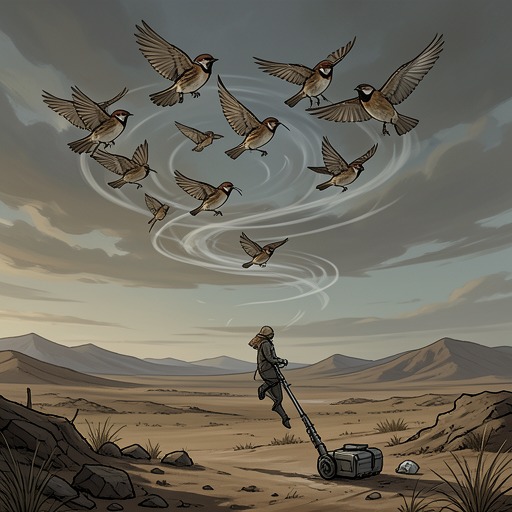
In 1960, when Thad was eleven, headaches that began mildly in August intensified after school resumed in September. By the end of that month he hoped the pain would kill him; by mid-October, as it worsened further, he feared it would not. The attacks left him lying in a darkened room, unable to do anything but endure them. Their approach was often marked by a sound no one else heard: distant, small birds cheeping. At times he thought he could see sparrows gathering on telephone wires and rooftops.
Doctors eventually found a mass in Thad’s prefrontal lobe and operated on what they assumed was a tumor. The tissue proved to be part of a twin that had not been absorbed during pregnancy. As Dr. Pritchard explained, twin absorption is common, but incomplete absorption is rare; the foreign tissue in Thad had begun growing again after remaining inert. Its position and growth caused intracranial pressure, accounting for the headaches and the seizure that brought Thad to the hospital. The diagnosis gives the bird-sounds a clinical frame without making the birds themselves part of the mass: they were Thad’s sensory precursor, the auditory warning accompanying a serious neurological condition.
Years later, Thad described the experience to Liz in those terms. Headaches and seizures can have sensory precursors, he explained, and while such precursors are often smells, his had been auditory. He specified that the sound was sparrows. That specificity matters: the symptom was not merely an indistinct noise, but a recurring perception attached to one kind of bird, a detail that later makes the real flocks harder to dismiss as coincidence.
Recurrence Without the Headaches
After experiencing the bird-sounds again, Thad sought medical advice from Dr. Hume. His medical records documented the 1960 operation, and he reported two recurrences of the sound that had preceded his earlier headaches. He told Hume that the headaches had not returned. Thad withheld other, more alarming information: he did not mention his trance, what he had written in it, or the words found on a murder victim’s apartment wall in Washington, D.C. The episodes already felt remote to him, almost dreamlike, and he was trying to minimize their significance.
Dr. Hume did not share that dismissal. He ordered a cranial X-ray series and a computerized axial tomography scan at Eastern Maine Medical Center that afternoon. The gap between the returned warning and the absent headache leaves the recurrence medically unresolved in the available account. It also marks a change in the symptom’s narrative force: what had once accompanied a demonstrable brain condition now reappears amid events that Thad conceals from his doctor and struggles to believe himself.
The Hospital Flock and Pritchard’s Memory
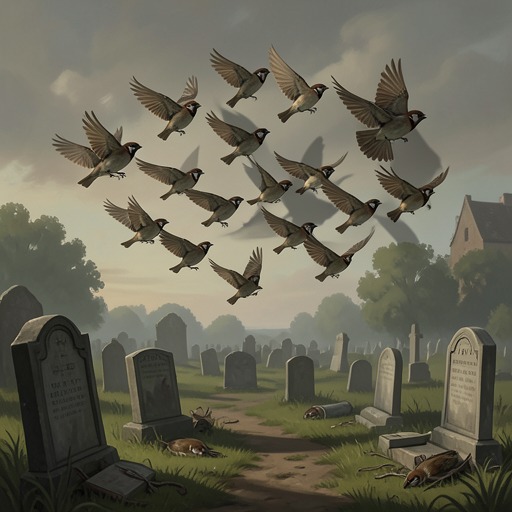
When Dr. Pritchard later explained Thad’s childhood case to Alan Pangborn, he recalled an extraordinary event at Bergenfield County Hospital. Shortly after Thad’s operation, a large flock of sparrows struck the hospital’s west side, where the Intensive Care Unit was located. The birds hit the windows at about 2:05 in the afternoon on October 28, 1960; Thad woke at about 2:10, possibly earlier. An ICU nurse believed the sound of breaking glass had awakened him. The collision injured two people with flying glass and frightened staff in the Hirschfield Wing.
Pritchard had not been present when the flock hit: after checking that Thad’s vital signs were stable, he had left to play golf. He nevertheless knew of the incident and compared its timing with the boy’s medical chart. An ornithologist offered a naturalistic explanation, suggesting that flocking birds coordinate through something like group telepathy, so that birds following one another might all fly into the glass. Pritchard could accept that account, but the coincidence remained troubling because he knew Thad’s sensory precursor was not simply birds in general. It was specifically sparrows.
Pritchard also said that Thad remembered the birds after surgery, rather than suffering the localized amnesia that can follow removal of the cause of a sensory precursor. Thad had reported seeing them as well as hearing them, covering the houses, lawns, and streets of Ridgeway, the Bergenfield neighborhood where he lived. The account thus places a vast real flock beside the private perception that had preceded his headaches. It does not establish that the flock caused Thad’s perception, but the near-simultaneous collision and awakening give the symptom a public, documented echo.
From Symptom to Supernatural Pattern
The hospital incident becomes part of Pangborn’s struggle to assess the evidence surrounding George Stark. Pangborn reflects that the flock cannot be explained any more readily than the matching fingerprints and voiceprints associated with Thad and Stark. He knows Thad shared the womb with a stranger, and remembers Pritchard’s suggestion that the foreign tissue’s growth might have coincided with the early onset of puberty. Pangborn then wonders whether it began growing when Thad began to write. This is a question raised by Pangborn’s reasoning, not a confirmed medical conclusion; its importance lies in how the symptom joins bodily history to the writer’s creative life and to Stark’s apparent existence.
The sparrows also recur beyond the childhood hospital episode. At Gold’s Junkyard and Auto Supply, Thad and Rawlie DeLesseps find birds covering the rows of dead cars and trucks stacked across the back ten acres. The flock has arrived without Thad hearing a single bird. At the lake, sparrows land on Alan’s shoulder and hand; when he brushes at the bird, it hops onto his hand, pauses with its beak lowered, then leaves him and joins the others. The birds’ quietness and their proximity make them present as animals, not just as a remembered sound or a figure of speech.
Their presence also appears selective. Alan sees them massed on the slope near the Williamses’ A-frame, but none on Lake Lane, and thinks the flock may be holding back as if at a staging area. On the road toward the house, Thad encounters a sharply bounded edge to the flock: a sparrow lands on the hood of his Volkswagen and seems to look in at him. He senses a dispassionate curiosity in its eyes, while recognizing that the birds have made the road itself an obstacle he may have to cross. These scenes give the recurrence a pattern of gathering, watching, and withholding that the original neurological explanation alone cannot settle.
The Psychopomps and the Ending
At the final confrontation with George Stark, the old symptom’s meaning turns outward. Thad recognizes the gathered psychopomps as Stark’s escort back to Endsville, the land of the dead. He drops his pencil and retreats toward his children as sparrows fill the air and the door opens. They settle on Stark’s shoulders, arms, and head, then strike his chest in increasing numbers. Stark twists and tries to fight them off as the birds overwhelm him.
The ending makes the birds more than a recurrence of Thad’s private warning: they act collectively in the events that carry Stark away. Yet the story preserves the distinction between what medicine can account for and what the flock does. The prefrontal mass explains the childhood headaches and seizure; it does not explain the later gatherings, their apparent restraint around Alan, or their role in Stark’s removal. The symptom’s lasting significance lies in that unresolved passage from internal sensation to external presence. Sparrows announce danger in Thad’s body, recur as real birds witnessed by others, and finally become agents in the supernatural order the medical diagnosis could not contain.