Thad's automatic writing pages
The Dark HalfThad's automatic writing pages are the physical record of a frightening connection between his fugue states, the sparrows, and George Stark. Their significance changes as Thad first tries to interpret them, then destroys one set to keep its contents secret, and later presents the recurring message to Alan Pangborn as evidence that something inexplicable is happening.
Appearance and Circumstances
In Thad’s study, amid manuscripts, correspondence, books, and galley proofs, the pages from his typewriter sit beside the manuscript of his new novel, The Golden Dog. His ordinary output is six pages; as Stark, he usually writes eight, sometimes ten. That contrast locates the automatic writing inside a room already crowded with the different forms of Thad’s authorship, but the strange words on the pages do not belong to a deliberate novel-writing session.
Thad gives a small stack of that day’s pages to Liz and explains that the sparrow sound came while he was working on them. It has happened for the second time that day, he says, and this episode was much more intense. Liz studies the top sheet for a long time. When she looks up, the color has left her face; she recognizes what is written there as the same message she has seen before. The pages make a private, baffling experience visible to another person, and her reaction confirms that the writing is not simply Thad’s ordinary work.
The Office Fugue and Its Destruction
During a later episode in his office, Thad returns to himself less than five minutes after the first isolated cries begin in his mind. He is sweating heavily, his left wrist throbs, but he has no headache. On his desk lies an order form for complimentary American literature textbooks, covered with words he does not understand. Some appear to have come from his dream of Stark; the rest are disconnected gibberish. The writing is legible as marks but offers no coherent explanation to its author.
Thad decides not to tell Liz about this episode. He wonders whether keeping it secret is necessary, but is too tired of fear and speculation to settle what the words mean. Instead, he acts on the desire to stop thinking about them: he tears the order form into strips, tears those strips across again, and throws the pieces into the wastebasket. For almost two minutes he watches them, half expecting them to reassemble and return to the desk. He then carries the wastebasket to the incinerator and empties it down the chute. Destruction does not solve the mystery; it removes the one material trace of the episode that he could have examined later.
Evidence Shared with Alan Pangborn
Thad eventually tells Alan Pangborn that the inexplicable events began, he thinks, when he was eleven. He recounts his childhood headaches and the shrill cries and muddy visions of sparrows that preceded them, then describes the birds’ return. He shows Alan a manuscript page bearing the words “THE SPARROWS ARE FLYING” in dark pencil strokes and explains the fugue in his office, the writing on the order form, and his decision to destroy it. The pages thus become part of a broader account connecting a childhood pattern to the current crisis, while the burned order form leaves Thad reporting an episode whose original evidence is gone.
When Thad tells Alan that he knows Stark is involved, he knocks lightly on his own chest. The gesture makes the relationship between the pages and Stark more than a question of handwriting or subject matter: Thad experiences the threat as bound up with himself. Yet the recurring words do not, by themselves, explain how the connection works. They preserve a message and a disturbance, not a complete account of their cause.
The Sparrows and the Limits of Interpretation
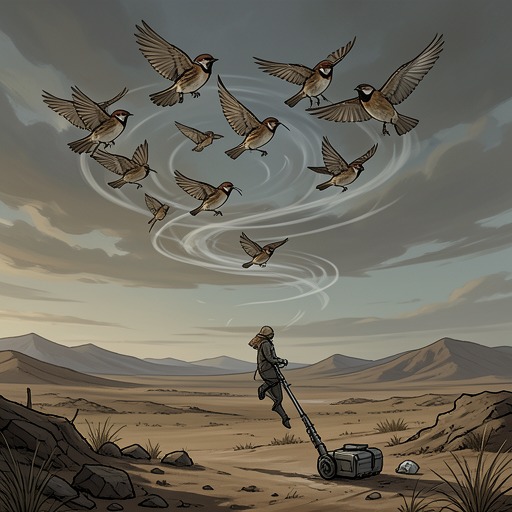
The manuscript message gains force against the sparrows’ increasingly uncanny appearances. At Gold’s Junkyard and Auto Supply, a vast, silent flock covers the dead cars and trucks stacked across the back ten acres. Thad and Rawlie DeLesseps find that the birds have arrived without Thad hearing them. Their stillness and numbers turn the sparrows from a sound in his head into a visible presence that fills a landscape.
Later, at the Williamses’ driveway, one sparrow lands on Alan’s shoulder. He brushes at it; it hops onto his hand, pauses with its beak lowered, then hops away and joins the others. The flock does not behave as a simple, controllable instrument: the bird’s brief proximity to Alan ends without attack, while the surrounding trees appear full of sparrows and a branch cracks under their accumulated weight. Alan retreats from the driveway and suspects that the birds are holding back, as if the area were a staging ground. The pages’ repeated message therefore accompanies an agency that exceeds what either Thad or the police can readily explain.
On the road to the Beaumont summer house, Thad encounters a sharply bounded mass of sparrows beginning less than twelve feet in front of his stopped Volkswagen. One bird settles on the hood and regards him with dispassionate curiosity. He understands that reaching the house may require driving over the flock, which has become not merely an omen beside the road but the road itself. At the climax, Thad recognizes the psychopomps as an escort for George Stark back to the land of the dead. The birds settle on Stark and strike his body in growing numbers, carrying the pages’ recurring message into a final action that Thad’s earlier writing could foreshadow but not command.