Thaddeus “Thad” Beaumont
The Dark HalfThaddeus “Thad” Beaumont is a writer whose life is shaped by the creation of George Stark, a successful crime-fiction pen name that becomes more than a literary identity. From his first recognized story as an eleven-year-old to the murders associated with Stark, Thad’s trajectory joins the problem of artistic invention to questions of responsibility, identity, and the boundary between fiction and reality.
Identity and Early Writing
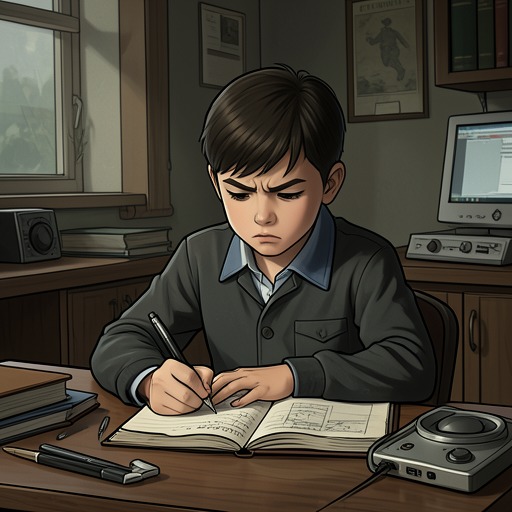
Thad grew up in the Ridgeway section of Bergenfield, New Jersey. The book marks 1960, when he was eleven, as the beginning of his real life—not merely his physical existence—because two events that year set the course of his future. In January, he submitted a story to a writing contest sponsored by American Teen magazine. In June, the editors awarded him an honorable mention in the fiction category, explaining that the story might have won second prize if he had been old enough to qualify as an American Teen.
The story, “Outside Marty’s House,” was praised as extraordinarily mature. Two weeks after the editors’ letter, a registered and insured package delivered a Certificate of Merit bearing Thad’s name in ornate Old English lettering and a gold seal with the magazine’s logo. The episode gives his eventual career a concrete beginning: before the invented crime writer and the danger that follows him, there is a child whose work has already attracted serious notice.
George Stark and the Work of a Pen Name
As an adult, Thad is a well-regarded writer. His first novel, The Sudden Dancers, was nominated for the National Book Award in 1972, but he published only one other novel under his own name. His far larger commercial success came through George Stark: Thad wrote one major bestseller and three successful follow-up novels under that identity. The contrast between literary recognition and popular success makes the pen name both a practical career achievement and a separate public self.
Thad has explained that choosing the name was difficult but important. He believed a distinct identity could break his writer’s block, giving the work a voice separate from his own. The name recalled crime writer Donald E. Westlake’s Richard Stark pseudonym and its novels about Parker, a professional thief with little apparent life beyond robbery. Thad was particularly struck by the contrast between Westlake’s writing under his own name and the Stark books, as well as by the idea that the pseudonym took over on rainy days. Thad associated his own period from 1973 to early 1975 with such rainy days.
The model also clarifies the fictional character George Stark’s tone. Thad describes Parker as almost a killer robot, governed by a single objective and a repeated demand for money. The interviewer recognizes that this description fits Alexis Machine, the central character of the first and last George Stark novels. Thad says that Machine’s Way began in a way that would have made publication feel like plagiarism, but that roughly a quarter of the way through it found its own rhythm. His account presents authorship not as a single, stable voice but as a process in which imitation can turn into an independent work.
Public Exposure and Police Suspicion
When Thad’s authorship of the Stark books becomes public, the story reaches beyond literary circles. His agent, Rick Cowley, passed the disclosure to Publishers Weekly with Thad’s approval, and an Associated Press reporter broadened its circulation. The coverage emphasized the disparity between the respected author and the commercially successful pseudonym. Thad resisted including Frederick Clawson in the account, regarding Clawson not as the subject of the story but as the person forcing them to reveal it.
A remark Thad made about his invented alter ego—that George was not a very nice guy—became the inscription on a fake gravestone commissioned after the story drew attention. The tombstone traveled from New York City to the Beaumonts’ summer home in Castle Rock, Maine. Its movement turns a casual description into a public emblem of the scandal: a fictional name, a real author, and a manufactured grave are placed together as if the boundary between them were already unstable.
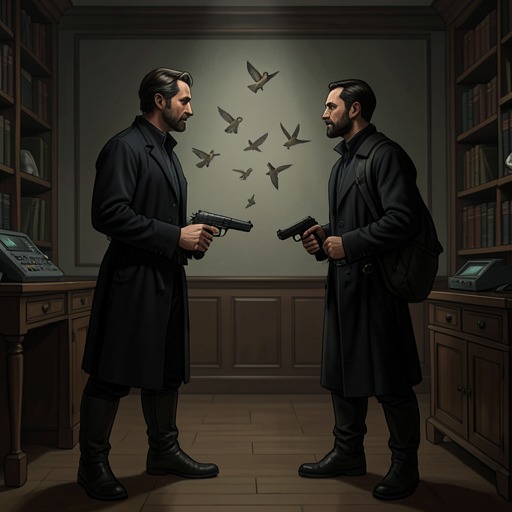
That instability becomes personal when Sheriff Alan Pangborn and state troopers arrive at the Beaumont home. Pangborn refuses Thad’s offered handshake and speaks to him as someone suspected of wrongdoing. Thad later describes how quickly his feelings shifted from curiosity to fear; for an instant, the officers’ manner made him feel as though he must have committed the crimes and would be unable to resist confessing. In another room, one of the twins begins to cry while Liz asks what is happening. Thad tells her to look after the children without taking his gaze from Pangborn, making the family’s exposure to the investigation part of the confrontation.
Thad answers suspicion with a deliberately elaborate reconstruction of the apparent case against him. He imagines Pangborn’s theory involving an identical twin who could host a party, sleep with Liz, and keep appointments while Thad traveled in Homer Gamache’s truck, switched cars at a Connecticut rest stop, went to New York, and then to Washington, D.C., where he killed Clawson before returning to Ludlow. He even includes the possibility that Liz helped conceal the scheme. Liz is surprised into hard laughter, and Pangborn responds with open surprise. The imagined alibi exposes the case’s dependence on the possibility of a double while also showing Thad using dark humor to challenge the accusation.
Fictional Violence and Real Consequences
The crimes attributed to Stark echo the conventions of the crime novels that made the name successful. Dodie Eberhart, a reader deeply attached to hard-boiled crime fiction, considers Stark one of the best writers in the field and has followed the novels from Machine’s Way through Riding to Babylon. Her literary preferences center on stories of robbery, violence, and criminal relationships; the Stark books therefore inhabit a recognizable genre tradition rather than appearing as an unrelated invention.
Yet the violence associated with Stark is no longer contained within books. Michael Donaldson’s murder shows Stark acting against a real person: he waits in the hallway outside Donaldson’s ninth-floor apartment and attacks when Donaldson returns. The intended assault does not proceed as Stark expected, and Donaldson manages to evade the first blow. The scene converts the planned, goal-driven violence of Stark’s crime-fiction model into an unpredictable real encounter. For Thad, the danger is not simply that readers confuse author and pseudonym; the identity he created has become connected to actions with consequences beyond the page.
Narrative Role and Significance
Thad’s character binds together several competing accounts of identity. He is the gifted child whose story wins recognition, the accomplished novelist whose own-name career is comparatively limited, and the author who constructs a second identity to overcome a creative block. The Stark books’ hard-boiled conventions offer a sharp contrast to the respectable public image attached to Thad’s own literary career, but that contrast cannot keep the two names safely separate once the pseudonym is exposed and linked to murder.
The book also uses Thad’s literary knowledge as a way to interpret events without allowing genre to contain them. His explanation of Parker and Alexis Machine makes the Stark persona legible as a fictional design: a figure driven by a narrow objective and shaped by crime-writing conventions. But the case involving Pangborn, the family at the Beaumont home, and Donaldson’s murder demonstrates the limits of that explanation. What began as a device for separating Thad from his work becomes the central threat to that separation, turning the act of naming an authorial double into a question of who must answer for what the double does.