The Beaumonts' lake house
The Dark HalfThe Beaumonts' lake house is both a family refuge and the final arena of George Stark’s attack: its rooms are arranged for a forced collaboration, its surrounding woods and driveway become a staging ground for the sparrows, and its destruction marks the end of Stark’s threat. By the time the flock descends, the house’s domestic spaces have become inseparable from the conflict between Thad and his dark half.
Setting and Domestic Space
The lake house stands beside Castle Lake, reached by the dirt track of Lake Lane. The approach is initially marked by a sharp boundary: the sparrows gather across the road, and Thad recognizes that reaching the house means driving over them. Their presence makes the route itself an obstacle, transforming familiar access to the family home into a passage through an unnatural mass of birds.
The building’s lake-facing rooms retain ordinary domestic functions, but those functions acquire new urgency during the siege. From the living room, one can look out over the lake; from the window-wall, Liz sees the deck, the slope to the water, and the sky beyond. That broad view first offers a connection to the landscape, then exposes the family to the approaching flock. The house is not isolated from the surrounding world so much as opened to it, with glass and windows unable to hold back what is coming.
The Study and the Doubled Writing Room
The small study is an interior space without windows, arranged around Thad’s desk and the conditions of his writing. Liz recalls that he once wished for a window there, imagining that he would write two words and then spend hours watching boats pass. In the final confrontation, however, the room’s significance lies less in a view than in its deliberately constructed symmetry.
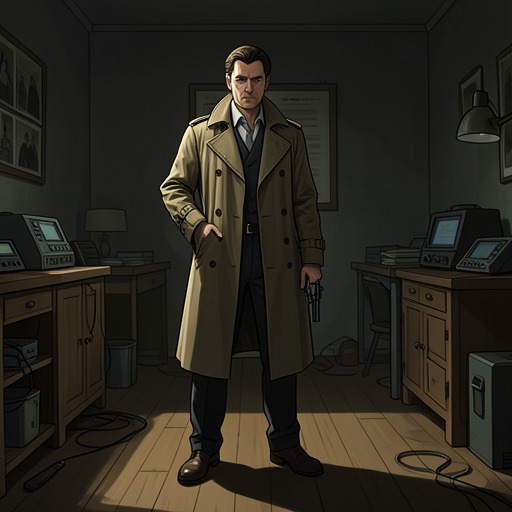
Thad sets two blank notebooks side by side beneath a bright quartz-halogen desk lamp. Two sharpened Berol Black Beauty pencils rest on each notebook, and two chairs face the paired writing stations: Thad’s office chair and a folding camp chair brought in from the hall closet. He has unplugged the IBM electric he sometimes uses and moved it aside. The resulting arrangement turns a solitary workspace into a visible double, making the room a concrete expression of the forced writing encounter between Thad and Stark.
The glass case at the study’s distinctive door is turned inward, creating two entrances separated by the case’s thickness. The altered doorway and duplicated furniture make the study feel split into parallel stations. Liz reads this arrangement as deeply unsettling, another version of the doubled creature she believes she has glimpsed. The room’s design therefore prepares the final confrontation through objects and spatial arrangement before the writing begins.
The Flock Closes In
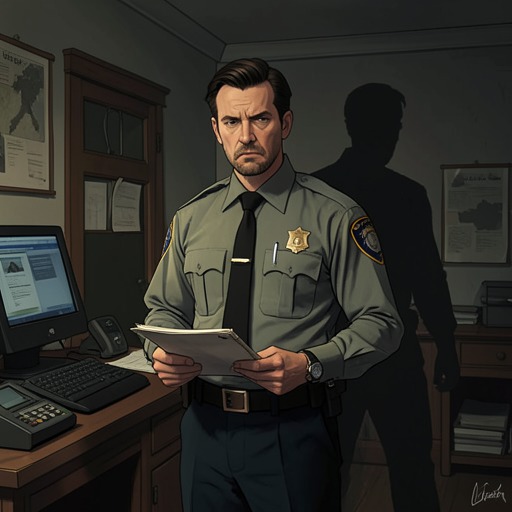
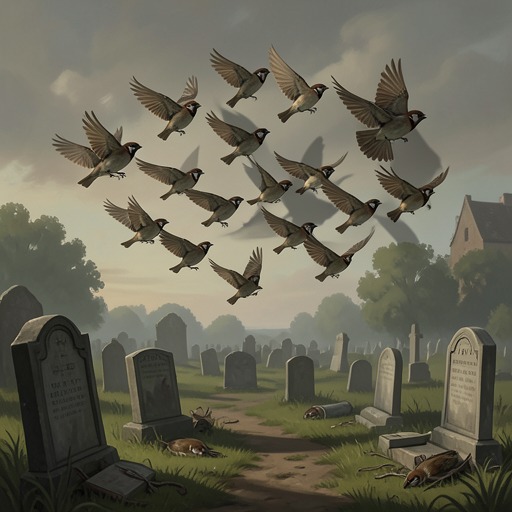
The sparrows’ approach is marked by an eerie combination of scale and quiet. At Gold’s Junkyard and Auto Supply, birds carpet the stacked wrecks across the back ten acres, yet Thad has heard none of them arrive. Later, Alan finds them gathered around the Williamses’ driveway and on his car. One lands on his shoulder, hops onto his hand, and pauses with its beak near his palm before joining the others. His brief, careful contact does not establish control: the birds remain watchful and inscrutable, while the trees around Castle Lake fill under their weight.
The flock appears to keep its distance from Alan on Lake Lane, as though the slope around the A-frame were a staging area. That apparent restraint only heightens the sense of purpose in its movement. When Thad approaches in the VW, the flock begins less than twelve feet ahead of him, ending at a boundary so clean it seems ruler-drawn. A sparrow settles on the hood and peers through the glass. Thad understands that the birds cover not merely the road but the route to the house itself, and that reaching his family will require crossing them.
At the house, the flock becomes impossible to mistake for a distant phenomenon. Liz looks through the window-wall and sees birds covering the deck and blackening the slope; more stream toward the lake house from the west until the sky is full of them. When a baby cries, Liz moves toward the sound rather than taking cover. Alan sprints across the room and tackles her just as the window-wall gives way under the weight of the birds. Thousands more follow, flooding the living room and breaking the other windows. Birds strike the smoke detectors and pots, pictures fall from the walls, and the television screen explodes. The house’s domestic interior becomes the site of a violent, engulfing incursion.
The House as Stark’s Last Arena
The flock’s arrival is bound to Stark’s presence in the house. Thad recognizes the sparrows as psychopomps—escorts carrying Stark back to the dead—and retreats toward his children as the birds fill the air. They settle on Stark’s shoulders, arms, and head, then strike his chest in growing numbers. The study, prepared as a paired writing room, thus becomes part of the same final passage in which the birds overwhelm Stark and carry him away.
The aftermath reveals the cost to the building. At quarter past nine, Thad and Alan stand beside Stark’s Toronado, now gray with bird droppings, while Liz and the twins wait at the top of the driveway where it meets Lake Lane. Alan cannot look away from the wrecked house. The east side, where the study is located, has borne the worst of the damage, though the whole building is shattered. Holes gape in the walls; the lake-side deck railing hangs down like a wooden ladder; broken glass catches the moonlight. Dead sparrows lie in drifts around the house, caught in the roof and packed into the gutters.
Narrative Significance
The lake house gathers the novel’s opposing meanings of home. It is where Thad’s family is held under threat, where Stark tries to force a return to writing, and where the last struggle ends. Its ordinary details—the sofa facing the lake, the kitchen drawer holding a butcher-knife, the study lamp and pencils—become parts of a space under siege, but the house is not merely a passive backdrop: its layout shapes Liz’s plan, the writing-room arrangement stages the doubled conflict, and its exposed windows determine how the flock enters.
Its destruction also gives the ending a visible boundary. The sparrows that first appear as a silent, inexplicable presence at the junkyard and along the road finally enter the home in overwhelming numbers; after they take Stark away, the building remains splintered and ringed with dead birds. The family survives at the edge of the ruined property, while the house bears the material trace of the supernatural conflict that has passed through it.