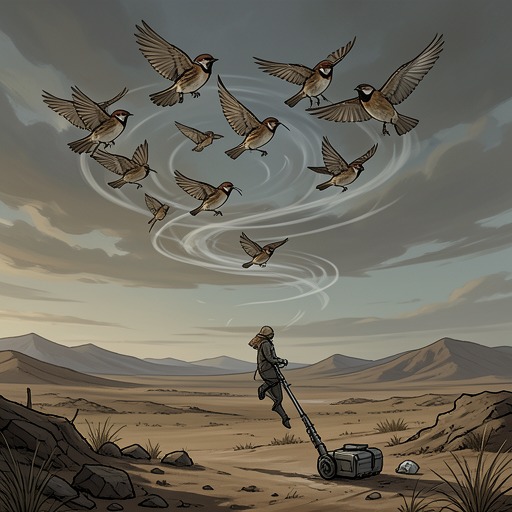
The Harbingers of the Living Dead
The Dark HalfThe Harbingers of the Living Dead is Rawlie DeLesseps’s name for the ominous role folklore assigns to sparrows: unlike birds said to gather where death is approaching and guide the newly dead onward, sparrows are believed to lead lost souls back among the living. The phrase gives Thad Beaumont a framework for understanding the flocks following him, but its meaning remains uncertain until the birds converge on George Stark and escort him back to the land of the dead.
Folklore and Meaning
When Thad asks whether Rawlie still teaches his Folk Myth seminar, he offers a possible story idea as his reason. Rawlie later says he may have found what Thad is looking for. Consulting Barringer’s Folklore of America, he explains that sparrows, loons, and whippoorwills are psychopomps—conductors of souls between the living and the dead. In the account he cites, loons and whippoorwills gather near impending death and guide newly dead souls to their proper place in the afterlife; they are not birds of ill omen.
Sparrows, Rawlie adds, have a more ominous function. They are said to be the outriders of the deceased, guiding lost souls back into the land of the living. He calls them the harbingers of the living dead. His explanation is folklore, not a complete account of what Thad is experiencing, and Rawlie urges extreme caution because Thad appears to be in serious trouble.
Thad’s Encounters with the Flocks
After hearing Rawlie’s explanation, Thad sees sparrows lining telephone wires and the roof of the infirmary, with more arriving on a tennis court. They seem to be watching him. A flock then descends on Bennett Hall, and the word psychopomps makes the sight newly charged with meaning. The birds are not simply a remembered sound or a figure in a story: they gather in the visible world around him.
Later, the idea offers Thad a partial explanation for George Stark. Stark is alive again, yet dead and rotting; perhaps, Thad reasons, the sparrows guided him back from the land of the dead. But the fit is incomplete. Stark does not remember the birds, or writing the phrase “THE SPARROWS ARE FLYING AGAIN” in blood on the walls of two apartments. The folklore supplies a pattern without resolving the mystery of how the birds and Stark are connected.
The flocks recur in places where Thad encounters death’s traces. At Gold’s Junkyard and Auto Supply, among wrecked cars and engines, he sees sparrows perched close enough to touch and rubs the small white scar on his forehead as he recalls their ominous title. Later, the dead vehicles stacked across the junkyard’s back ten acres are carpeted with birds. Thad and Rawlie had not heard a single one arrive; the silent mass seems to have assembled beyond ordinary perception.
Agency and the Final Escort
The birds’ behavior complicates any idea that they are merely signs for human observers. At the Williamses’ driveway, one lands on Alan Pangborn’s shoulder, hops onto his hand, and pauses with its beak lowered as if to peck his palm. It then hops away and joins the flock. Alan’s gesture cannot drive the birds off. From Lake Lane, he sees them covering his car, while the road beyond remains clear; he wonders whether they are holding back, as if the area were a staging ground.
On the way to the house, Thad meets a sharp boundary: the flock begins less than twelve feet ahead of his Volkswagen, and birds fill the road itself. One flutters onto the hood and peers in at him. Thad fears Stark may have seen the gathering, but knows that reaching the house means driving over the birds. Their presence has become a physical obstacle, not just an omen or interpretation.
At the climax, the earlier folklore finds its clearest fulfillment. As the sparrows pour through the opened door, Thad understands them as George Stark’s escort back to Endsville, back to the land of the dead. They settle on Stark’s shoulders, arms, and head, then strike his chest in growing numbers. The phrase therefore does not simply predict that death is near: it names the birds’ collective action in removing a figure who is both living and dead. Yet their vast, coordinated arrival, their silent watchfulness, and their selective responses leave them more than a humanly controlled symbol. The folklore helps Thad recognize what is happening, while the birds themselves determine how the ending proceeds.