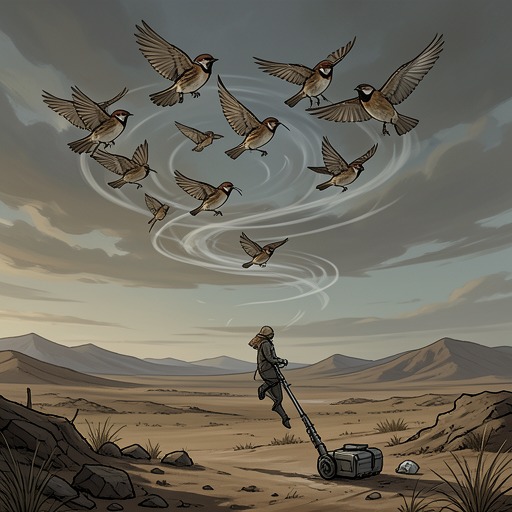
The sparrows return and trigger automatic writing
The Dark HalfThe sparrows’ return and the automatic writing it triggers mark the moment when Thad Beaumont’s childhood neurological history begins to recur as a present supernatural crisis. A sound once associated with agonizing headaches and a mass of twin tissue in his brain comes back without the headache; instead, it overwhelms his perception, briefly displaces him into the past, and leaves a warning written across the manuscript in a hand he cannot remember using. The episode joins a medical explanation to an increasingly uncanny pattern, and makes the birds—not merely a remembered symptom, but an active presence in the novel’s unfolding events—the signal of George Stark’s return.
The Childhood Warning and Its Medical History
In 1960, when Thad was a boy, severe headaches developed over the course of several months. They began mildly in August, became monstrous by the return to school in early September, and by October had grown so painful that he feared not only that he might die, but that he might not. Before the headaches, he often heard a phantom sound like the distant cheeping of thousands of small birds, which he imagined as sparrows gathered on telephone wires and rooftops. His mother took him to Dr. Seward, and a later operation revealed that the mass in his prefrontal lobe was not a cancerous tumor: it was part of his twin, incompletely absorbed before birth, whose tissue had begun growing again.
The adult Thad understands the bird sound as a sensory precursor to the childhood headaches and seizure. He describes it as an auditory warning associated with his brain tumor, rather than one of the more familiar sensory precursors involving smells. That history gives the sound two competing meanings when it returns: it can suggest a recurrence of the childhood condition, but it also carries an older, more disturbing significance that medical language alone does not settle.
The Sound Returns in 1988
The first recurrence arrives amid a day already unsettled by the police and their certainty in an accusation against Thad. During a conversation with Alan Pangborn, the bird sound suddenly fills Thad’s mind. Its familiarity reaches back nearly thirty years, and he touches the small scar on his head as the shiver intensifies. Inwardly, he calls on George Stark to provide him with an alibi, an appeal that links the strange sensation to the identity Thad had tried to separate from himself.
That evening, while proofreading the manuscript of The Golden Dog in his study, Thad hears the birds again. This time he sees them as well: thousands of sparrows crowding roof peaks and telephone wires, then lifting together into a darkening spring sky. The vision carries him momentarily back to the frightened boy who expected another headache and wondered whether the tumor had returned, perhaps malignantly. A guttural voice that does not seem to be his own says, “Gonna hook back north, hoss.” Then the birds vanish, and Thad finds himself again in 1988, in his study, with his wife, children, and typewriter. No headache follows. The expected bodily crisis does not arrive, but the experience has already crossed beyond an ordinary memory or symptom.
Automatic Writing and the Stark Connection
Looking down at the manuscript, Thad discovers large capital letters slashed across its neat lines: “THE SPARROWS ARE FLYING AGAIN.” The act is as unsettling as the message. He has no memory of writing it and no memory of exchanging his Scripto pen for one of the Berol Black Beauty pencils. The Berols belong to an earlier period of his life, and he has stopped using them; after writing the message, he puts the pencil back in its jar and hides the manuscript in a drawer. His hand is unsteady as he does so.
The scene makes the return of the birds legible as both a sensory event and an act of involuntary inscription. Thad’s mind supplies the vision and his hand supplies the words, but his conscious self cannot account for either. The exact phrase turns an otherwise private episode into a warning that can be read and remembered. It also recalls the public burial of George Stark: when Liz calls out that someone is back, Thad’s first terrified thought is Stark, although Stark is supposedly dead and had never existed as a real person in the first place. The bird message therefore binds the returning symptom to the threat Thad most fears.
Recognition, Denial, and Investigation
Thad does not immediately tell Liz what has happened. Fear that the childhood tumor has returned—and that it might now be malignant—helps seal his lips; the interruption of the doorbell and Liz’s exclamation that someone is back intensify the association with Stark. In the first instant before reality reasserts itself, Thad is certain that she means George. The episode is thus followed not by a settled explanation but by a collision between a plausible medical fear and the impossible return Thad senses in the birds.
When the sound recurs, Thad reports two episodes to Dr. Hume, who orders cranial X-rays and a CAT scan. Thad withholds the trance, the words written during it, and the writing found on a murder victim’s apartment wall in Washington, D.C.; he tries to dismiss the whole matter as if it were already a dream. Hume nevertheless takes the report seriously. This medical consultation preserves the distinction between what Thad tells a doctor—the familiar auditory warning, without renewed headaches—and what he conceals: an altered state and writing he cannot remember producing.
The novel later supplies further context for that distinction. Dr. Pritchard explains that Thad’s childhood mass was his incompletely absorbed twin and that such tissue usually remains inert, while the earlier account identifies renewed growth and intracranial pressure as causes of the headaches and seizure. The medical history can account for the childhood crisis and for why Thad recognizes the sound, but the 1988 recurrence comes without the old headache and produces a message tied to Stark. The return therefore reopens the medical explanation without allowing it to contain everything that follows.
From Private Omen to Collective Presence
The sparrows’ significance expands beyond Thad’s hearing and writing. Later, at Gold’s Junkyard and Auto Supply, sparrows cover the dead cars and trucks across the back ten acres; Rawlie DeLesseps and Thad see a silent multitude that has arrived without Thad hearing it. Rawlie connects sparrows, loons, and especially whippoorwills with psychopomps, guides of the dead, giving the birds a folkloric meaning that anticipates their eventual function.
The flock’s conduct is rendered as more than a human projection. A sparrow lands on Alan Pangborn’s shoulder, hops onto his hand, and pauses with its beak poised over his palm before rejoining the others. The birds fill nearby trees and crowd the area, yet appear not to approach Lake Lane too closely; Thad senses the road itself has become a barrier of birds, and a sparrow on his car’s hood seems to regard him with dispassionate curiosity. At the end, Thad recognizes the flock as George Stark’s escort back to the land of the dead. What began as a sound associated with a boy’s illness has become a collective force that acts in the present, resists human control, and carries the story’s threat toward its conclusion.