“the strawberry lark”
The Darling Buds of May“the strawberry lark” is the Larkin family’s seasonal strawberry-picking livelihood: at once a source of cash, a recurring family undertaking, and Pop Larkin’s shorthand for making an opportunity out of work. It connects the landscape’s crop calendar to the family’s finances and social life, but its apparent abundance is already undercut by disease and the prospect that the fruit trade will soon disappear.
Seasonal Work and Local Economy
The strawberry lark belongs to a wider sequence of seasonal picking and farm work. In a good summer, strawberries come first in June, cherries follow before the month ends and continue through July, and apples may begin before August, alongside early plums and pears. Apples are picked again in August and September; September also brings hops, and October potatoes. For a large family, the strawberry harvest alone could bring in fifteen pounds a day. This calendar makes the lark more than a single crop or brief job: it is the opening of a chain of seasonal earnings.
The family sees the work approaching in the fields themselves. Passing orchards and strawberry fields in sunlight, Pop Larkin points out the rows covered with fresh yellow straw and says that picking is only a few days away. When Montgomery Larkin later reports that work will begin on Monday at Benacre, Pop Larkin calls the start exceptionally early, crediting the weather with ripening the fruit. In this way the livelihood is governed by seasonal conditions as well as by family readiness: a change in the weather can move the harvest forward, and the family must respond when the crop is ready.
A Family Undertaking
Pop Larkin treats the strawberry lark as work everyone can join. As the truck passes the fields, he asks the children whether anyone wants to go picking. Later, once Cedric Charlton is drawn into the household, Pop Larkin urges him to come along too, presenting the work as an opportunity to earn money and eat as many strawberries as he likes. The invitation is characteristic of how the Larkins fold an outsider into their activities: work is offered not as a formal employment arrangement but as part of the family’s open-ended hospitality and collective routine.
That routine is reinforced by the contrast between the household’s generosity and the visitor’s obligations elsewhere. Cedric Charlton has come to the farm in his capacity as a tax inspector, and Pop Larkin tries to turn his attention away from paperwork and office life toward meals, drinks, a place to stay, and finally the strawberry harvest. The invitation to pick is one element in this wider welcome, but it also tests whether Cedric can be drawn into the Larkins’ alternative economy and way of life. His repeated anxiety about the tax form remains in tension with Pop Larkin’s insistence that the work—and the company—are more immediately compelling.
Disease and the Prospect of Decline
The apparent promise of the strawberry lark is qualified by Pop Larkin’s warning that it is nearly over. He attributes the end not to a lack of willingness to work but to disease: Sovereigns, Climaxes, and Huxleys are finished, he says, and soon there will be no strawberries anywhere. He broadens the warning beyond the local district, insisting that the decline is not confined to one place and predicting that within two years the strawberry lark will be finished. His account makes the crop’s vulnerability a threat to the family’s livelihood, not merely a complaint about a bad season.
Pop Larkin places strawberries within a larger pattern of failing fruit crops. The raspberry lark is also nearing its end, he says, because of mosaic disease and a weakening strain; the plum, cherry, and apple larks are in trouble too. Set against the earlier calendar of cherries, apples, pears, plums, hops, and potatoes, this catalogue of decline reverses the sense of seasonal continuity. The same sequence that once promised one harvest after another now suggests that the family’s familiar work may be closing down crop by crop.
Harvest, Earnings, and Its Afterlife
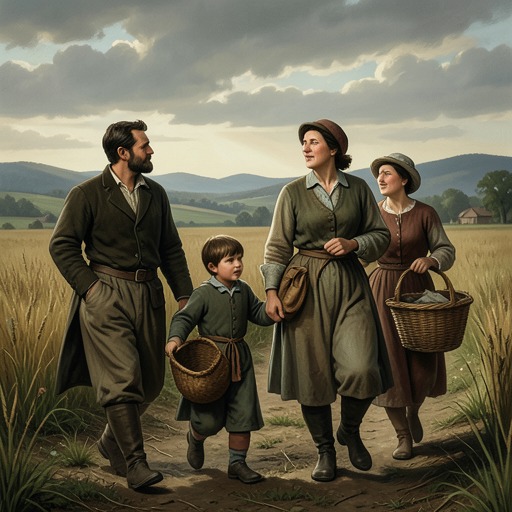
When the picking begins, the scale of the work becomes tangible. Cedric Charlton enters a field where twenty or thirty women and girls, with a few men, are already picking along the straw-covered rows. A green canvas tent stands among them, piled with fresh white chip baskets. In the unusual heat, the field is crowded with workers and voices, while Cedric bends to pick despite wishing for a cool place to rest. The scene gives physical form to the lark Pop Larkin has promoted: it depends on many hands, sustained work, and the shared organization of a busy harvest.
Cedric later helps in the tent, checking strawberries in and out and calculating that he has handled more than a ton in a single day. His trained attention turns the family’s activity into a question of quantity and financial accounting; he wonders what the tax position might be and assumes Pop Larkin will know. The contrast is pointed: Pop Larkin speaks of the harvest as an accessible way to earn, while Cedric instinctively measures its scale through records and obligations.
Pop Larkin’s sales pitch makes the earnings sound immediate and almost extravagant. At a cocktail gathering, he raises his glass to the strawberry lark and looks ahead to Monday’s picking. He tells Cedric Charlton that he could make fifteen or twenty pounds quickly, eat all the strawberries he wants, receive a pound free each day, and gather as much as a hundred and fifty pounds a day. The figures and inducements make clear why Pop Larkin regards the harvest as a valuable family opportunity, even as his earlier warning has established how precarious its future is.
The lark also becomes an emblem of Pop Larkin’s resistance to the structures that surround formal work and taxation. He calls national health provision another “lark” and urges Cedric Charlton to make use of it rather than remain at his office, while later mocking the prospect of working for decades to receive a pension he considers inadequate. After marrying Mariette Larkin, Cedric leaves his job at the tax inspector’s office and takes up more practical work with her. Pop Larkin gives the couple five hundred laying pullets to start an egg business; within a year, they have earned enough to buy another five hundred. That enterprise is not the strawberry lark itself, but its development shows the continuing force of the same family logic: identify a source of income, work it together, and turn an opportunity into a livelihood, even while Cedric continues to make proper income-tax returns—a habit Pop Larkin regards as misguided.
Significance
The strawberry lark gives the story a material seasonal rhythm. Its timing depends on ripening weather, its work fills the family’s days, and its income promises a return substantial enough to shape decisions. Yet the phrase carries a note of instability: the work Pop Larkin celebrates is also threatened by disease across several crops. The lark thus stands between abundance and disappearance, linking the family’s confidence in its resourcefulness to a countryside whose yields cannot be taken for granted.
The word “lark” also blurs the line between work and play in Pop Larkin’s vocabulary. He presents picking as a chance to earn, eat, and join the family, making labor sound like an inviting shared adventure rather than a narrowly defined job. Cedric Charlton’s movement from tax inspector to family participant gives that invitation a lasting consequence, while the eventual egg business carries its practical spirit forward. The strawberry lark is therefore both a specific harvest and a model for how the Larkins turn seasonal labor into belonging and enterprise.