Bluebell Wood
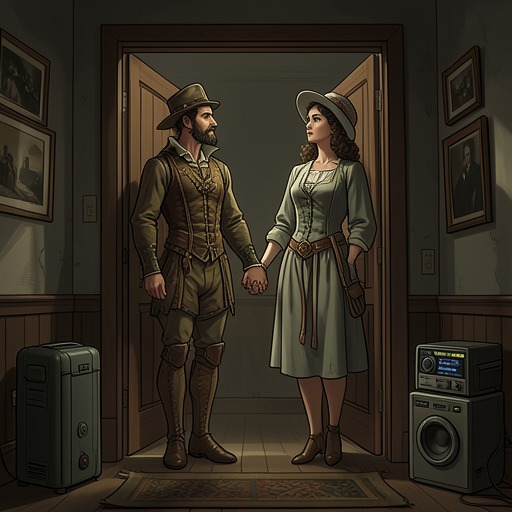
The Darling Buds of MayBluebell Wood is both a rural landmark and a repository of family history in the Larkins’ world. Ma recalls it as the place where she and Pop Larkin went, on a night just before Cedric Charlton arrived, to look for a supposed wild duck’s nest; she says that encounter dates the pregnancy Pop had not realized he had caused. Later, Pop proposes building Mariette Larkin and Charley a bungalow in the meadow near the wood, giving the remembered place a future as well as a past.
Setting and Seasonal Landscape
The wood belongs to a countryside organized by weather, crops, and seasonal work. Early in the story, the family’s truck passes strawberry fields between orchards whose branches are pink in the sunlight. Pop points out the straw laid over the rows and judges that the crop will be ready in a few days. His estimate leads into the annual round of picking: strawberries in June, cherries through June and July, then apples, early plums, and pears in good summers, followed by apples again, hops, and potatoes. Bluebell Wood is not described in isolation from this working landscape; its later role as a family destination sits amid a farm economy governed by the same seasonal rhythms.
The strawberry season is at once an opportunity and a source of uncertainty. At its peak, a large family could earn fifteen pounds a day from picking, but Pop also warns that disease has ended familiar strawberry varieties and predicts that the local “strawberry lark” will be finished within two years. When the first picking at Benacre is announced earlier than ever, he connects the early crop to warm weather. Later, an exceptional May heat bears down on the strawberry field: the previous day had been reported as the hottest May thirtieth in forty years, and the next day is hotter still. Mr Charlton counts more than a ton of strawberries through the tent in one day. Against this changing agricultural world, the wood serves as a durable point of orientation, its bluebells and meadow offering a setting not defined solely by harvest and income.
The Night Ma Remembers
At a family meal, Ma gives the wood its most intimate significance. Asked how far back the matter dates, she answers that it was “that night in the bluebell wood,” just before Mr Charlton came. Pop remembers going with her to see whether there was a wild duck’s nest there, but initially says he had not thought of the night in the way Ma has. Her recollection supplies the missing explanation: she identifies that visit as the occasion from which her pregnancy dates. The revelation turns an apparently ordinary excursion into a concealed hinge in the family’s history.
The scene’s force comes from the difference between what the two remember. Ma is certain of the date and gently practical even as she discloses it, telling Pop that he does not know his own strength before passing him more apple tart and ketchup. Pop’s surprise makes the memory newly consequential: what had been a search for a nest becomes the origin of a pregnancy he had not understood. The wood therefore holds a private past that the family’s lively present can suddenly bring into view, without changing the domestic, matter-of-fact tone in which Ma tells it.
A Place in the Next Generation’s Future
The wood recurs as a landmark in Pop’s offer to Mariette and Charley. Once Charley says he may lose his pension if he does not return to the tax inspector’s office, Pop dismisses the prospect of spending forty years at work for a small pension and proposes another course. He expects to undertake a demolition job at a large mansion and suggests using the best materials to build the couple a bungalow “in the medder, near the bluebell wood.” Mariette responds with delight, kisses Pop, and leaves Mr Charlton with nothing more to say.
The promise makes the wood more than a place associated with the older couple’s past: it becomes the intended setting for the young couple’s independent household. The plan is not immediately fulfilled. Later, Pop remains too busy with other ventures even to begin demolishing the mansion whose materials were meant for the bungalow, so the building must wait. That delay gives the place a prospective rather than completed role: the wood is named as the anchor of a future home, while Pop’s restless business keeps that future open.
Narrative Significance
Bluebell Wood links two moments of family formation across generations. Ma’s recollection locates the beginning of her pregnancy in a night shared with Pop; Pop’s later proposal places Mariette and Charley’s prospective home beside the same landmark. In the first instance, the wood protects a memory whose significance was not equally understood by the people who made it. In the second, it is invoked deliberately as a point around which a new household might take shape.
That double use distinguishes the wood from the surrounding fields. The fields are measured in crop varieties, picking dates, tonnage, and earnings; the wood gathers personal memory and future expectation. Its importance is conveyed through these two family narratives rather than through a detailed physical portrait. It stands at once for an unrecognized beginning and for a promised, still-delayed home.