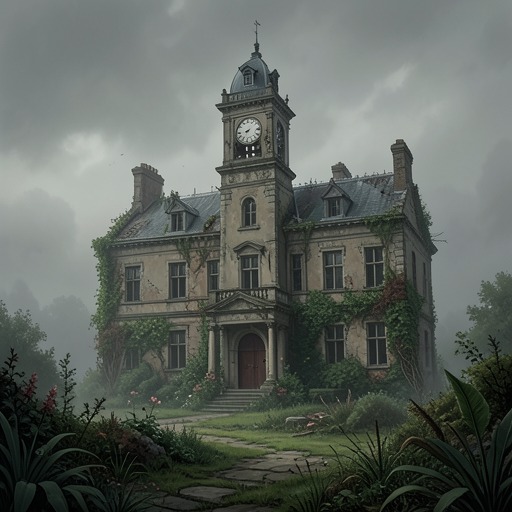
Bluff Court
The Darling Buds of MayBluff Court, the ancestral mansion of Sir George Bluff-Gore, is at once a monument to landed status and an unwieldy property its owner can neither comfortably maintain nor bring himself to relinquish. Pop Larkin’s proposal to buy and pull it down exposes the divide between the house’s symbolic weight and its practical value: for Pop, its bricks, tiles, doors, flooring, and hard core can become both a deal and the materials for a home for Mariette and Charley. The demolition is promised, but remains unfinished in the later account.
The mansion and its burdens
Bluff Court is far too large for Sir George to live in, yet its scale makes the cost of keeping it formidable. It has sixty rooms, a hamlet’s worth of barns, dairies, and stables, half a mile of greenhouses and potting sheds, and an orangery in which no oranges have grown for fifty years. Heating it takes a hundred tons of coal each winter; keeping it tidy and productive in summer would require eighteen gardeners. Its domestic establishment is equally out of reach: twenty servants to wait on the household and another twenty to wait on them. The account makes the estate’s splendour inseparable from the labour and money it demands, even as the servants themselves are difficult to obtain and unaffordable to pay.
The grounds extend the same picture of scale and decline. Miles of beech, elm, and oak stand around the mansion, while its greenhouses, stables, and barns are presented as obsolete or neglected. The orangery’s half-century without oranges compresses the estate’s lost usefulness into a single image: the structure remains, but the purpose it once served has disappeared. Bluff Court is not simply a large house; it is an inherited arrangement of buildings and grounds whose upkeep has become difficult to reconcile with the resources available to its owner.
Refusal and the proposed sale
When Pop asks when Sir George will sell Bluff Court, the question catches him unprepared. Sir George has no intention of selling, despite the house being too large to inhabit. Giving it up is, to him, unthinkable, and he rejects the prospect with the insistence that the house must remain where it stands. The refusal is not based on a workable plan for living there: it rests on the conviction that surrendering the ancestral property would itself be intolerable.
That attachment coexists with acute financial constraint. Sir George imagines that the estate might one day be let to wealthy stockbrokers who farm at a loss and recover their position through tax advantages, a practice he regards as evidence of national decline. The alternative is not an easy, practical sale but a future hope that someone else might make the property financially manageable. The house thus holds its owner in a bind: too costly and too large to sustain comfortably, yet too bound to inheritance and identity to sell.
Pop regards this impasse as proof that Sir George has failed to face the obvious. He points out that Sir George does not really live in the house and, in Pop’s view, never will. When Sir George asks whether Pop is proposing to buy it, Pop confirms that he is. Asked what he would do with the property, he answers that he would pull the whole thing down. Sir George’s shocked pallor and stunned, tear-bright eyes make clear how violently the proposal collides with his understanding of the house. What Pop sees as a direct solution sounds to its owner like the destruction of something beyond price.
Lady Bluff-Gore and the value of demolition
Lady Rose Bluff-Gore responds differently from her husband. After hearing that Pop has suggested pulling the house down, she admits that she has long wanted to demolish it herself, along with its miles of greenhouses, unused stables, and draughty barns. Her private hopes make the proposal more than a clash between Pop’s practicality and Sir George’s attachment: the household’s own members do not experience the estate in the same way. For Lady Rose, removal offers the possibility of money in the bank, an end to living on overdrafts, and a chance of comfort. She also wonders whether Rosemary might come back.
When Lady Rose asks what Pop thinks the house is worth, he does not settle on a price immediately. He says he can inspect it the following day and give her an estimate. His response turns the mansion into a potential stock of recoverable materials. He is already thinking about the bricks, tiles, doors, flooring, and hard core he could obtain, and about contacting Freddy Fox to make a deal. The contrast is sharp: where the Bluff-Gores confront the house as inheritance, burden, and domestic loss, Pop assesses its components and the transactions they might enable.
Promise, delay, and changing fortunes
Pop connects the proposed demolition to a concrete future for Mariette and Charley. He offers to select the best material from the big mansion and use it to build them a bungalow in the meadow near the bluebell wood. Mariette receives the idea with immediate delight, kissing Pop; Charley’s response leaves him with no objection to add. In this exchange Bluff Court’s possible destruction acquires a constructive consequence: material taken from the old estate is imagined as the basis for the younger couple’s separate home.
The plan remains unrealized in the later account. Pop has not even got around to demolishing the mansion because he has been busy with other ventures, including a large army-surplus deal involving such assorted goods as pickled beetroot, rat-traps, body belts, collar studs, gherkins, rubber shoe heels, and caper sauce. The bungalow must wait. This delay qualifies the promise without erasing it: Bluff Court has been assigned a new imagined use, but its conversion into a home for Mariette and Charley is still pending.
Later, the estate appears under the name Gore Court in the account of Pop’s earlier purchase of the ancestral property. Sir George sold it to Pop for demolition and went to live in a stable. This outcome gives the earlier proposal a grimly practical sequel: the house that Sir George could not bear to sell is ultimately sold, and his displacement underscores the material cost of preserving an estate that its owner cannot afford to maintain. The prospective bungalow for Mariette and Charley, however, is still described as unbuilt, so the demolition and the promised new home do not resolve into a simple story of replacement.
Architectural inheritance and practical value
Bluff Court’s significance lies in the tension between what a great house represents and what it can do for the people tied to it. Its rooms, outbuildings, greenhouses, and long-established grounds testify to inherited status, but their size also makes them liabilities. Sir George’s attachment treats the estate’s continued presence as an obligation in itself; Lady Rose sees demolition as a chance to escape debt and recover comfort; Pop sees a saleable structure and useful materials. The house becomes the point at which these incompatible valuations meet.
Its proposed afterlife also links the declining estate to the Larkins’ domestic future. Pop’s plan does not preserve Bluff Court as a residence: it transfers value from the mansion’s fabric into the possibility of a bungalow near the bluebell wood. Yet the postponement of the work matters. Even after Sir George sells the estate for demolition, Pop’s competing enterprises leave the promised home unfinished. Bluff Court’s story therefore turns not only on the collapse of inherited grandeur, but on the gap between an old house’s imagined reuse and the practical completion of what that reuse is meant to provide.