Hôtel Beau Rivage
The Darling Buds of MayThe Hôtel Beau Rivage is the Larkin family’s lodging in France and the scene of a sharp collision between remembered holiday charm and present discomfort. When they arrive on the last day of August, the Atlantic gale and the hotel’s battered appearance make the name seem almost a promise the place can no longer keep.
Setting and Arrival
At half past six in the evening, Pop draws the Rolls up outside the Hôtel Beau Rivage as a gale blows in from the Atlantic. Even the blue fishing boats in the port’s most sheltered corners look battered, while white spray climbs the quay walls and rain and pebbles strike the hotel’s shuttered windows. The cold wind circles the harbour with a shriek that recalls Mr Charlton’s much-loved distant train, giving the arrival an oddly familiar sound amid the storm.
The hotel’s name and appearance pull in opposite directions. Its creosoted Tudor style looks flimsy in the weather; blistered brown shutters spring on their hooks, and coloured fairy lights swing between pollarded plane trees, with some crashing onto the terrace. The storm makes the building seem not simply unattractive but precarious, as though it might collapse and wash away.
Memory and Disappointment
For Mr Charlton, the Hôtel Beau Rivage is not an unknown stop but a place remembered from the summer before the war. He had pictured it as large and gay; faced with it now, he finds it smaller, shabbier, darker, and pokier than memory had preserved. The discrepancy turns the hotel into a measure of changed expectation: the remembered holiday refuge has returned as a dilapidated building under assault from the weather.
His appraisal gathers into a rueful verdict that there is very little Beau about it, and not much Rivage. The joke registers more than a mismatch between name and place. The storm and the hotel’s decay together strip the French seaside setting of the ease and glamour Mr Charlton had carried in his recollection.
The Family Inside
Despite his dismay, Mr Charlton eventually says they ought to go in and leads the way with conspicuous alacrity. The family follow in a compact procession: Ma carries Oscar; Primrose and Montgomery share a raincoat; the twins, Victoria, and Mariette share an umbrella; and Pop brings two suitcases and a zip canvas bag. The passage from quay to hotel is less a triumphant holiday entrance than a practical retreat from the weather.
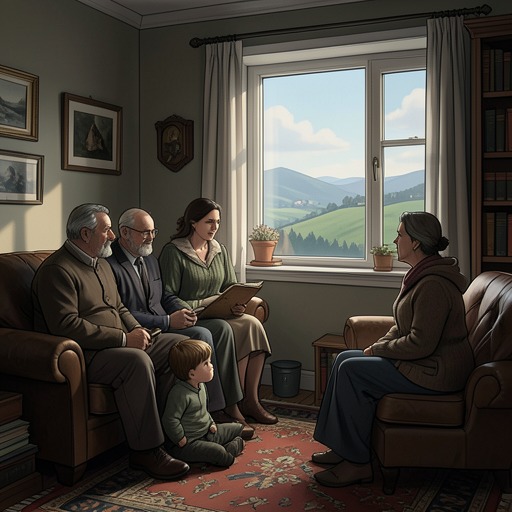
Inside, the Hôtel Beau Rivage also imposes its own bureaucracy. A man wearing pince-nez emerges from a door marked “Bureau,” sniffs and rattles keys, and asks whether Mr Charlton has filled in the forms. There are ten. Mr Charlton has not completed them, so he hands Oscar to Montgomery, takes out his fountain pen, and sits in a decrepit wicker chair to begin, his hands still damp from the baby. The arrival’s discomfort thus continues indoors: the family must exchange the storm outside for paperwork and worn furnishings.
Narrative Significance
The hotel is introduced through a double test of travel: the physical ordeal of reaching it in a gale and the emotional disappointment of finding that a cherished memory no longer matches the place. Its unstable shutters, failing lights, and shabby interior make the anticipated refuge feel vulnerable rather than restorative. The family’s crowded entry and Mr Charlton’s immediate encounter with ten forms bring the grand idea of a French holiday down to wet luggage, shared shelter, a baby passed between relatives, and administrative routine.