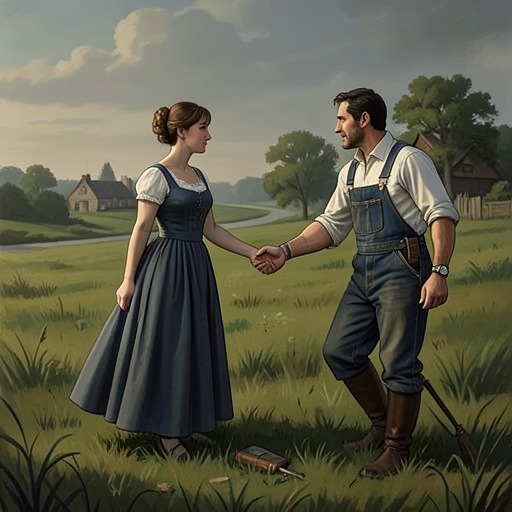
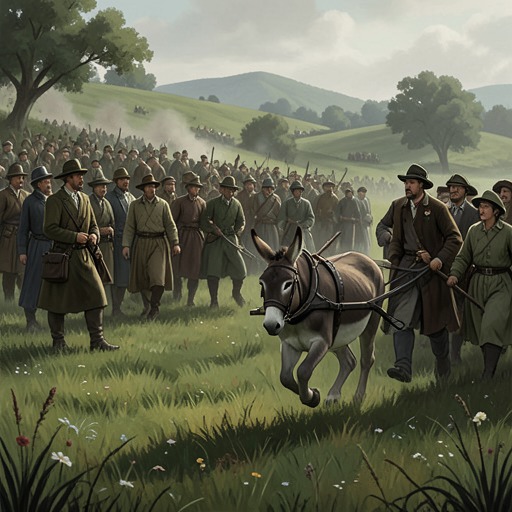
Jasmine bolts out of the Ladies' Donkey Derby with Miss Pilchester aboard
The Darling Buds of MayJasmine’s bolt with Edith Pilchester aboard turns the Ladies' Donkey Derby from a comic country-sports event into an uncontrolled ride to the riverbank. Pop chooses the donkey for Edith, but Jasmine’s stubborn refusal to move gives way at the sound of a loudspeaker announcement; she tears through the course and returns to the place where Pop had found her, bringing her rider face to face with a couple in the long grass. The episode’s reversal is sharply physical: the mount Pop cannot push into motion becomes an animal whose sudden speed carries Edith beyond the race’s rules and into an embarrassing encounter.
The Race and Its Participants
At four o’clock, Edith is ready to ride in the women’s event, fifteen minutes after Montgomery and Mr Charlton had taken part in the men’s donkey Derby. That earlier race has already established the donkeys’ capriciousness. Most need carrots to get started; the one exception, a pale, sagacious animal named Whiskey Johnny, wins. Mr Charlton manages only three yards before falling, and his donkey bolts all the way beyond the tea tent to the river.
Pop goes after the escaped animal, Jasmine, and finds her staring at a soldier and a young blonde embracing in the grasses by the bank. When she has been led away, Jasmine turns back with pricked ears, apparently still interested in the scene. Her return to that riverside setting later is therefore not a new destination chosen at random: it repeats the route established by Mr Charlton’s failed ride and by Pop’s recovery of the donkey.
For Edith’s race, Pop selects Jasmine and gives the rider earnest advice from the starting point. He tells her to grip with her knees and hang on as if for dear life. Edith, already apprehensive, looks at the other competitors: they are girls of sixteen or seventeen, young and effervescent in contrast with her own sense that she is neither. The donkey’s coarse hair against her calves intensifies her discomfort before the race has properly begun.
A Stalled Start, Then a Sudden Break
Jasmine initially stands fast. Pop calls to her and pushes against her rump, putting his weight into the effort, but she will not move and seems to have planted her feet in the ground. Around them, carrots are waved in bright arcs. A few donkeys trot indifferently down the track; one covers about thirty yards, then turns back as though bored, while another drifts to the side and stands against a post as children, including Victoria and the twins, stroke it. Two girls fall off amid screams and brief glimpses of their underwear. The Derby is less a controlled contest than a series of small refusals, misdirections, and falls.
Edith is thinking that the whole affair is absolutely ghastly when the loudspeaker interrupts the spectacle with an announcement about Anne Fitzgerald, aged three, who has lost her mother. The announcement does not provide a deliberate signal from Pop or a race official: it is the unexpected sound that changes Jasmine’s behaviour. The loudspeaker gives a few sharp barks, Jasmine cocks her ears, and the animal suddenly breaks through the final waving carrots in a frenzy. Pop is left on the ground, and the people around the start scatter.
The Ride to the River
Once Jasmine bolts, the advice Pop had repeated as encouragement becomes a practical necessity. Edith clings firmly with her knees, just as he told her to do, while Jasmine races away from the course. Within thirty seconds, she is back at the river, among the grasses, irises, and water-lilies where Pop had previously found her watching the soldier and the blonde.
The return reverses the scene’s expectations. At the start, Jasmine’s immobility makes Pop’s efforts seem futile and leaves Edith exposed before the younger riders; after the announcement, the same donkey supplies more speed than anyone can control. Pop’s instruction to hang on, comic when delivered to an unwilling mount, proves correct when the mount finally moves. The change from stalled spectacle to uncontrolled flight is driven by Jasmine’s response to the loudspeaker, not by any success in coaxing her forward.
An Embarrassing Arrival
At the river, Edith half-dismounts and half-falls, dishevelled and demoralized. She looks at the couple in the grass, and the soldier, interrupted in the middle of his intimacy, calmly tells her to go away, addressing her as Ma and referring to her sister. The encounter makes the Derby’s route unexpectedly intrusive: what began as public entertainment deposits Edith and Jasmine back among people who had been oblivious to the watching crowd.
The episode ends not with a winner or a return to the course but with Edith’s humiliation and the soldier’s rebuke. Its comedy depends on the contrast between the organized language of a race, Pop’s confident instructions, and the unruly agency of an animal that first refuses every prompt and then carries its rider precisely where she least wants to be. Jasmine’s earlier attention to the riverside couple foreshadows the destination; the lost-child announcement supplies the immediate trigger. The result is a brief but complete reversal, from reluctant participation to involuntary flight and an awkward landing among strangers.