Ladies' Donkey Derby
The Darling Buds of MayThe Ladies' Donkey Derby is a late addition to the Larkin family gymkhana that turns Pop’s persuasive showmanship into a spectacle of stubborn animals, scattered spectators, and an unwilling rider carried far from the course. Miss Pilchester’s ride on Jasmine supplies the event’s decisive comic reversal: the donkey refuses to move while urged on, then bolts at the sound of a lost-child announcement and takes her back to the river, where both rider and animal encounter a scene wholly outside the competition’s official program.
Conception and Stakes
The race is Pop’s late, inspired idea, not a planned centerpiece. He persuades the committee that they owe it to him in return for the field, and he supplies a silver cup he had bought at a sale for his sideboard. It is engraved for an angling competition, but Pop sees no reason that the mismatch should matter. The Derby’s improvised origins anticipate its governing spirit: rules and ceremony are useful chiefly when they help keep the show moving.
Pop also recruits the rider. While Ma wanders with the children and Mr Charlton watches the other events, Pop goes behind the beer tent to persuade Miss Pilchester to take part. Ma tells the Brigadier’s sister that Miss Pilchester is going in and that Pop is trying to persuade her. Miss Pilchester’s own response is that riding would be absolutely ghastly. The event therefore begins with a conflict between Pop’s drive to make the program more entertaining and her anxiety about becoming part of it.
The Race and Its Disorder
Miss Pilchester is ready to ride at four o’clock. Fifteen minutes earlier, Montgomery and Mr Charlton have taken part in the men’s Derby. Most of the donkeys, including Mr Charlton’s, need carrots to get started; the pale, sagacious Whiskey Johnny wins without them. Mr Charlton rides three yards before falling off, and his mount bolts beyond the tea tent, ending up by the river. The men’s race has already established that the animals will not reliably follow the human plan.
Pop selects Jasmine for Miss Pilchester and gives her emphatic advice: “Hang on with your knees. Don’t let go. Hang on tight. Like grim death.” At the start, Jasmine stands dangerously still while Miss Pilchester sits astride her. The rider sees young competitors of sixteen or seventeen, feels neither young nor effervescent beside them, and finds the donkey’s hair unpleasant against her calves. Pop repeats his instruction to look ahead and hold on, treating determination as the answer to a contest in which he cannot make the mount move.
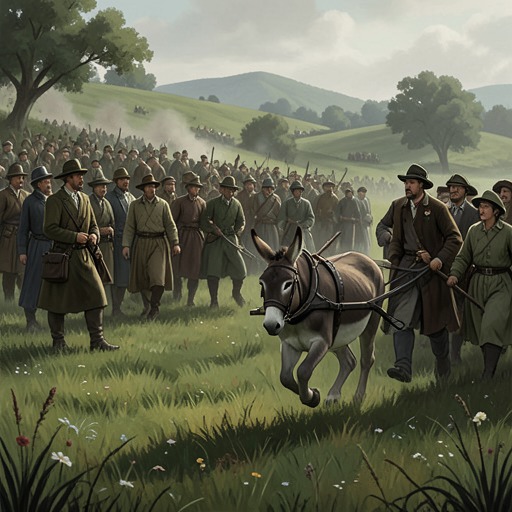
The course offers no orderly procession. Carrots are waved in orange arcs; some donkeys trot a short distance through the shrieking spectators, one turns back after thirty yards, and another leaves the track to lean against a post and accept strokes from children, including Victoria and the twins. Two girls fall off, screaming. Jasmine, meanwhile, stays planted. Pop calls to her and pushes against her rump, putting his weight into the effort, but she seems to have sunk her feet into the ground. Human exhortation, food, and physical force all fail to produce the expected start.
Jasmine’s Bolt and the Aftermath
The immediate turning point is not a racing signal or a carrot but the loudspeaker. While Miss Pilchester is thinking that the whole affair is ghastly, an announcement begins about Anne Fitzgerald, aged three, who has lost her mother. The loudspeaker then gives a few sharp barks. Jasmine cocks her ears and breaks through the last waving arcs of carrots in a frenzy, leaving Pop on the ground and the crowd scattered. The same animal that could not be pushed into motion suddenly has force enough to overturn the start-line tableau.
Miss Pilchester follows Pop’s advice and grips Jasmine desperately with her knees. Within thirty seconds the donkey is back at the river, away from the racecourse and its spectators. Jasmine has returned to the grasses, water-lilies, irises, and the soldier’s summer love: the place where Pop had earlier found her watching a soldier and a young blonde in the long grass. The ride’s destination is thus not a finish line but the setting of an intimate encounter that the Derby’s public spectacle had only briefly, and accidentally, approached.
Miss Pilchester half-dismounts and half-falls, dishevelled and demoralized, and stands staring alongside Jasmine. The rider’s worst expectation has been fulfilled, and the interruption becomes more humiliating when the soldier looks up and tells her and her sister to go away. The race has carried her from reluctance, through a brief loss of control, into an encounter with people who do not recognize its sporting context and have no interest in accommodating it.
Comic Logic and Significance
The Derby’s comedy comes from the widening mismatch between its official frame and the animals’ behavior. A committee, an engraved cup, a starting point, carrots, a loudspeaker, and Pop’s confident instructions suggest a managed event; the donkeys repeatedly ignore those arrangements. Whiskey Johnny needs no carrot, other mounts wander or stop for children, and Jasmine’s refusal gives way not to Pop’s effort but to a sudden noise. The contest depends on creatures whose choices exceed its organizers’ intentions.
Miss Pilchester’s ride makes that mismatch especially sharp. Pop treats the event as an opportunity to persuade another participant into the family’s public entertainment, while her repeated fear of finding it ghastly remains justified at every turn. His instruction to cling like grim death proves mechanically useful, but it cannot control Jasmine’s destination or protect Miss Pilchester from the encounter at the river. The event ends not with a winner’s ceremony in the evidence presented, but with an abrupt departure from the course and an embarrassed, unwanted arrival elsewhere.
As a set piece within the gymkhana, the Derby gathers the book’s comic interest in improvised enterprise and unruly physical life. Pop can invent the race, negotiate its place on the program, find a cup, and recruit a rider; he cannot make the donkeys behave as if they belonged to his plan. The result is a miniature of his broader talent for turning whatever is at hand into an occasion, with the equally important qualification that the occasion may escape his control.