Mariette Larkin and Mr Charlton's wedding
The Darling Buds of MayMariette Larkin and Mr Charlton’s wedding is remembered as a radiant family celebration and a turning point in the household’s relationships. Its joy is set against the unresolved status of Pop Larkin and Ma, whose unmarried partnership becomes newly consequential when the family considers passports and travel.
The Wedding in Retrospect
The wedding enters the narrative not as a present-tense ceremony but through Pop’s recollection while the family is together in Brittany. He remembers a day of bright sunshine, a large marquee in the garden, iced port, cold salmon, and champagne. The abundance belongs to the family’s familiar style of hospitality, but here it frames a formal rite that joins Mariette and Mr Charlton before their assembled relatives and friends.
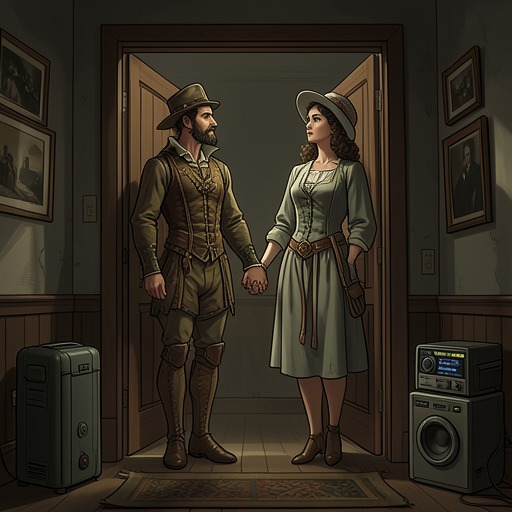
Mariette’s appearance gives the memory its most vivid focus. She wore a striking, unconventional dress of yellow silk that suited her dark hair, and carried stephanotis and cherry-red nerines whose petals seemed dusted with gold. Her sisters Zinnia and Petunia, along with Victoria and Primrose, were bridesmaids in deep cream, wearing small golden roses in their head-dresses and carrying posies of lily-of-the-valley. The precise colors and flowers make the occasion persist in Pop’s mind as an image of beauty as well as a family milestone.
The response was openly emotional. Ma, Miss Pilchester, and several friends wept at the sight of the wedding party; even Pop had a tear in his eye. The scene does not present the family’s celebration as restrained or decorous: its formality coexists with unmistakable affection, and Pop’s memory preserves both its pageantry and the feeling it stirred.
Marriage and Family Life
The wedding marks the change in Mariette and Mr Charlton’s relationship from courtship to marriage, but the narrative’s attention quickly turns to the life that follows. Less than a week after the couple returned from their honeymoon, Pop began asking Ma whether anything was happening yet. Ma replied that she should think not, adding that not everybody was like Pop; she joked that merely catching his eye across a forty-acre field could make her wonder whether she would have twins or triplets. The exchange places the newly married couple within a family where marriage, intimacy, and pregnancy are discussed with teasing directness.
That domestic ease contrasts with the legal and administrative implications of marriage. When the family later discusses passports, Mr Charlton reminds them tactfully of the delicate situation concerning Pop and Ma and suggests that it might have been better if they had married. Pop says they still could, though without enthusiasm, calling it a palaver; Ma says she has always been willing. The wedding therefore becomes a point of comparison: Mariette and Mr Charlton have formalized their union, while Pop and Ma’s long-standing partnership remains legally distinct.
The Wedding’s Later Consequences
The passport discussion makes that distinction practical rather than abstract. Mr Charlton proposes that the children could travel on Pop’s passport, while Ma would need to obtain her own using her maiden name. Asked what that name is, Ma identifies herself as Flo Parker. Pop is painfully startled, as if hearing Ma introduced by name for the first time; she remains placid, fondling the head of her seventh child and expecting the issue to sort itself out. The contrast with Mariette and Mr Charlton’s wedding reveals how a family may be firmly constituted through shared life and care while still encountering difficulties when official documents demand legal categories.
The wedding’s narrative force lies in this double register. It is a lovingly remembered celebration, full of color, food, flowers, and shared tears; it is also the occasion against which the household’s different arrangements of partnership and family status become legible. The ceremony settles Mariette and Mr Charlton’s marital relationship, but it does not resolve the distinct question of Pop and Ma’s legal standing, which resurfaces when the family’s plans require passports.