May
The Darling Buds of MayMay is more than a date on the calendar in the world of the Larkins: it is the hinge between blossom and harvest, the first hot spell of the year, and the opening of the family’s busiest seasonal livelihood. Its abundant light makes the countryside seem newly flourishing, but the month also brings punishing heat and the warning that disease is undermining the strawberries on which local pickers depend.
Spring Light and the Approach of Work
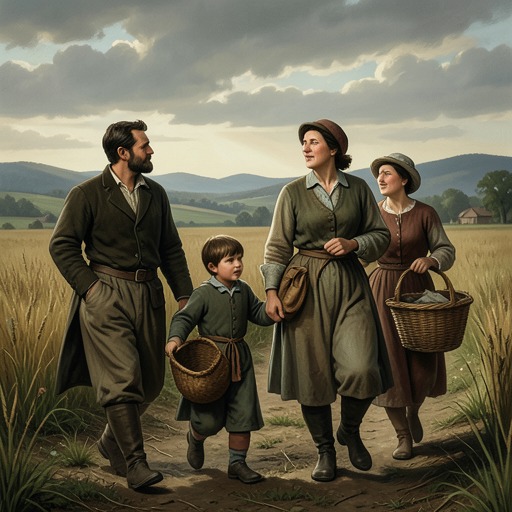
The month first appears as an enveloping landscape. In strong May sunlight, the bonnet of the Larkins’ blue truck gleams like enamel as it travels through a valley of pink apple orchards in late bloom. The petals are compared to confetti, giving the drive a festive brightness. Yet the family outing is already oriented toward work: when the truck reaches the strawberry fields, Pop Larkin points out the straw laid in long yellow rows and says the crop will be ready in a few days. The beautiful countryside is also a timetable and a source of income.
The transition from blossom to picking is unusually early. At the family table, Montgomery Larkin reports that strawberry picking at Benacre will begin on Monday, having heard the news from Fred Brown. Pop recognizes that this is earlier than ever and connects the crop’s development to the weather, saying that the warm conditions have soon put colour on the berries. The exchange brings the seasonal change into domestic life: a report about the fields immediately becomes a practical matter for the family.
A Calendar of Crops and Earnings
May stands at the threshold of a year-round sequence of seasonal work. Strawberries are due in June, followed by cherries before that month ends and more cherries through July. In favourable summers, apples may begin before August, alongside early plums and pears; apples continue in August and September, while September also brings hops and October potatoes. This calendar makes the year legible through successive crops, with each harvest preparing the next phase of labour.
The strawberry season has particular economic weight. Pop estimates that a large family can earn fifteen pounds a day from picking strawberries alone. That figure helps explain why a drive through the fields is also an assessment of the coming work: he slows the truck beside the fresh straw and asks the children whether anyone does not want to pick. The crop’s readiness promises earnings, but it also commits the family to a demanding period in the fields.
May’s weather sharpens both sides of that calculation. On the hottest thirtieth of May in forty years, the sun bears down on the strawberry field; the following day is hotter still. Mr Charlton, newly involved in the strawberry operation, goes into the tent and calculates that he has checked in more than a ton of berries. His trained mind turns the total into a question about the pickers’ share and the tax position, while the heat makes the scale of the day’s work palpable. The month’s abundance is not pastoral abstraction: it is measured in fruit weighed, handled, and brought through the tent.
Beauty, Heat, and Intimacy
The same spring setting that makes May seem idyllic also gives the month an intimate emotional charge. One May evening, Mariette teaches Mr Charlton to distinguish a nightingale from a blackbird and a wren. He hears a nightingale consciously for the first time against the evening sky, and the encounter turns from instruction into physical closeness when Mariette raises her hands to his cheeks and kisses him. The nightingale’s song, the flowering season, and the developing attraction come together in a scene where the landscape is not merely scenery but part of what the two characters are learning to share.
By the end of the month, however, the warmth that softens that encounter has become oppressive. Mr Charlton finds the strawberry field shimmering under a sun that seems hotter than any May heat he has known. The pickers remove their blouses and shirts to work in bodices and brassieres; from the tent, he counts more than a ton of fruit passing through. The scene places bodily discomfort beside productive abundance. The crop is plentiful enough to demand relentless work, while the heat alters the conditions under which that work can be done.
The Threat to the Strawberry Season
The expectation of a continuing harvest is undercut by the disease affecting the fruit. When Mr Charlton asks about the strawberry trade, Pop says that the “strawberry lark” is nearly over. Sovereigns, Climax, and Huxleys are already finished, he explains, and he predicts that soon strawberries will be unavailable everywhere. His forecast reaches beyond one farm or one district: he says that in two years the strawberry trade will be over in every district.
May therefore holds a pointed contrast between visible promise and projected loss. At the beginning of the picking season, the orchards are in bloom, the straw is laid, and the weather has brought the berries on early. At the same time, disease has made Pop regard this seasonal livelihood as nearing its end. The month gathers the novel’s countryside into a cycle of beauty and labour, but does not present that cycle as secure: even a field ready for picking can belong to an industry whose future is disappearing.