Poll Sanders and Lil
The Darling Buds of MayPoll Sanders and Lil are experienced strawberry pickers whose encounters with Cedric Charlton turn the harvest tent into a test of his arithmetic, judgment, and composure. Their brisk corrections and coordinated schemes give the strawberry field a social order of its own: beneath the season’s heat and abundance, every basket has to be counted, and a mistake has consequences for the people who picked it.
Workers in a Seasonal Economy
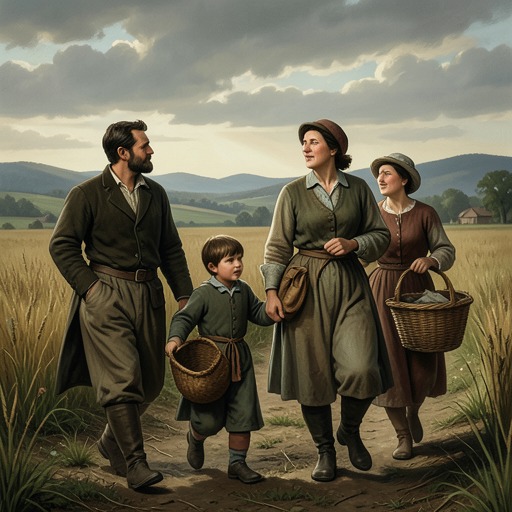
The strawberry crop belongs to a wider annual cycle of farm work. After strawberries came cherries, sometimes continuing through July; apples, early plums, and pears could follow, then apples again, hops, and potatoes. At strawberry-picking time, a large family could earn fifteen pounds in a day. The schedule makes the field more than a picturesque setting: it is a temporary workplace whose income depends on the ripening season and the number of baskets brought in.
That season appears unusually early. At Benacre, Montgomery tells Pop that picking will begin on Monday, earlier than it ever has before; Pop attributes the advance to the warm weather. The prospect of the harvest is shadowed by his warning that disease is finishing familiar strawberry varieties, including Sovereigns, Climax, and Huxleys. He predicts that the strawberry trade will be over everywhere within two years. Poll and Lil therefore work within a livelihood that can be busy and profitable yet remains exposed to weather, crop disease, and the uncertain future of the industry.
The Harvest Tent and Its Arithmetic
On the hottest day of the season, Cedric is assigned to check and weigh incoming baskets. The heat is already extreme: the newspapers have called the previous day’s May 30 the hottest in forty years, and Cedric expects this day to be hotter still. Poll describes sweat running down her back; Lil agrees that it runs off her like water. Their remarks establish the bodily cost of the work before their dealings with the clerk turn on the less visible labor of keeping the records straight.
Cedric first records two dozen baskets for Poll, then realizes that he has forgotten how many Lil brought. He follows Lil across the field to ask her, and she answers with a hard, distrustful look. His next calculation goes wrong in the opposite direction: he writes down three baskets for Poll instead of two. When he chases after her to check the figure, Poll insists that she brought three and reminds him that she was standing there as he entered it. The paired errors leave Cedric reliant on the pickers’ own accounts, while their unflinching responses make clear that his official-looking book does not make him infallible.
A Coordinated Scheme
As the afternoon wears on, Poll and Lil confer about whether they can trick Cedric a second time so soon, or whether they should wait and attempt a double trick later. The narration presents this as an established joint practice: they know several schemes and, for reasons left comic and unexplained, generally do better in the afternoon. When they return, they greet him familiarly and set about a new attempt.
Their request is tied to immediate need. Poll explains that she and Lil have come out without money because it is too early to reach the Post Office for the children’s allowances. After reporting three dozen baskets, she asks Cedric to lend them five shillings so Lil can cycle to the shop, promising repayment the next morning. Their practiced approach turns the tent’s informal familiarity into an opportunity for credit; Cedric, absorbed in writing the figures, does not even notice how closely the two women are watching him. The episode balances their resourcefulness against his earnestness without establishing that he actually lends them the money.
Heat, Labor, and the Book’s Comic Contrast
By mid-afternoon, the heat has become severe enough for Cedric to get a bucket of water from the standpipe by the gate. He drinks, plunges his head into it, dries himself with a handkerchief, and cleans his spectacles. Across the field, many women have taken off their blouses and shirts to work in bodices and brassieres. The changing appearance of the rows, and the workers’ plainly stated discomfort, keep the comedy grounded in the conditions of the labor rather than making the heat a mere backdrop.
The day’s scale also changes Cedric’s sense of what the strawberry work entails. He adds up the quantities moving through the tent and discovers that he has checked in more than a ton of fruit. His trained mind immediately turns to the tax position, and he assumes Pop will know the answer. That calculation links the pickers’ baskets to the book’s larger concern with income and official accounting: the same harvest that sustains seasonal work also prompts questions about what must be declared and how the farm’s business is understood.
Poll and Lil are drawn through a handful of sharply defined actions rather than extended biographies. Their sweating bodies register the strain of the field; their exact corrections assert their authority over the basket count; and their conference, return visit, and request show how they operate together. The contrast with Cedric is central to their brief but effective role: he approaches the figures as a matter of orderly record-keeping, while they know both the harvest’s physical demands and the possibilities created by his mistakes. JSON