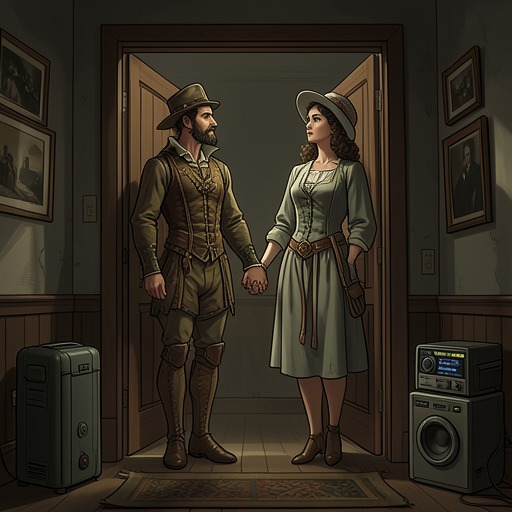
Sidney (Pop) Larkin—Ma Larkin
The Darling Buds of MayPop Larkin and Ma’s relationship is the durable center of the Larkin household: an intimate, mutually playful partnership built through shared family life, appetite, and physical affection, yet never formalized in marriage. The novel presents their closeness not as an abstract declaration but as a daily practice—Ma laughing beside Pop in the car, Pop instinctively reaching for her in the kitchen, and both making room at their table and in their home for others. Their unmarried status becomes consequential when another pregnancy and the prospect of travel bring tax and passport rules into the family’s private world.
Shared Life and Family
Their partnership is visible from the opening scenes in the ease with which they occupy space together. As Ma laughs in the car, ice cream running over her hands, Pop nudges against her and asks her to hitch up so he can reach the clutch. The comedy rests on familiarity rather than distance: she shifts a little, still laughing, and the two continue as a settled pair. Pop’s affectionate attention to Ma’s body is part of the book’s unembarrassed depiction of their intimacy, but the scene also establishes their shared rhythm—his joking request, her laughter, their practical accommodation of one another.
That companionship extends into their joint sense of family. Driving through the May countryside, Pop takes pleasure in the cherries, apples, and strawberry fields, and in the six children whose names he and Ma chose together. He recalls the reasons behind several names—Montgomery after the general, Primrose for spring, the twins Zinnia and Petunia after Ma’s favorite flowers, and Victoria for the season of plums—while puzzling over why their eldest, Mariette, was named as she was. The moment combines pride in the family they have made with an affectionate, comic admission that even its origins are not all equally clear to him.
Their family’s material life is shared as freely as its emotional life. When Cedric Charlton arrives with a form, Pop brushes past the paperwork and offers him dinner, tea, coffee, beer, Guinness, or cider; Ma joins the welcome, and the crowded table is loaded with fish and chips, pineapples, ice cream, jam, sauces, biscuits, and buns. Ma insists that Pop is a farmer rather than a dealer, defending his standing in terms of land and work. Later, when Pop invites Cedric to stay overnight, Ma agrees readily, and Pop proposes the billiard table as his bed. Such hospitality is not detached from their partnership: it is a joint household practice, through which Pop’s expansive welcome and Ma’s ready participation make the family’s domestic world open to a visitor.
Affection in Ordinary Moments
The relationship’s erotic warmth persists within domestic routine. When Ma reaches up for salt in the kitchen, Pop is suddenly overcome by desire and pulls her close. She pretends to protest while giggling, then turns and yields to his kiss. Pop prolongs the embrace, and the narration connects his heightened passion to the kitchen’s food smells and familiar surroundings. Against the stove, pans, and sunlit walnut leaves, he sees Ma as his dream. The scene makes desire part of household life rather than an interruption of it: the kitchen is at once a place of cooking and the setting for their recurring physical affection.
Their closeness also includes room for invitation and care. When Cedric declines an invitation to Sunday dinner, Ma is shocked at the prospect of his having a cold meal at the pub and asks him to eat with them instead. Pop backs her up, treating their table as the obvious alternative to the pub’s Sunday fare. After Ma reaches into a cupboard, the scene returns to the couple’s intimacy: Pop embraces and kisses her, and she responds. Hospitality and erotic affection are presented side by side, both arising within the ordinary habits of the household.
The same ease is evident in a later exchange in which Ma asks Pop whether he is going to kiss her. He drains his glass, clasps her, and answers with a long kiss; she settles back into her chair, and their quiet is broken only by her breathing. Warm rain begins to fall, but neither attends to it. The moment’s small reversal—Ma having to prompt a kiss—does not signal estrangement; it becomes an occasion for renewed tenderness. Their affection is active and reciprocal, sustained by teasing, familiarity, and the capacity to return to one another without ceremony.
Practical Partnership and Pregnancy
Their relationship is also tested and reaffirmed through the demands of family change. Pop asks when Mariette expects her baby, and Ma replies that Mariette cannot make up her mind. His question places the daughter’s pregnancy within the couple’s shared concern for their family, although Ma’s answer leaves the timing unsettled. Later, the two announce that they have decided to marry because Ma is going to have another baby. The news is delivered jointly: Pop introduces it, while Ma prompts him to tell the others. Their impending marriage is thus linked not to a sudden discovery of affection but to a practical change in circumstances within an already established partnership.
That announcement leads immediately to a question of financial consequence. Cedric begins to explain that marriage may not be advantageous for tax purposes, and Ma objects when he nearly uses a word she finds offensive. The exchange shows the unusual terms on which the household weighs formal marriage: intimacy and parenthood are already facts, while legal status is considered alongside the tax position. Pop and Ma’s affection is not reduced to calculation, but neither can their family arrangements be separated from the administrative and financial systems that classify them.
Unmarried Status and Public Identity
The unresolved legal status returns when passports become necessary. Cedric tactfully reminds the family that Pop and Ma’s situation may complicate their travel arrangements and suggests that perhaps they should have married after all. Pop concedes that they still could, but regards it as a palaver rather than an emotionally urgent decision. Cedric proposes that the children travel on Pop’s passport while Ma obtains her own in her maiden name, although he does not know what that name is.
Ma supplies it plainly: she is still Flo Parker. The revelation gives a precise public name to the woman everyone in the household calls Ma, and it makes visible the distinction between her social place in the family and her legal identity. Pop is startled and embarrassed, as though he is being introduced to her anew; Ma, by contrast, is untroubled and expects the matter to sort itself out. The scene does not resolve their status. Instead, it leaves the couple where the book has repeatedly placed them: deeply joined in daily life, parents within a shared household, and still unmarried when official documents demand a clearer category.
Significance
The partnership’s significance lies in the contrast between its emotional certainty and its formal incompleteness. Pop and Ma act as a couple in their shared care of the children, their coordinated welcome of visitors, and their continuing physical affection. Yet marriage, taxation, and passports make their relationship legible to institutions in ways their household life does not require. The book lets that tension appear through concrete domestic episodes—a crowded table, a proposed bed on the billiard table, a baby on the way, and Ma’s maiden name—rather than treating marriage as the sole measure of family.
Their relationship also gives the Larkin household its characteristic mixture of abundance and informality. Pop’s invitations and Ma’s assent repeatedly turn the home into a place where visitors are fed and accommodated; their private affection continues amid cooking, family announcements, and practical decisions. The final passport discussion leaves the legal question open, but not the nature of their bond: Ma remains part of Pop’s family in lived practice, while Flo Parker remains the name she carries outside marriage.