Sir George Bluff-Gore
The Darling Buds of MaySir George Bluff-Gore is the owner of Bluff Court, a grand but unmanageable country estate and a portrait of the rural gentry caught between inherited status and economic decline. His meeting with Pop Larkin turns the mansion’s decay into a direct question: whether a house that has become impossible to inhabit can still be treated as impossible to relinquish.
Identity and Circumstances
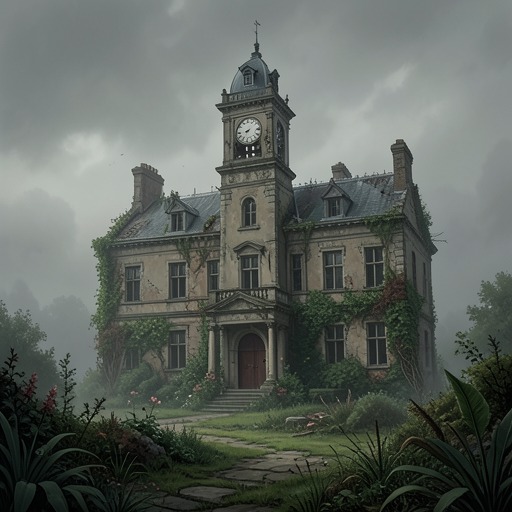
Sir George appears at Pop Larkin’s cocktail party as a yellowish, funereal, stiff, despondent man whose face suggests a pall bearer made uncomfortable by indigestion. The description makes his bearing seem almost continuous with the burden he carries: he owns a red-brick Georgian mansion too expensive to keep up, yet he and Lady Rose live in a keeper’s cottage instead. The estate remains his property and his social inheritance, but not the place in which he can practically make a home.
He and Lady Rose rarely get out, and he is grateful to have been invited to the party. Their relative isolation gives the occasion a small social importance, though it does not erase the awkwardness between the host and his guest. Pop and Ma had not invited the judge and the committee members who ignore Pop at the beer tent; Sir George, by contrast, is there, and Pop approaches him with a hearty slap on the back despite his stiff, funereal manner. The gesture is almost aggressively informal, a sharp contrast with the reserve that defines Sir George.
Bluff Court and the Question of Selling
Pop abruptly asks when Sir George will sell Bluff Court. The question exposes the scale of the estate’s practical crisis. The mansion has sixty rooms, with a hamlet’s worth of barns, dairies, and stables; half a mile of greenhouses and potting sheds; and an orangery in which no oranges have grown for fifty years. Heating it takes a hundred tons of coal each winter. Keeping the grounds tidy and productive would require eighteen gardeners, while the household’s service arrangements would call for twenty servants and another twenty to wait on them. In practice, servants cannot be found, and Sir George could not afford them if they could.
For all that, Sir George cannot bring himself to entertain a sale. The house may be too large to live in, too costly to maintain, and too depleted to support its old functions, but giving it up remains unthinkable to him. He imagines it standing among its miles of neglected beeches, elms, and oaks, as if the estate’s continuity could outlast the social and financial conditions that once made it viable. His answer to Pop is pointed: he never asked for Pop’s opinion about whether to sell.
The thought of letting the estate to a wealthy stockbroker who plays at farming offers a possible economic workaround, but it is no real resolution. Such owners, Sir George reflects, can make colossal losses and still come out ahead through tax advantages. He treats this practice as another symptom of national decline, describing the country as committing suicide and the situation as grim. The contrast is telling: he condemns the modern arrangement that might keep an estate afloat, yet cannot accept the alternative of selling the property outright.
Relationship with Pop Larkin
Pop and Sir George meet across opposing habits of speech and judgment. Pop is direct enough to say that Sir George does not live in Bluff Court and never will; Sir George responds with funereal acidity that he is not asking for Pop’s view. Pop’s friendliness is not deference. He treats the baronet with the same unembarrassed ease he applies elsewhere, while Sir George’s reserve marks the distance between old landed standing and Pop’s practical, opportunistic approach to property.
That difference becomes more consequential after their conversation. Lady Rose tells Pop that she has heard about his suggestion to her husband, and Pop answers plainly that Bluff Court ought to be pulled down. His interest is not merely in the mansion as a symbol of decline: he expects a demolition job to yield good building material. Later, he proposes using the best of it to build Mariette Larkin and Cedric Charlton a bungalow in the meadow near Bluebell Wood. The same house that Sir George cannot imagine selling has, in Pop’s mind, already become a source of useful materials for a new domestic future.
The proposal makes the conflict less a simple contest between a buyer and a reluctant seller than a clash between two ways of valuing the estate. For Sir George, the neglected grounds and empty rooms remain bound to continuity and inheritance; for Pop, the mansion’s physical substance can be separated from that history and put to work. Pop’s bluntness unsettles Sir George because it treats the apparent permanence of Bluff Court as a practical choice rather than a sacred fact.
Change and Narrative Significance
Sir George is not shown agreeing to sell, nor does the available account resolve the future of Bluff Court. The estate’s removal remains a plan Pop has not yet carried out: later, he has been too busy with other schemes even to begin the demolition. Sir George’s refusal therefore stands, at least for the time being, against Pop’s confidence that the mansion can be turned into something useful. The promise of a bungalow remains suspended between Pop’s resourcefulness and the inertia of the old house.
His importance lies in the tension concentrated in that refusal. Bluff Court is both a huge, costly structure and an inherited idea of permanence; its practical collapse is visible in the empty orangery, the impossible staffing requirements, and the family’s residence in a keeper’s cottage. Sir George sees the prospect of selling as a monstrous break with what the estate ought to mean, while Pop sees demolition as a way to recover value from what no longer works. Through their encounter, Sir George embodies the decline of the rural gentry without becoming simply indifferent to his property: his attachment is precisely what makes its decay so difficult to escape.