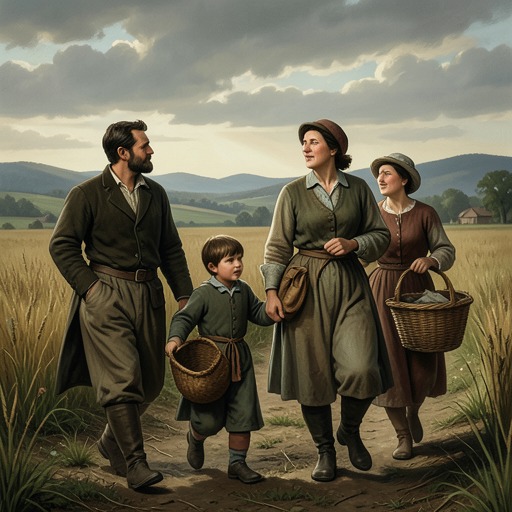
Strawberry-picking season
The Darling Buds of MayStrawberry-picking season gives the Larkins’ rural life its working calendar and its characteristic blend of abundance and uncertainty. The crop is more than a summer task: it begins a sequence of seasonal earnings, gathers the family into shared labor, and makes the landscape itself part of their livelihood. Yet the season that promises income is already under threat from disease, so its recurrence carries a warning as well as the anticipation of harvest.
Place in the Agricultural Calendar
The strawberry harvest belongs to a succession rather than standing alone. The Larkins’ year moves from strawberries in June to cherries before the month ends, with more cherries through July. In a good summer, apples may begin before August, alongside early plums and pears; apples return in August and September, hops are gathered in September, and potatoes follow in October. Strawberry-picking season therefore opens a long sequence of seasonal work, linking the family’s routine to the timing and condition of several crops.
At the beginning, the fields are not yet ready for picking. As the truck passes between orchards in bright sunlight, it goes by strawberry fields covered in yellow straw. Pop estimates that the covering will be needed for only a few more days, then slows beside the rows and asks the children whether anyone wants to go picking. The landscape is already being read as a timetable: the straw marks the wait before the work, and the rows promise a family undertaking soon to begin.
The timing can change from year to year. When Montgomery reports that picking at Benacre will begin on Monday, having heard from Fred Brown, Pop recognizes it as the earliest start they have known. He attributes the early ripening to the weather. That exchange makes seasonality practical rather than abstract: a shift in conditions changes the date work begins, and the family responds at once to news from the fields.
Work, Income, and the Larkins’ Livelihood
The harvest is both labor and a source of income. Pop tells the children that a large family could earn fifteen pounds a day from strawberries alone. The figure explains why the season matters so much to the household: a crop is not merely something to watch ripen, but an opportunity to turn the family’s size and available effort into earnings. Pop’s invitation to join the picking frames the work as collective, drawing the children into the same seasonal economy that governs the adults’ plans.
Mr Charlton encounters that economy from inside the operation. At the strawberry field, the heat is already oppressive: the previous day, the papers had reported, was the hottest thirtieth of May in forty years, and the day ahead promises to be hotter. He anticipates the difficulty of the work and longs for somewhere cool and quiet. The contrast between his discomfort and the Larkins’ familiar participation makes the harvest a physical test as well as a financial opportunity.
His duties also give him a view of the scale of the undertaking. Working in the tent, he tries to understand what Pop calls the strawberry lark by calculating the fruit passing through it. He finds that he has checked in more than a ton in a single day and concludes that the pickers must have earned a substantial amount. His trained mind immediately turns to the tax position, a reminder that the same harvest can be seen in two different ways: as a source of work and income, and as something that may carry obligations beyond the field.
A Crop under Threat
The season’s promise is shadowed by the decline Pop foresees. As the strawberry period nears its end, he names disease as the reason the familiar varieties are disappearing, listing Sovereigns, Climaxes, and Huxleys as finished. He predicts that soon there will be no strawberries anywhere and extends the warning beyond the immediate growing district: in his view, within two years the strawberry lark will be over everywhere. The decline is not just an interruption to one year’s picking; it calls into question whether the custom can continue at all.
The contrast between the early field and this later reckoning gives the harvest a changing significance. At first, straw-covered rows and an unusually early start suggest that the crop is approaching on schedule, perhaps even ahead of it. Later, disease turns the same seasonal work into evidence of a vanishing livelihood. The Larkins’ practical confidence remains tied to what the land will produce, but Pop’s forecast reveals how vulnerable that confidence is to conditions the family cannot simply overcome by working harder.
The Season in the Family’s Story
Strawberry-picking season also changes the relationships formed around the work. Mr Charlton first arrives in the Larkins’ orbit as the tax inspector, intent on discussing the required form; Pop repeatedly diverts that business into meals, conversation, and the rhythms of family life. When Charlton says he does not think he can return and asks to discuss the form before leaving, Pop insists on tea first. The visit that is meant to be official is gradually absorbed into the household’s ordinary acts of hospitality.
That inclusion becomes more than a matter of courtesy. During the cocktail gathering, Charlton laughs at one of Pop’s remarks, and Pop responds by striking him on the back and calling him a rattling good fellow. He says Charlton should feel as if they have known him for years, and Ma confirms that this is how the family feels. The scene makes belonging something enacted through food, jokes, and physical familiarity, not merely announced as an abstract affection.
The harvest provides a further setting for Charlton’s involvement with the family, while the season’s end supplies a sharp counterpoint to this growing intimacy. Pop’s warning that the strawberry lark is nearly over arrives in the midst of other concerns, but its repetition gives the work an approaching limit: a way of life can feel abundant and sociable while its material basis is already fading. By the time Charlton seeks Pop’s permission to marry Mariette during the fireworks, Pop’s easy assent belongs to the same capacious household world that has drawn him in. The seasonal labor does not itself cause the marriage, but it helps establish the shared everyday life in which Charlton ceases to be merely an outsider with a tax form.
Narrative Significance
The season organizes time through both a broad annual cycle and specific moments of work. The account of crops from June through October compresses recurring agricultural rhythms into a compact calendar, while the truck’s passage past the straw-covered fields and Charlton’s day in the tent bring those rhythms into particular scenes. This movement between yearly pattern and immediate experience makes weather, harvest dates, labor, and earnings part of the story’s structure rather than incidental background.
Its central irony is that the harvest’s liveliness cannot guarantee its future. The family can anticipate the fields, begin picking early, and process more than a ton in a day, yet none of those signs of activity answer the disease Pop describes. Strawberry-picking season thus stands for both the Larkins’ ability to make a life out of seasonal work and the limits imposed on that life by a changing crop. The phrase strawberry lark carries the warmth of a familiar family enterprise, but its near-ending turns that familiarity into a measure of what may be lost.