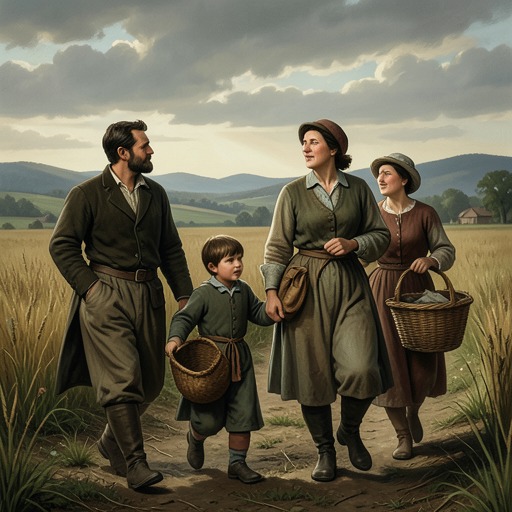
The Larkin family
The Darling Buds of MayThe Larkin family is a tightly bound, expansive household whose shared life runs on affection, appetite, and Pop’s instinct for turning circumstances into opportunities. Its defining pattern is the collision between domestic intimacy and public systems: a government form can become an argument, a job a matter of family allegiance, and a family holiday a collective project. The result is a portrait of a household that absorbs change by bringing it inside and making it its own.
A Household in Motion
The family’s scale is visible in the kitchen. After the birth of Ma’s seventh child, little Oscar lies in a lavish silver pram while Pop, returning from feeding the pigs, pauses to wipe the baby’s mouth with a hand-worked feeder decorated with blue daisies and a bright red nursery scene. Ma has made it despite having seven children to care for; her rings nearly hide her plump fingers. The scene makes care a practical, shared activity: Pop tends to the baby, Ma has prepared the feeder, and the morning continues around them.
The room is also a place of abundance and routine. Ma cooks three pounds of sausages, fried bread, bacon, and fresh field mushrooms; a lump of butter the size of a tennis ball hisses in the pan. Pop kisses her before breakfast, then greets his son-in-law with his customary open-handed slap on the back. Charley, reading The Times, accepts it without flinching. Nearly a year in the household has accustomed him to its noisy, physical forms of welcome.
Public Rules, Domestic Uses
The family’s dealings with government begin in confrontation. When an official tells Pop that the records show no income return for the previous year, Pop insists that nobody asked him to make one. The young man produces a yellow-buff form as evidence of the expected paperwork, but the exchange establishes the family’s characteristic gap between official procedure and Pop’s own account of obligation: a form may exist, yet its authority is not something he readily accepts.
That suspicion extends to the state’s provision of sickness benefits. Pop urges Charley to take advantage of what he calls the National Elf lark, arguing that Charley has paid into it through weekly contributions and should not be a mug about going sick. His advice joins resentment to opportunism: the state has created the scheme, Pop reasons, so a person may as well have some fun with it. Charley’s eventual thought that it is time to use his loaf belongs to this argument, though the immediate pressure is personal as well as financial. Mariette kisses him on the dark stairs, and her warm hands and repeated affection leave him divided between the family’s enticements and his earlier resolve to go.
The household’s resistance to official expectations is not simply a rejection of practical administration. Pop himself relies on Charley to handle paperwork, forms, returns, and what Pop calls the dodgy stuff. This division of labour becomes especially clear after Charley leaves the tax inspector’s office: Pop is pleased to have no one in the family connected to the tax lark, but still values his son-in-law’s skill with figures and documents. The family’s independence thus depends partly on the very expertise it treats with suspicion.
Charley Joins the Family’s Economy
Pop’s welcome to Charley takes the form of advice, teasing, and eventually material support. He urges Charley to abandon the prospect of a pension after decades of office work, mocking its value as a future return that might buy only half as much. Instead, he proposes building a bungalow for Charley and Mariette from materials salvaged from a mansion due for demolition. Mariette responds with delighted kisses, and Charley understands that the proposal leaves little more to say.
The promised house is not built immediately. Pop is too busy with other ventures, including a large army-surplus deal involving such unlikely stock as beetroot in vinegar, rat-traps, body belts, collar studs, gherkins in mustard, rubber shoe heels, and caper sauce. The delay gives Pop’s promises their characteristic place in family life: they are real expressions of generosity, but they must compete with whatever enterprise has captured his attention.
Pop also gives the newly married couple five hundred laying pullets, setting them up in the egg business. Within a year, Charley and Mariette have earned enough profit to buy another five hundred hens and are doing well. Their success shows how readily a family gift can become an independent livelihood. Yet Charley continues to make proper income-tax returns, a habit Pop considers unwise. The contrast is affectionate but lasting: Charley brings order and declared accounts to an enterprise Pop values partly for its ability to keep money from the government.
Shared Journeys and Family Attachment
The family’s readiness to act together is clearest in the plan to travel to France. When Mariette hears that they are going, she immediately asks when they will start and whether everyone is included. Her assumption turns the idea into a family undertaking before the arrangements are settled; she even asks Ma whether she wants to go. Later, Charley proposes the third week of August, explaining that it will avoid the French national holiday on the fifteenth. Ma declares that the trip will be educational for everyone, like television, and Pop agrees to go.
Charley’s practical competence shapes the holiday from the beginning. He offers to obtain a full quotation from the Beau Rivage, including taxes, the tourist tax, and service, and to check that Mr Dupont is still there. Pop values Charley’s capacity to manage figures and arrangements, just as he has come to entrust him with the family’s paperwork. On arrival, Charley speaks French at the hotel reception and looks calm and authoritative, a composure that reassures Pop as the family enters a dark, shabby hotel in a storm.
The arrival itself gathers the household into one struggling procession. Ma carries Oscar; Primrose and Montgomery are submerged beneath one raincoat; the twins, Victoria, and Mariette share an umbrella; Pop brings two suitcases and a canvas bag. The rain and spray buffet him on the short walk from the car, and a suitcase begins washing away along the quay before he retrieves it. The scene makes the family’s togetherness tangible without making it effortless: they travel as a group, but each person must negotiate the weather, the luggage, and the increasingly dismal reality of the hotel.
A Comic Domestic World
The family’s identity is expressed not through a single creed but through repeated acts of looking after one another, ribbing one another, and pressing advantage wherever possible. Its household life and its enterprise are inseparable: the same kitchen that holds a new baby and a lavish breakfast also supplies the setting for schemes, decisions, and the next departure. Pop’s resistance to state rules sits beside Ma’s care, Charley’s methodical competence, and Mariette’s impulsive enthusiasm; the family operates through these contrasting temperaments rather than smoothing them into one.
Even the aftermath of a public celebration returns to household routine. After the evening is over and television has closed down, Ma and Pop sit alone in the kitchen. Ma still shakes as she remembers the donkeys, Miss Pilchester, and Pop being blown onto his back by a Roman Candle. Pop asks whether there is anything left to eat, and Ma fetches a large apple tart with plates, a knife, and, from habit, the ketchup. The family’s adventures do not end in solemn reflection: spectacle gives way to food, familiar habits, and the next conversation. That return to the kitchen is the household’s small but decisive form of continuity.