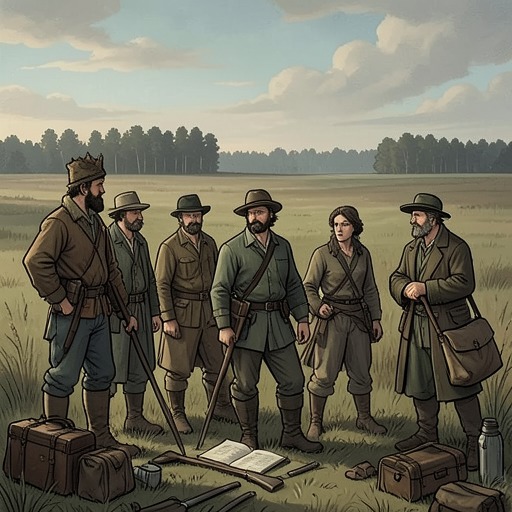
Ahfal Oma Revenge and Exile
The Deer KingAhfal Oma Revenge and Exile refers to a reprisal against settlers after the Ahfal Oma’s fire horses died from toxic grain, followed by the burning of a settlement and the Ahfal Oma’s exile. The episode is not presented as a battle scene: its causes and aftermath emerge later through testimony, where conflicting memories give way to a more complicated account of how introduced rye pollen altered a native crop. The violence is inseparable from the ecological disruption that preceded it and the displacement that followed.
Causes and Background
The dispute began with the death of the Ahfal Oma’s fire horses. During a later conversation with Hohsalle, an older woman recalled the uproar over the animals’ deaths and the burning of a village, emphasizing that it had not been hers. The account connected the reprisal to a crisis that affected both the native community’s horses and settlers’ livestock.
Taya explained that the poisonous grain was not simply the native Aquafa wheat the fire horses had eaten for generations. The Ahfal Oma had grown Aquafa wheat, but it appears to have crossbred with rye brought by the settlers. Rye pollen may have drifted into the wheat fields, producing a hybrid grain that was more likely to be toxic; its poison was strong enough to kill fire horses. The unintended crossing of crops thus became a material cause of a political and communal rupture.
The danger did not stop at the horses. Taya said many settlers’ sheep also died after eating the toxic grain. They leapt about as if dancing before falling into convulsions, a pattern the settlers called sheep-dancing sickness. The same crop failure therefore carried different meanings for the affected groups: it destroyed the Ahfal Oma’s fire horses and also threatened the settlers’ flocks.
Reprisal and Exile
The remembered sequence links the horses’ deaths to the Ahfal Oma’s revenge. Cheehana identified the earliest infection site as the place closest to a settlement attacked by the Ahfal Oma in their quest for revenge. In another account, Nohmeh’s brother had been killed during this period, and she became distressed when the events were recalled. Taya apologized for her reaction and explained the personal loss behind it, showing that the conflict remained bound to bereavement as well as to the destruction of property.
Tomeh recalled that one village was burned to the ground, while making clear that it was not his own. The accounts establish the reprisal’s destructive consequence without detailing the attack itself. They also locate it within a larger history: the Ahfal Oma were eventually exiled, making the retaliation part of a process that ended in their removal rather than a self-contained episode of revenge.
Reconstructing the History
The episode comes into view through a conversation about disease maps. When Hohsalle noticed that the oldest infection lay in the first colonized area, Cheehana connected that location to the settlement targeted by the Ahfal Oma. Tomasolle had not yet raised the connection; he said he had been waiting for the right opportunity, not deliberately withholding it. The discussion turns the history of revenge into part of a wider inquiry, while making clear that the facts are politically and personally difficult to disclose.
The testimony also complicates any simple division between one group’s damage and another’s. The Ahfal Oma’s horses died from a hybrid grain created unintentionally, while settlers’ sheep also suffered from the same toxic crop. After the Ahfal Oma were exiled, settlers spent a long time burning off Aquafa wheat before they could grow rye safely. The effort to make farming safe continued after the reprisal, but its resolution depended on eliminating the crop implicated in the crisis.
Lasting Consequences
The exile and the later effort to remove Aquafa wheat mark two distinct aftermaths: a people were displaced, and the settlers changed their agricultural practice. The episode’s explanation arrives retrospectively, through witnesses who remember the burned settlement, the dead horses and sheep, and deaths within their families. It therefore resists a neat account of revenge as an isolated choice; the retaliation follows ecological damage, and the consequences persist in both land use and memory.
The conflict’s consequences also reach into Van’s later life among families raising pyuika. He recognizes that those animals are difficult to confine, that their breeding depends on accommodating their habits, and that a bond formed with a human can endure for life. In the Toga Mountains, such knowledge was learned through years of watching the animals; in the new settlement, Van helps families adapt their practices, including allowing pyuika to roam rather than forcing them into an unsuitable routine. These details do not make the historical reprisal a direct cause of his work, but they place animal husbandry and local ecological knowledge alongside the story’s account of crop and livestock disaster. The history of Ahfal Oma Revenge and Exile is thus recalled not only as a past act of violence, but as part of a continuing record of how communities live with the consequences of ecological disruption and displacement.