Black Wolf Fever
The Deer KingBlack Wolf Fever, also called mittsual, is a deadly illness whose suspected return turns scattered animal bites and human deaths into an urgent problem of medical inference and public safety. In the story, Hohsalle connects it to a past epidemic that killed six thousand people and nearly extinguished Otawalle’s kingdom, but the present cases resist an easy explanation: the disease appears to follow bites, yet its wide distribution and patterns leave open the possibility that something other than ordinary transmission is at work.
Identity and Historical Background
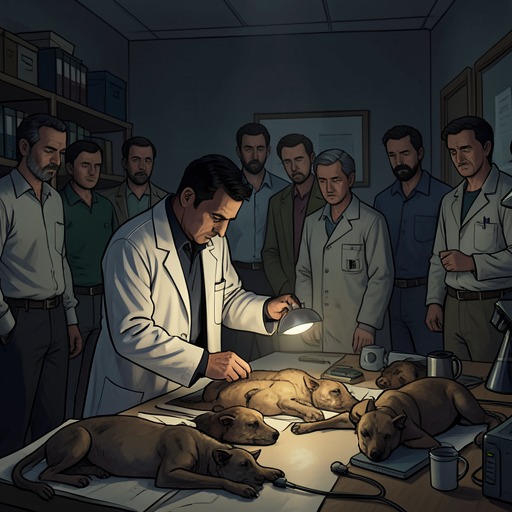
The name Black Wolf Fever is associated with a disease believed to have affected both people and animals. When Hohsalle examines bodies after the salt-mine deaths, he can only infer from what he has seen and the circumstances that mittsual may be responsible. The diagnosis is therefore initially provisional, not a certainty. He later makes clear that the name means “black wolf fever,” and that Makokan’s fear of it is justified: the suspected illness is a pestilence, not merely an alarming name.
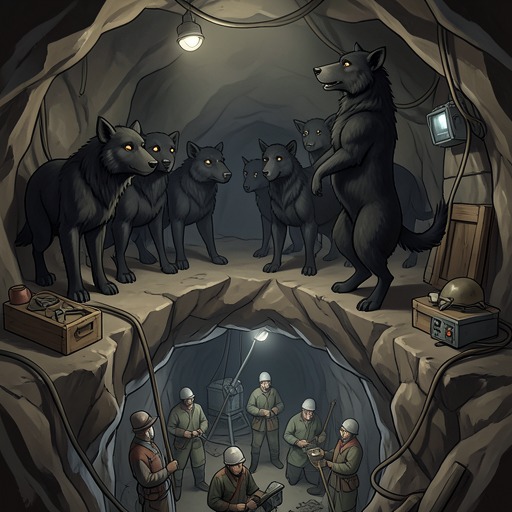
The story traces the disease’s historical association with black wolves to an account of Otawalle’s decline. In the tale, noblemen brought wolves back from the Toga Mountains for sport. The wolves had striking black fur and clever faces, and their pelts became objects of competition among the nobility. Merchants and hunters captured and sold them, and historical records indicate that some were bred with dogs. The account does not establish that the first wolves carried the disease; it presents that as uncertain, while showing how the animals’ desirability brought them into human-managed settings.
The remembered epidemic began in a hot, muggy summer and spread first through the capital’s poorest, most crowded districts. Physicians at the Academy of Deeper Learning proposed that the disease had passed from wolves to blood-feeding fleas and ticks, and then to rats, multiplying the carriers. By the time the capital began exterminating rodents and pests, thousands had died. Hohsalle gives the catastrophe a sharper measure elsewhere: a past outbreak killed six thousand people and pushed his people’s kingdom to the brink of extinction. He also says that no effective cure had yet been found.
Symptoms and Suspected Transmission
In the present-day cases, the illness can begin with symptoms resembling a cold, including a sore throat and fatigue. The appearance of a rash marks a rapid change in the course of the disease. One falconer developed a rash early in the morning, had a high fever by evening, and soon became severely ill; despite attempts to treat him, he died during the night. The sequence gives Hohsalle a concrete basis for describing the present disease as fast-moving, while making clear how little time treatment may allow.
The historical account offers one comparatively reassuring feature: it says the disease does not pass from person to person, and that symptoms appear quickly after a victim—human or animal—is bitten by an animal. Hohsalle uses the mine deaths to test the older explanation against current observations. The illness was highly virulent there, and almost everyone who became ill died; although the enslaved workers had weakened constitutions, the disease also killed their keepers. Yet no one working at the mine after the incident showed symptoms. To Hohsalle, that absence makes an infection caused by fleas or ticks less likely in that particular episode, and he considers airborne spread unlikely as well.
The pattern of animal exposure also matters. Hohsalle reasons that if infected wolves or Ossam attacked the sheep, shepherds who had been bitten should have become ill and died. He asks whether reports of such cases exist, making the absence of reported shepherd deaths part of the evidence rather than treating animal attacks alone as proof of transmission. These observations do not settle the cause; they narrow the possibilities and expose the limits of applying the historical model directly to the current disease.
Investigation and Containment
When the governor recognizes the name Black Wolf Fever, Hohsalle sets out two connected tasks: dealing with Ossam that may harbor the disease and caring for people who may have been infected. Killing or driving off suspected animals is not, by itself, a sufficient response. If fleas or ticks leave infected animals for human hosts, control must account for those vectors as well. Hohsalle therefore urges a thorough plan and caution, particularly because the illness is native to the region and the investigators know comparatively little about it.
The salt-mine episode yields samples of the disease-causing agent, giving medicine makers material to work with even though a cure remains unavailable. Hohsalle says the researchers have divided into three teams and describes the first team’s approach: weaken the infectious agent to produce a less potent preparation intended to strengthen resistance, by analogy with medicine used against rabies. This is a proposed line of work, not a report that a proven preventive treatment or cure has already been achieved. The distinction matters throughout the investigation: evidence and samples make research possible, but do not remove the danger or uncertainty.
Hohsalle’s caution also reflects the possibility that transmission could change with exposure and season. If the present illness shares the historical disease’s characteristics, warmer weather could bring more fleas and ticks. Those insects might feed on infected people or animals and then help the illness spread more widely. The scenario remains a risk under discussion rather than an observed explanation for the current cases, but its consequences would be serious enough to justify planning before the weather changes.
The New Cases and Unresolved Pattern
The illness is not confined to the salt mine or to one immediate cluster. Tohma reports deaths among people bitten by dogs in settlements on the Yukata Plains and on the south side of the Oki Valley, as well as among immigrants. He adds that, in the fall, the Hounds of the Gods closed in on Aquafa’s old capital and that something terrible seems to have happened there. His account broadens the geographical picture, but it does not by itself establish that every report has the same cause or that the historical Black Wolf Fever has been conclusively identified.
The record of cases deepens the problem. When Hohsalle sees a chart marked with red dots across territory that once belonged to the Kingdom of Aquafa, he is surprised that so many cases predate the salt-mine incident. The distribution forces him to reconsider a simple explanation based on a recent outbreak. If the disease is not transmitted from person to person and wolf bites are infectious, cases should appear more often within the territories of packs containing an infected wolf. Several years have passed since the first case, however, giving fleas and ticks multiple summers to multiply; if the illness were spreading in the expected way, Hohsalle reasons, it should by now have become more widespread.
The patients also show unequal resistance. Hohsalle identifies the Zolian falconer bitten near the chin as the person most dramatically affected and quickest to develop severe symptoms. Sulumina showed the greatest resistance, followed by Mazai and Olimu. These comparisons establish differences among observed patients, but the evidence does not explain their cause. They contribute to the investigation without resolving why the cases vary so sharply in severity.
The geographical pattern raises a further question: how could the disease have reached dogs and wolves across such a wide area? Tomasolle points out that wolves from the north could not have mingled with those in the south, making ordinary movement between those distant packs an inadequate explanation. Hohsalle’s chart and Tomasolle’s challenge leave the outbreak unsettled. The disease has a devastating historical precedent, a plausible connection to animal bites and parasites, and a set of present-day cases that do not fit neatly into the expected pattern. Its narrative significance lies in that tension: identifying Black Wolf Fever names a danger, but does not yet explain how it is spreading or how it can be stopped.