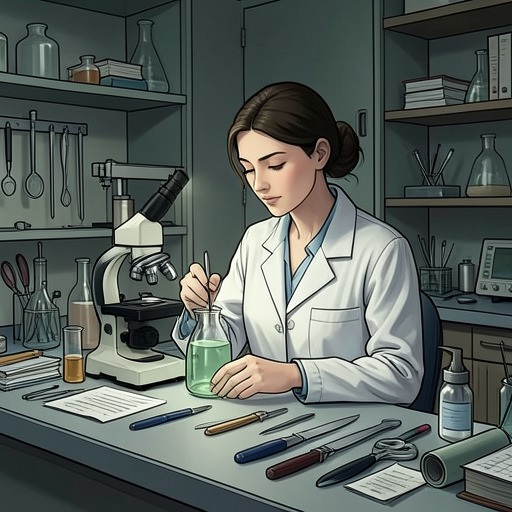
Chimya Tolosse Clinic
The Deer KingChimya Tolosse Clinic is Hohsalle’s research clinic in Kazan, built with the governor’s support and organized around three research wings and a residence for Hohsalle and his assistants. More than a workplace, it is a base for Otawalle medical inquiry: its investigations into bodies infected with mittsual and its experimental treatments stand against the Zolian priest-doctors’ authority to define which forms of healing are acceptable.
Location and Organization
The clinic’s name, Chimya Tolosse, means “Nest of Little People.” Its unusual name belongs to a substantial institution: three research wings adjoin living quarters where Hohsalle resides with his assistants. When he is in Kazan, he commonly shuts himself away there for days, a pattern that makes the clinic both his home and the enclosed setting of sustained research.
The clinic’s work extends beyond Hohsalle alone. His assistant Milalle and several other aides examine corpses brought back from the salt mine. On their return, Hohsalle tries to go directly to the building where the bodies have been delivered; Milalle stops him and steers him to the dining hall, where she has kept meat-and-onion stew warm over the fire. The interruption reveals the human support behind the research: Hohsalle’s urgency does not cancel his need for food, rest, and the practical judgment of colleagues who can make him pause.
Research and Mittsual
The arrival of bodies infected with mittsual, after two hundred and fifty years without such material for study, excites Hohsalle and Milalle because disease that can be identified and examined can also be investigated as a possible source of treatment. Milalle compares the bodies to treasure chests that may contain as many as three kinds of medicine. The clinic’s work thus begins not with certainty about a cure but with the opportunity to study physical evidence that had long been unavailable.
That investigative outlook contrasts with the Zolian Pure Heart Creed, in which priest-doctors regard medicine as bound to divine teaching and generally limit care for incurable patients to easing their deaths. Otawalle medical practice, by contrast, seeks knowledge and treatment rather than accepting the disease’s verdict in advance. The disagreement is not merely a contest over professional authority: Hohsalle comes to understand that the two medical traditions diverge at their fundamental premises, making preventive treatment particularly difficult to reconcile with the priest-doctors’ beliefs.
Medical Practice and Risk
Hohsalle’s work also includes an experimental injected treatment, developed from an approach begun by his grandfather Limuelle. He reports that twelve people have survived without symptoms after receiving it, although the evidence remains limited and he will not claim that it is free of risk. In a discussion with Utalu, Hohsalle explains that rabies, once manifest, is inevitably fatal; the treatment offers a chance of survival, but carries uncertainty. Its administration requires several injections, with a few days between them.
The clinic’s decisions make that uncertainty concrete. Hohsalle explains to the gravely ill Mazai that the medicine may cause a severe allergic reaction, even stopping his breathing and killing him. Mazai nonetheless asks for the injection: bitten by a dog infected with mittsual and fearing for the wife and children he would leave behind, he would rather risk a remedy that might improve his chances than face the disease without it. Hohsalle has Makokan summon Milalle to prepare the supplies needed to respond to an allergic reaction before proceeding. In another case, Yotalu asks that the treatment be given to Sulumina and Olimu. Limuelle insists on obtaining Yotalu’s permission first and gathering the necessary supplies; when the syringe frightens Sulumina and her young son, he reassures Olimu before the injections. These episodes show the clinic’s treatment as neither guaranteed salvation nor a simple act of administration, but a decision shaped by informed risk, consent, preparation, and urgency.
Political and Institutional Significance
The clinic’s existence depends in part on political support. Earlier, Emperor Natalu summoned Limuelle and Hohsalle to cure his wife after hearing that they had treated the same mortal illness in others. They cured her, and the emperor asked them to stay as palace physicians and teach the priest-doctors Otawalle medicine. Their refusal to remain did not prevent a clash between the emperor and the association of priest-doctors. The episode exposed the political stakes of medical success: nobles later sought Otawalle physicians covertly, while Otawalle medicine remained officially branded heresy even a decade after the empress’s recovery.
During the mittsual outbreak, the same tension governs whether information and help can cross institutional lines. Hohsalle plans to notify the Otawalle Sacred Territory but waits for Yotalu’s permission. Yotalu welcomes Otawalle support, citing the danger of mishandling an illness about which his own people know little, and says Governor Ohan has asked him to follow Hohsalle’s instructions and draw on the Academy of Deeper Learning. The clinic therefore operates within more than a medical network: its work depends on trust and authorization among officials, researchers, and communities, even as the Pure Heart Creed’s authority constrains the spread of its methods.
Limuelle sees winning the priest-doctors’ cooperation as a way to release Otawalle medicine from that constraint. He argues that a tradition which begins by accepting death cannot offer the same impetus to investigate disease, while refusing to give up may matter beyond an individual patient when illness can spread. With greater institutional support, resources, and access to patients, Otawalle knowledge could reach Zolians across ranks. Chimya Tolosse Clinic stands at the practical center of that unresolved possibility: a place where bodies become evidence, risky treatment becomes a choice, and medical knowledge meets the religious and political structures that determine whether it can be used.