Fan Xie Youna escapes from the salt mine
The Deer KingVan’s escape from the salt mine turns a flight from confinement into an act of rescue: after breaking free of his chain, he finds a living child hidden in an oven beside her dead mother and carries her beyond the mine’s perimeter. The escape joins physical release to a new responsibility, as Van leaves the compound with the child secured to his back rather than fleeing alone.
Confinement and escape
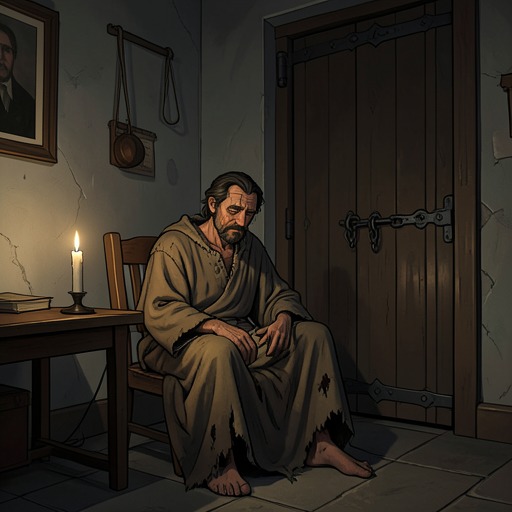
Van first staggers to his feet, unsettled by what he sees, and understands little of his situation. His immediate certainties are bodily and urgent: he must get out, and he is hungry. Anger at the chain holding him gives way to action. Though he knows he cannot pull the metal plate and bolts from the stakes set into the stone, he strains against the restraint until one thick ring twists open and breaks. He falls backward, then rises and runs with the severed length still attached to his ankle.
That break frees Van from the chain but not from the manacle. He searches the foreman’s house for the key and opens it, feeling the weight drop from his leg. The distinction matters: the first release comes through force and rage, while the second requires him to search the mine’s built environment for a means of removing what remains. He likens the relief to a dog shaking off its collar, an image that registers how completely confinement had marked his condition.
The child in the oven
As Van searches the compound, muffled crying leads him to a room where the people lying on the floor appear dead. At the back, a young woman is propped against an oven, positioned as though she had tried to block its firebox. Her scarf has slipped out of place, and her hair clings to her cheeks. She appears to have died while struggling through fever and hallucinations to protect something inside the oven from the beasts.
Van gently moves the woman away from the opening. The crying becomes clear, and he sees a small child looking up at him, tear-streaked and clutching a crust of fahmu. The child’s survival is the decisive reversal in the escape: the room that first appears to hold only the dead also contains someone Van can still save. He speaks softly, offers his arm, and waits while she studies him before reaching out.
The girl can stand, though unsteadily, when Van sets her down. She reaches toward her mother’s body and says “Mauma.” Van holds her steady so she can press her face against her mother. His escape therefore does not erase the loss in the room; it carries the child away from it while allowing her a moment beside the woman who protected her.
Leaving the mine
Van chooses not to open the south gate, although he thinks he could find its keys in the guardhouse. The mine is enclosed by a formidable iron fence, and the gate onto the road used for moving salt and supplies has remained shut because no one is there to open it. Van reasons that an open gate could reveal that someone has escaped. Instead, he places a discarded wooden tub by the fence near a garbage heap and lays a thick, frayed horse rug across the spikes at the top.
He throws his bag over first, then climbs across with the child on his back, and tips the blanket back toward the mine side. The route is deliberate: he uses what he finds at hand, crosses the barrier without opening the obvious exit, and avoids leaving the gate as a clear sign of flight. The baby sling he finds beside the child’s mother makes it possible to secure the girl to him and helps him climb.
On the far side, Van faces the forest. The child clings to his neck without making a sound; the sling may have reassured her, and it has certainly made the climb easier. The escape ends not with a return to safety or an explanation of what lies ahead, but with Van and the child outside the mine and facing the forest together.
Significance
The event’s progression is defined by changing obligations. At first Van’s only stated aim is to flee, driven by fear and hunger; once he hears the child, leaving alone is no longer the action he takes. The chain’s sudden failure opens a path out, but the child’s discovery changes what escape means: freedom now depends on carrying another life across the same boundary.
The mine’s closed gate, spiked fence, discarded tub, and worn horse rug give the escape its practical shape. Rather than making the departure a simple dash for an exit, the narrative makes it a sequence of decisions: remove the ankle restraint, find the child, choose a less revealing route, and cross while carrying her. The final image of the child clinging to Van as they face the forest holds both the immediate achievement and its uncertainty: they have left the enclosure, but their destination is not given.