House of the Inner Circle
The Deer KingThe House of the Inner Circle is a nearly century-old institutional residence whose formal architecture and guarded audiences make authority visible in layers: visitors pass from the snowy entrance through controlled thresholds to the academy’s upper-floor reception rooms. It is also a place where investigation meets the Pure Heart Creed’s account of defilement, and where Cheehana Okiraul’s behind-the-scenes command enables evidence about disease to be assembled across the former Kingdom of Aquafa.
Setting and Approach
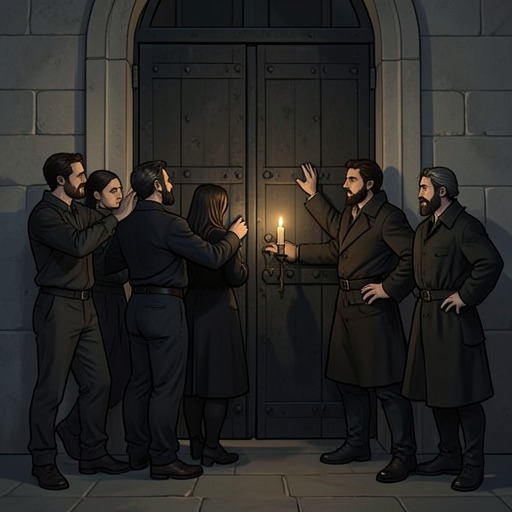
The entrance is marked by black flagstones that remain nonslippery even when wet with snow. At the door, Makokan gives his umbrella to the doorman and receives several pairs of indoor slippers in exchange, which he distributes to the visitors after they remove their boots. The building is sturdy and almost a hundred years old; reflectors placed with the lanterns keep its interior from feeling dark, though the high-ceilinged entrance remains cold. A straight hallway and gently curving staircases lead upward, with the familiar route for Hohsalle contrasting with Makokan’s nervousness at entering the second floor for the first time.
That upper floor changes the character of the approach. A long carpet embroidered with spring flowers runs down the hall, its soft colors illuminated by ceiling lamps and its thick weave muffling footsteps. When Hohsalle and Tomasolle arrive, the doorman is ready to open the heavy door, apparently having been told of their visit in advance. The progression from snowy stones and warmed slippers to carpeted quiet and a private audience makes access feel managed at every step.
Authority and the Inner Circle
The reception room is spacious, with a fireplace and a large table. Director Rotoman Okiraul sits there with Cheehana Okiraul, an elderly woman seated beside him. Hohsalle and Tomasolle bow formally to both. Makokan tenses at Cheehana’s presence: people of lower rank are not permitted an audience with her, and most do not even know that the person who commands the Servants of the Inner Circle is a woman. Though she is not publicly presented as the academy’s director, Cheehana runs it from behind the scenes.
Rotoman sets a more welcoming tone once the formal greetings are over. He invites the visitors to sit by the fire, noting their journey through winter weather, and servants bring chairs, tea, and cookies. The courtesies soften the room without erasing its hierarchy: the director receives the guests, attendants arrange their comfort, and Cheehana’s authority remains present in the same chamber even though her position is concealed from most outsiders.
Creed, Contamination, and Medical Debate
The House’s institutional significance is connected to a dispute over what counts as contamination. Kiya explains that followers of the Pure Heart Creed believe consuming animal milk makes a person bestial, while her people—absorbed into the empire but not adherents of the Creed—have long drunk reindeer milk. The contrast shows that a shared political label does not mean a shared religious practice. Elsewhere, Utalu invokes the Creed to claim that faithful believers cannot contract rabies, associating illness with defilement by animal spirits and with people who live near animals. Lona complicates that certainty: even nobles may become infected, since defilement can enter the body without intention.
The dispute becomes sharper when Utalu treats an animal-derived preventive treatment as spiritual defilement. Lona argues that accepting such contamination out of fear would stray from the Heavenly Path, and says that, with no medical cure for rabies, a person who contracts it should accept heaven’s will. Hohsalle is startled by the severity of Lona’s position. Later, he asks Lona whether the Creed’s medicine should leave a patient to divine will only when no other way of healing exists, pointing out that rabies can be prevented. The question exposes a tension between a doctrine of purity and the obligation to preserve life; the House’s discussions give that tension an institutional setting rather than resolving it by assertion alone.
Investigation and Evidence
The academy also serves as a base for collecting and interpreting evidence. At a later audience with Rotoman and Cheehana, Tomasolle presents a map prepared with Cheehana’s help, summarizing reports of people who suffered illnesses resembling mittsual. Red dots extend across the territory of the former Kingdom of Aquafa. The reported cases range from the Yukata Plains in the south to the Oki forests in the north, where Makokan had pursued a fugitive. Their distribution predates the salt-mine incident, challenging any assumption that such illness began there.
The map links Cheehana’s hidden administrative reach to practical inquiry: she can help gather information across a broad territory and bring it into the academy’s deliberations. The House is therefore more than an imposing place of reception. Within its rooms, rank determines who may enter, but evidence can also unsettle inherited explanations—whether the subject is the geography of disease or the claim that illness reliably reveals a person’s spiritual purity.
A Place of Competing Medical Paths
The conflict over medical knowledge continues in the House through Mana’s refusal to view the tiny organisms Hohsalle offers to show him. Mana explains that the priest-doctors of the Pure Heart Creed do not consider it necessary to seek the cause of disease in that way. They attend instead to what is evident in the patient, interpreting the organisms described by Hohsalle as another form of defilement and seeking to remove the obstacles it creates. He intends to study the human form and care for the sick; after he leaves to return to his teacher, Limuelle sighs that this is a pity.
That exchange gives the House a second role alongside its gatekeeping and administration: it is a meeting place for incompatible accounts of how illness should be understood. The contrast is not simply between belief and indifference. Mana articulates a coherent practice centered on the patient, while Hohsalle’s offer points toward identifying disease-causing organisms. Set beside the map of cases and the dispute over preventive treatment, the academy’s rooms bring distinct forms of knowledge into contact without making them identical.