Kienma Dog Trainer
The Deer KingThe Kinma Handlers are an Ahfal Oma band remembered for hunting wolves with packs of dogs, moving between the mountains and plains in head-to-toe horsehide outfits. Their reputation links practical knowledge of predators to a religious tradition about wolves and horses; later, the possibility that some took refuge among Makokan’s clan after the Ahfal Oma were driven from the Yukata Plains places them within the uncertain history Hohsalle is trying to reconstruct.
Identity and Hunting Practice
Tomasolle points to the handlers’ dogs to explain why the northern Ahfal Oma were more renowned as hunters than as herders. Cheehana identifies the animals as rochai, a cross between black wolves and ossam, which the Ahfal Oma call a gift from Kinma. The handlers’ specialty, then, rests not simply on their own skill but on working with dogs whose mixed ancestry connects them to both the predator they pursue and the horse-related lore of their people.
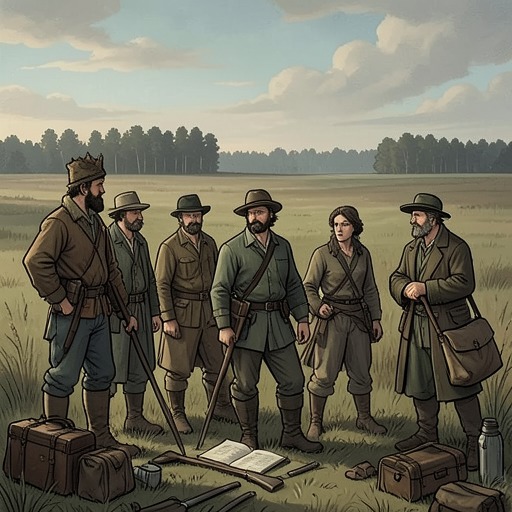
Makokan’s childhood recollection supplies a more concrete picture of the band. He remembers men dressed in an unusual horsehide garment that slipped over the head and covered the body from head to toe. With a pack of dogs, they traveled between the mountains and plains, stalking wolves. To the child, one handler looked like an apparition; the sight frightened him enough that he clung to his father. The recollection preserves both the handlers’ distinctive equipment and the unsettling impression it made on someone who rarely encountered them.
Kinma’s Tradition and the Rochai
Cheehana connects the rochai to a story attributed to Kinma. In the account she recites, Kinma commands that a horse that dies should be burned rather than buried, lest wolves dig it up and learn the taste of horseflesh. A horse that dies of sickness, by contrast, is to be buried so that the wolf will suffer and no longer want to eat horses. The handlers’ dogs are thus understood through a tradition that treats the boundary between horse and wolf as something requiring ritual care: the dogs are called a divine gift, while the story explains how people should manage wolves’ contact with horse remains.
The story and the handlers’ hunting work belong to different kinds of knowledge, but the narrative places them beside one another. Tomasolle explains the practical importance of hunting dogs; Cheehana names their breed and recounts the tradition; Makokan remembers the handlers moving through the landscape with their pack. Together, these accounts associate the group with both a specialized means of hunting and a rule-bound understanding of the animals involved.
Territory and Shared Hunting
Makokan recalls that, when he lived there, the handlers resided on the plains and he seldom met them. He thinks they must nevertheless have had some dealings with his clan, since he encountered one near the mountain path he later traveled with Hohsalle. Hohsalle asks whether the People of the Fire Horse could hunt freely in the area. Makokan answers that they could not: the Ofal Hazak belonged to the mountain clans, and outsiders who hunted there without permission would be punished.
The restriction did not rule out cooperation. Makokan has a vague memory of mountain hunters and Kinma Handlers together in the yard behind the clan chief’s hall, dressing and dividing the game they had caught. The scene suggests that territorial boundaries and shared hunting could coexist: access was governed by the mountain peoples, while particular hunts could bring groups together. Makokan offers the episode cautiously, as a distant memory rather than a firm account of how often such collaboration occurred.
Exile and the Unresolved Disease Connection
Hohsalle reasons that the Kinma Handlers were close enough to the People of the Fire Horse to share roots, and suggests they may have hidden among Makokan’s clan when the Ahfal Oma were driven from the plains. Makokan does not confirm this. He had left his homeland before the expulsion and knew nothing about it; Taya, the settlement’s chief, later asked whether he truly knew nothing, and he did. He cannot say whether the handlers sought refuge with his people.
That uncertainty matters because, if they did take refuge there, Kinma Handlers would have been living with Makokan’s clan when the disease’s first case occurred. The text presents this as a possibility, not proof that the handlers caused or carried the disease. Hohsalle warns Makokan that they have not come to convict anyone of a crime, underscoring the distinction between reconstructing a community’s history and assigning blame. The handlers remain partly offstage—known through a remembered figure, a hunting tradition, and a possible migration—but their movements may connect the history of exile with the investigation’s unresolved origins.