Mohoki
The Deer KingMohoki is a lichen whose unusual effect on pyuika makes it both a practical means of managing the animals and, for Van, a suddenly unsettling presence. It can guide their movements and secure a fence without relying on confinement alone; when Van encounters it while gathering supplies and then uses it to release the penned herd, its familiar usefulness collides with an unfamiliar bodily revulsion.
Nature and Use
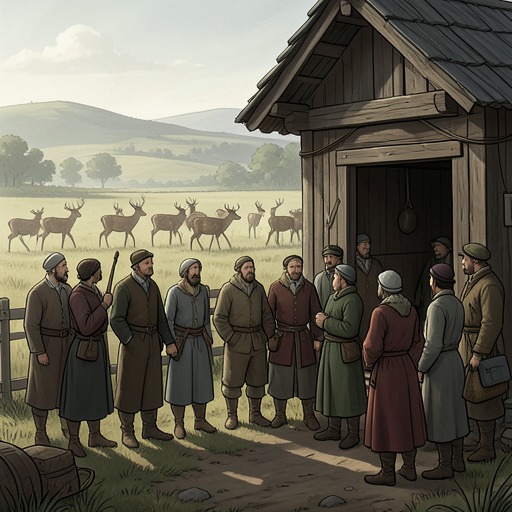
Mohoki grows on old trees. Pyuika loathe it and will not willingly venture near it, a response that gives herders a way to control animals otherwise difficult to contain. By braiding dried mohoki into rope and tying the rope along all four sides of a fence, herders can keep pyuika inside. The lichen’s effect is strong enough that an animal may leap the fence to escape or, if it cannot get out, decline. Mohoki is thus not simply a boundary material: it makes a boundary compelling to the animals themselves.
That method has to be understood alongside the pyuika’s needs. They are grazers like reindeer and are not ideally suited to enclosure. They may need to be penned at night, when wolves prowl, but are better allowed to roam by day. Their herd structure is broad and indistinct, with a doe and her fawns forming the clearest unit; although independent, pyuika are also loyal and prone to loneliness. An animal bonded with a person as a fawn remembers him and responds to his whistle. Seasonal migration follows habitual routes, so placing mohoki at strategic points can influence where the animals travel without keeping them fenced in continuously.
Knowledge, Trade, and Risk
Knowledge of mohoki is part of the Oki’s inherited animal husbandry. The children of Van’s clan spend their days in the forest with adults, learning pyuika habits, watching how fawns are selected for training and how they bond with people. In that way, they acquire the skills to pick out and train the animals, continuing a practice maintained since ancient times. The lichen matters not only as a material tool but as one element in a body of knowledge built through close observation and passed between generations.
When Yoki has never heard of mohoki, Van realizes that the men from Okuba who sold the pyuika to Tohma’s people must have known about it. He suspects they withheld information essential to raising the animals, perhaps because they had submitted to Zol outwardly while hoping the breeding project would fail. But the cost of that possible deception would fall chiefly on the Oki, not on Zolian soldiers. The Oki had gone into debt to buy the pyuika and sold their reindeer to stake their future on breeding them; failure would leave them destitute and expose them to heavy taxes. Success, by contrast, would bring the soldiers a windfall. Mohoki therefore marks an imbalance in who possesses useful knowledge and who bears the consequences when it is missing.
Gathering and Bodily Estrangement
On the day winter preparations are completed, Van goes into the forest to gather mohoki. He has made a long-handled scythe by fastening a blade to a pole and carries a basket on his back. The sunlit southern wood is bright beneath the deciduous trees, now stripped of leaves. As he walks, the forest brings back his childhood: the cold fear of being separated from friends while searching for mohoki, and the shame that kept him from calling out even though they would have answered. The errand is an old one, but the unfamiliar forest makes the old memory feel close.
Van detects mohoki from a distance and recognizes that his sense of smell is awakening again, though he does not understand why. Its raw odor, which had never troubled him before, now stirs a clamor in him: he feels repelled and drawn toward it at once. Near an ancient timber, yellow, hairlike strands hang in profusion from the branches. Van covers his mouth and nose, rubs the goose bumps on his arm, and approaches despite a powerful urge to turn back. The familiar lichen has become strange to him—not because its appearance or use has changed, but because his body no longer responds to it as he expects.
As the sensation intensifies, Van wonders whether this is what the pyuika feel. Yet he is not a pyuika, and the thought deepens his fear that his own body is becoming something he does not recognize. He steadies himself by naming what is before him and recalling why he must gather it: he is a Pyuika Rider, and others are waiting for the mohoki. Once he masters the fear, his body relaxes; his hands, practiced since boyhood, move automatically as he harvests. The task gradually restores a sense of normality, but the feeling remains that another self is lurking inside him, waiting to awaken. Mohoki’s significance in this encounter is therefore also sensory: it makes the divide between Van’s trained knowledge and his unexplained physical response impossible to ignore.
Freeing the Pyuika
Van returns to the settlement near dusk and goes straight to the enclosure. Ordinarily, he would dry the mohoki and weave it into rope before using it. This time he cannot wait: seeing the pyuika tied to stakes has become intolerable to him, and he wants them free. He wraps the fresh lichen around strategic points in the fence, then enters the enclosure carrying a stick of firewood in his left hand and an ax in his right.
With clicking sounds from his tongue, Van cuts the rope securing a large antlered buck. The animal rears and brings its antlers down toward his head; the watching men gasp. Van pokes it beneath the jaw with the firewood stick, and it collapses as if its strings have been cut. It shudders, waves its legs, rises, and runs around the enclosure while keeping clear of the fence. Van waits until it calms and begins to graze, then repeats the process at the other stakes. The scene shows both the danger of releasing an excited animal at close range and the practical skill with which Van handles it.
At last he approaches Tsupi, who is carrying young. He calms her with the same clicking sounds and quietly cuts her rope. She bounds like a fawn, butts Van in the back, nuzzles him beneath the arm, and then wanders off to graze. By dusk, every pyuika has been freed. Mohoki has served as a means of confinement, yet Van uses it to make the enclosure’s boundary legible while he releases the animals one by one. Its utility is inseparable from the choice of how and when to restrain them: the lichen can help people manage pyuika, but Van’s actions insist that such management should not become needless captivity.