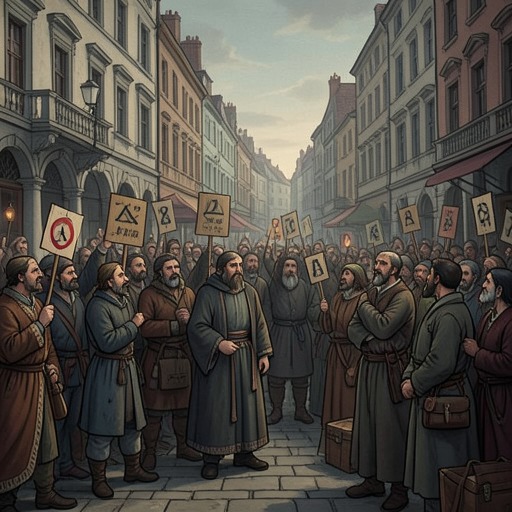
Mukonia
The Deer KingMukonia is the western power beyond the Toga Mountains, a kingdom whose proximity makes the range a contested frontier rather than a secure boundary. Its history of threatening Aquafa gives the border enduring strategic importance and helps explain why Zol’s rule there depends on more than conquest: citizenship, settlement, military planning, and local survival are all shaped by the possibility of Mukonian expansion.
Location and Frontier Setting
The Toga Mountains form the western edge of Aquafa and stand between Mukonia and the lands farther east. They are a formidable obstacle, but not an impassable one. Crossing the passes would exhaust an invading army, while maintaining its supplies in the mountains would be difficult. The terrain therefore offers protection without guaranteeing safety: it raises the cost of invasion but cannot make the frontier irrelevant.
Before Zol’s annexation, Aquafa had faced incursions from Mukonia for centuries. The mountain clans had fought to protect Aquafa’s borders, yet after Aquafa became an imperial province, Zol did not recognize those clans as citizens. Their historic role in defending the border thus did not secure them a place in the new political order.
Strategic Importance
Mukonia’s interest in Aquafa is not limited to the land itself. If Mukonia conquered Aquafa, it would gain a base for attacking Zol. Hohsalle explains that the Toga Mountains slow an advance but do not eliminate this danger; a state that assumes mountains make it safe risks losing the territory beyond them. Aquafa consequently remains strategically important as long as Zol and Mukonia exist as rival powers.
This analysis contrasts with the idea that both empires might simply leave the mountainous region alone. The mountains constrain each side, but their existence also makes the frontier a buffer that neither power can afford to treat as politically neutral. Governor Ohan’s concern about Mukonian movements informs his push to strengthen the military in the west, even though the emperor is reportedly less interested in further western expansion and faces resource demands on Zol’s southern frontier.
Conquest, Citizenship, and Displacement
Mukonia’s threat also shapes Zol’s treatment of the Toga clans. When Zol turned to completing its annexation of the region, Aquafa’s former king could offer to negotiate for the clans’ safety but could not determine their status under imperial rule. The clans were not accepted as Aquafaese citizens, despite speaking Aquafa’s language and having defended its borders against Mukonian incursions. Without ordinary-citizen status, they risked relocation under Zol’s policy for lower castes.
The Gansa elders therefore considered a strategy of feigned resistance. Their hope was that a conspicuous show of armed opposition would demonstrate the clans’ usefulness as allies and as a buffer against Mukonia, persuading Zol to let them remain in their homeland. The Lone Antlers, a band of warriors who had sworn to protect the Gansa, made this quasi-resistance possible. Mukonia’s pressure on the border thus figures not only in imperial military calculations but also in the clans’ attempt to bargain for continued residence.
A Frontier Population and Its Costs
Zol’s frontier policy placed people as well as soldiers along contested borders. Poor farmers and herders from the edges of the Zolian realm were ordered to settle newly conquered territory, build communities in the Zolian manner, and introduce Zolian crops and livestock. They acted as an unarmed vanguard, helping transform conquered land before its political and cultural incorporation was complete. Their settlement served the empire’s westward expansion, while the border’s vulnerability to Mukonia gave that expansion a continuing military rationale.
The policy offered settlers lower taxes than they would have paid at home and ownership of land they cleared, but many grieved the loss of their native homes and could not return. The same frontier could therefore mean dispossession for one population and a state-directed new settlement for another. Mukonia is central to this geography of pressure: its position beyond the mountains helps make the border a strategic concern, while the people living along that border bear the consequences of policies designed to secure it.