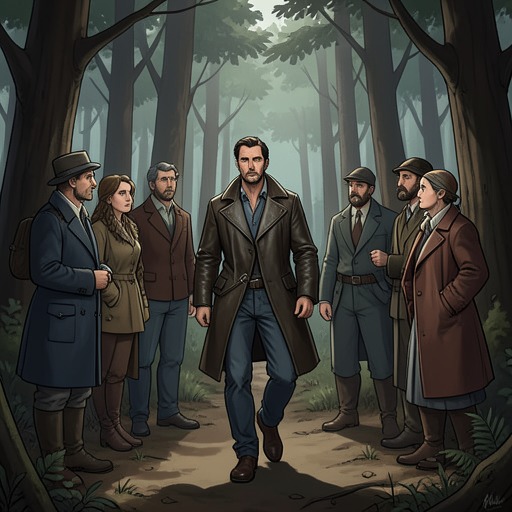
Ofal Oma
The Deer KingOfal Oma are the mountain people of the Yukata region, a clan whose territory and customary rules shape both local hunting and relations with neighboring groups. The account places them within a wider history of shared ancestry and practical cooperation, while also showing how imperial rule and displacement unsettle the region’s older connections.
Territory and customary rules
Ofal Oma territory is called the Ofal Hazak. Hunting there is restricted: people who do not belong to the mountain peoples may not hunt without permission, and those who do so risk punishment. The restriction marks the land as a domain governed by the local clans rather than as open hunting ground.
That boundary does not preclude cooperation. Makokan recalls a scene from his childhood in which mountain hunters and Kinma Handlers dressed and divided game together in the yard behind the clan chief’s hall. The memory suggests that hunting could bring neighboring groups together under recognized arrangements, even where the right to hunt remained limited by territory and permission.
Ancestry and neighboring peoples
Makokan’s father told him that the three clans of the Yukata region—the Ahfal Oma, the Ofal Oma, and the Yusula Oma, or People of the Marsh—had once been one people. Hohsalle had heard that the People of the Fire Horse and the People of the Mountains shared roots, but did not know about the third group.
The Yusula Oma are described as a small clan whose members serve the Ahfal Oma. Their close association makes them easy to mistake for the People of the Fire Horse, though the Ahfal Oma would object to being confused with them. The distinction matters even amid the account of common origins: shared ancestry has not erased the groups’ separate identities.
Displacement and historical uncertainty
When the Ahfal Oma were driven from the Yukata Plains, the Kinma Handlers may have taken refuge among Ofal Oma. Hohsalle proposes this possibility on the basis of the groups’ close historical ties; Makokan cannot confirm it. He had left his homeland before the expulsion and does not know whether Kinma Handlers were living with his clan when the first case of the disease occurred.
This uncertainty connects the history of the mountain peoples to the later disease investigation without resolving its origins. The account offers a plausible route by which displaced people might have joined another community, but leaves Makokan’s specific clan history open. Ofal Oma thus appear both as custodians of a bounded territory and as part of a wider regional history in which shared roots, hunting relationships, and forced movement cross clan boundaries.